Features / Politics

The Saudi Aramco Attack Explained

A burgeoning Middle Eastern conflict is putting the world’s energy security under threat. After Saudi Aramco, the world’s largest oil producer, was hit by drones, the global supplies were bound to be disrupted and prices to skyrocket. The conflict has many ambiguous and cascading effects that are yet to be explained.

The South China Sea and the Chinese Foreign Policy

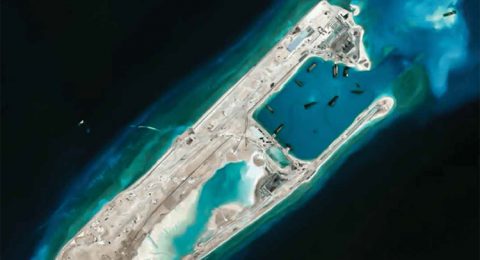
For the past few years, China has been garnering great power potential which is reflected in its assertive foreign policies. China’s persistence on dominating the South China Sea (SCS) has resulted in territorial disputes with its neighboring countries and has become a threat to both regional and global energy security. These ongoing disagreements have become “a focal point for big power rivalry”, and their repercussions stretch beyond the region.

Geopolitics and Natural Gas Development in the Eastern Mediterranean

Within the past few years, the context of geopolitics in the Eastern Mediterranean region has drastically changed. Is there a hidden agenda behind the fundamentals of this newly formed gas market? Or is it just the simple truth that peripheral power prevails when consolidated?

Impact of Brexit: A New Political Economy in Petroleum Industry?

Since 2016, Brexit negotiations started when the United Kingdom (UK) voted for separation from the European Union (EU) in a landmark referendum, where 51.9% voted to leave the EU against 48.1% voted to remain in the EU. On March 2017, Article 50 of the European Union’s Treaty was implemented and negotiations between UK and EU started to take place in April 2017. It was announced that England's separation from the EU would be in March 2019, two years after the start of the exit process. However, due to the inability to reach a deal, the time of the Brexit was postponed to April 12 then postponed again to October 31. During the mentioned period, Theresa May resigned last June. Accordingly, the future can be summed up in five different scenarios.
Is the Gulf Ready for VAT

As government finances of all six Gulf Cooperation Council (GCC) member states continue to deteriorate due to low global oil prices, finding a new source of income for the government that is unrelated to oil has become vital. Hence the introduction of a 5% value added tax (VAT), the region’s first ever tax levied on products and services.

OPEC Oil Deal: Between Promises and Frustration

Cairo – Decypha: In an attempt to prop up the oil prices, the Organization of the Petroleum Exporting Countries (OPEC), along with 11 non-members, decided in November 2016 cut oil production as they battle a global glut of crude to push oil above $50 a barrel in 2017.

An Interview with Cyprus’ Top Presidential Candidate

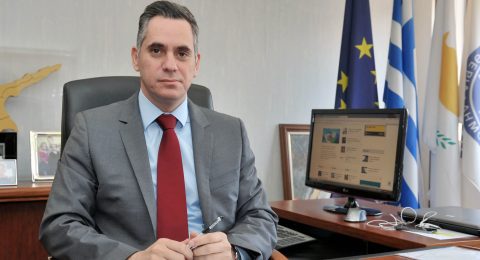
In the global chess game of energy, international relations tend to have the first hand.  When looking into the power of the Eastern Mediterranean region, one cannot side-step the central role of Cyprus. In an effort to steer away from Egypt’s angle of the equation, Egypt Oil & Gas conducted an interview with Nicholas Papadopoulos, the Presidential candidate of Cyprus and the Head of the country’s Democratic Party.

The Influential Role of Iran on OPEC’s Welfare

Fluctuating global oil prices for the past three years have continually hurt both government and private sector oil investors. The near halving of oil prices overnight since mid-2014 came six months after the US lifted economic sanctions placed on Iran since 2011.

The Real Influence of Saudi Arabia in the Oil Price Game

When it comes to influencing global oil prices by manipulating production levels, many politicians and economists agree that no country is more powerful than Saudi Arabia, the second biggest oil producer in the world after Russia. This was most evident when oil prices dropped from $105 a barrel mid-2014 to a low of $30 a barrel early 2016 at the behest of Saudi Arabia officials to fight off a shale gas boom in the USA.

QATAR CRISIS AND ITS IMPACTS ON THE PETROLEUM INDUSTRY

In June 5, Egypt, Saudi Arabia, the United Arab Emirates (UAE), Bahrain and other Arab countries cut diplomatic ties with Qatar in a coordinated move after allegations that Doha supports terrorist organizations and interferes in the internal affairs of countries in the region.

Page 8 of 9

Login

Welcome! Login in to your account

Remember me Lost your password?

Lost Password