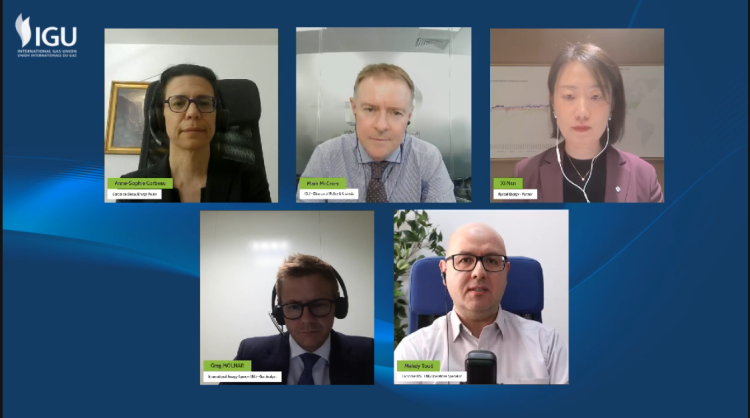
The liquefied natural gas (LNG) loadings from Qatar and the United Arab Emirates (UAE) dropped by 35 billion cubic meters (bcm) since the eruption of the Middle East conflict in March 2026 compared with the same period last year, said Gergely Molnar, Energy Analyst at the International Energy Agency (IEA) during a recent live webinar by the International Gas Union’s (IGU) reflecting on its 17th annual edition of the World LNG report.
He described the recent Gulf disruption as one of the biggest supply shocks the LNG market has ever faced. “To put it in perspective, the lost volumes equal almost 45% of Germany’s annual gas demand in 2025 , a massive hit to the global gas market,” Molnar said.
He noted, however, that around two-thirds of the lost supply was offset by higher LNG production from the US, Canada, Africa, Nigeria and Malaysia, supported by new liquefaction projects including Plaquemines, Golden Pass, Corpus Christi Stage 3, and LNG Canada. There have also been more piped gas deliveries coming to the European market, especially from Norway and North Africa.
The webinar , attended by Egypt Oil and Gas, discussed how demand structure in Asia and Europe is diverging. In June, Asian countries were importing more LNG to meet higher demand for cooling during hot weather. Meanwhile, in Europe, the way prices are currently structured doesn’t make it attractive for companies to buy LNG and store it — so Europe isn’t rushing to fill up its reserves.
Molnar explained that additions to Europe storage are currently 17% below last year’s pace, leaving inventories 15.5 billion cubic meters (bcm) below the five-year average. At the current rate, European storage would reach only around 75% of capacity, below the EU’s 80–90% target, meaning imports will likely have to accelerate in the coming months. If that coincides with stronger summer cooling demand in Asia, competition for flexible LNG cargoes could intensify, placing upward pressure on global prices.
During 2025, the global LNG trade reached a record 437 million tons (mt) in 2025, up 6.3% from 2024, connecting 24 exporting markets with 50 importing markets, according to Xi Nan, Senior Vice President on Rystad Energy’s Markets research team.
The US added 22.3 mt of new LNG supply during last year, maintaining its position as the world’s largest exporter with approximately 110 mt, ahead of Qatar (80.8 mt) and Australia (about 80 mt). Meanwhile, Canada and Mauritania/Senegal joined the global LNG market by shipping their first cargoes.
On the demand side, Europe drove import growth as it sought alternatives to Russian pipeline gas, while Africa emerged as one of the fastest-growing LNG import regions, led by Egypt, where LNG imports surged by 6.9 mt to 9.56 mt in 2025.
Xi Nan noted that global liquefaction capacity continues to expand rapidly, with 234 million tons per year (mt/y) currently under construction or approved as end of 2025, while more than 1,000 mt/y remains in the pre-final investment decision (FID) stage worldwide.
She added that global liquefaction capacity is expected to exceed 700 mt/y by 2030, stressing that 2026 represents a year of delays rather than a change in the industry’s long-term growth strategy.
A key message from the panel was that the Strait of Hormuz crisis has fundamentally changed how buyers assess energy security.
Mehdy Touil, Lead LNG Specialist Design SME at Capstone ITS, argued that much of the industry’s attention had focused on restarting liquefaction plants, while overlooking the greater challenge of restoring LNG shipping routes. “The real question is how long it will take for LNG cargoes to reliably reach buyers again. So it’s really a question of restoring exports versus restarting production. That is where the Strait of Hormuz crisis is becoming quite relevant for future LNG projects and future FIDs.”
Touil stressed that Gulf producers will remain central to global LNG supply. “I do not see this as Gulf LNG losing while other projects win. Qatar will remain central to the LNG market. The UAE and Oman will also remain important. But buyers have been reminded that the security of supply is not only about securing the molecule, finding the best price, or acquiring equity in liquefaction assets. It is also about the route to market.”
He noted that this shift is expected to increase interest in projects outside the Gulf, including in the US, Canada, Mozambique and Argentina, but cautioned that geopolitical momentum alone will not guarantee investment.
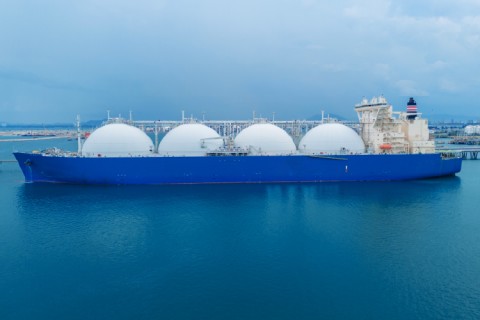
The webinar highlighted the rapid expansion of floating LNG infrastructure. Global regasification capacity reached 1,113.5 mt/y in 2025, across 50 markets, with 62.9 mt/y added in 2025. Chine alone added around 15 mt/y of the regasification terminal capacity across 5 projects. In addition 5 new floating terminals came online in Egypt, Jordan, Italy and Senegal, according to Xi Na
Xi Na explained why floating terminals continue gaining popularity as they “have a relatively shorter lead time, relatively lower capital expenditure, and are more flexible.”
Unlike large onshore terminals that require years of planning and long-term utilization, floating facilities provide countries with greater operational flexibility while reducing upfront investment.
Egypt seeks to expand its regasification infrastructure to strengthen energy security and meet rising domestic gas demand. The government brought the FSRU Hoegh Galleon online at the Ain Sokhna (Sumed) terminal in 2024. In 2025, the country added three more floating units: the FSRU Energos Eskimo at Ain Sokhna (Sumed), the FSRU Energos Power at Ain Sokhna (Sonkar), each rated at 5.7 mt/y, and the FSRU Energos Winter at Damietta, rated at 3.4 mt/y.
A fifth vessel, the FSRU Hoegh Gandria, is under construction at Ain Sokhna (Sumed) and is expected to add a further 7.6 mt/ywhen it comes online in the fourth quarter of 2026.