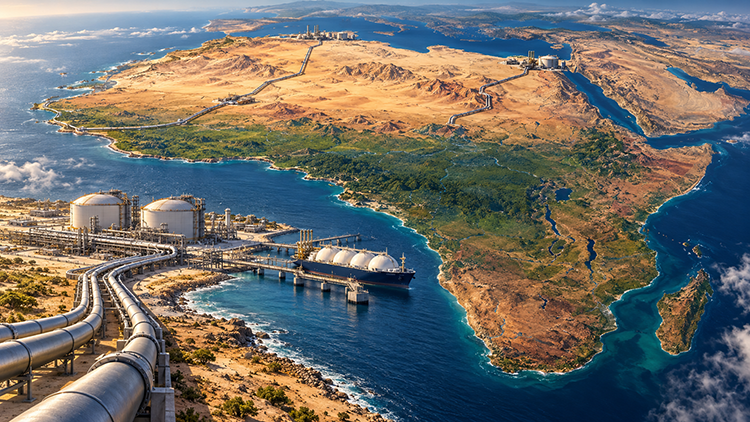
As global supply chains face structural reallocation and geopolitical volatility, the African continent’s energy architecture is evolving from isolated extraction points into an interconnected grid. Major energy corridors highlight how physical pipeline networks, liquefied natural gas (LNG) terminals, and cross-border infrastructure are collectively enabling Africa to realize its strategic potential as an indispensable energy supplier to global markets. The Trans-Saharan Gas Pipeline (TSGP), the African Atlantic Gas Pipeline (AAGP) the West African Gas Pipeline (WAGP), alongside Egypt’s strategic LNG and pipeline network, illustrate how these complementary corridors are reshaping continental energy flows.
Inside West Africa’s Pipeline Scene
After the Russian-Ukrainian war and the volatile events in the Middle East, Europe is seeking to diversify its imports. This urgent diversification push has highlighted two parallel mega-pipeline projects originating in Nigeria, each offering a fundamentally distinct approach to moving African natural gas to European consumers. The first is the Trans-Saharan Gas Pipeline (TSGP), a 4,128 km central inland route crossing Nigeria, Niger, and Algeria to deliver up to 30 billion cubic meters (bcm) of gas annually to Algeria’s Hassi R’Mel hub. Once the gas reaches Hassi R’Mel, it can flow north through Algeria’s export pipelines such as Transmed to Italy and Medgaz to Spain. Alternatively, it may be liquefied at coastal terminals like Arzew or Skikda and shipped by LNG tankers to European ports. According to France 24, the TSGP could supply roughly 11% of Europe’s annual gas imports. Approximately 60% of the route, has already been laid in Algeria and Nigeria, leaving 1,800 km to cross the Sahel.
In parallel, the Nigeria–Morocco Gas Pipeline charts an entirely different trajectory: running 6,800 km along West Africa’s Atlantic coast across 13 nations before connecting to the Maghreb-Europe Gas Pipeline in Morocco. As per recent regional developments, this ambitious corridor is now formally institutionalized as the African Atlantic Gas Pipeline (AAGP). On July 19, 2026, Economic Community of West African States (ECOWAS) leaders signed an intergovernmental agreement, establishing the legal framework for the $26 billion project, with construction targeted for 2028 and first gas expected by 2031, according to several news agencies.
Suleiman Yahyah, Founder of RHG Management Support Advisory (a strategic advisory firm specializing in African energy, infrastructure, and cross-border project development) explains that two separate projects are often confused. The West African Gas Pipeline (WAGP) is already operating, stretching 678 km from Nigeria through Benin, Togo, and Ghana, with a design capacity of 460 mmscf/d. By contrast, the planned African Atlantic Gas Pipeline (AAGP) would build on this base, extending west and north through Côte d’Ivoire, Liberia, Sierra Leone, Guinea, Senegal, and Mauritania, before reaching Morocco. Yahyah stresses that WAGP could serve as the eastern foundation of this much larger Atlantic corridor, but the two pipelines should not be conflated.
Divergent Risk Profiles
The contrast between the level of geopolitical risks between TSGP and AAGP parallel megaprojects is stark. The TSGP’s engineering feasibility is overshadowed by severe political volatility across Niger’s Sahel corridor, underscored by the June 2026 Jama’a Nusrat ul-Islam wa al-Muslimin (JNIM) attack in Niamey. According to the Jamestown Foundation, traversing 1,800 km of contested territory where governance has collapsed, the Saharan TSGP route is difficult to finance. Conversely, the AAGP’s coastal trajectory benefits from comparatively stable jurisdictions, making it far more bankable for Western development finance. Furthermore, as Africa Briefing observed, while the TSGP serves as a direct export pipeline, the AAGP’s primary strength lies in regional industrial electrification for West African states, with European exports providing the commercial justification for construction. However, as industry analysts emphasize, both pipelines still lack firm European offtake commitments to guarantee revenue certainty for lenders.
Egypt Anchors Africa’s Gas Triangle
Where West Africa’s pipeline projects face decade-long construction timelines and financing gaps, Egypt’s energy position presents a striking contrast grounded in immediate, tested operational capacity. As per U.S. Energy Information Administration (EIA) data, Egypt’s Idku and Damietta LNG plants hold a combined liquefaction capacity of 12.7 million tonnes per annum (mtpa) making them the only large-scale LNG export infrastructure in the entire Eastern Mediterranean.
These physical assets reinforce Egypt’s role as a regional processing hub rather than just a primary producer. As reported in recent industry coverage, the Arab Gas Pipeline enables regional flows, while the Eastern Mediterranean Gas Forum (EMGF) framework provides the commercial scaffolding to process offshore gas from Cyprus and Israel. A 2022 trilateral memorandum of understanding (MoU) among the EU, Egypt, and Israel explicitly recognizes Egyptian LNG plants as a primary export route to Europe. Beyond gas, Egypt’s Suez- Mediterranean (SUMED) crude pipeline recently operated at full capacity during Red Sea shipping disruptions, proving its irreplaceability in global energy trade.
Addressing how Egypt aligns with wider continental pipeline ambitions, Yahyah emphasizes that Egypt’s integration should be market-driven rather than purely physical: “Egypt should not be positioned as a physical extension of WAGP, but brought in as a North African gas-market and LNG energy-trading partner.”
Yahyah outlines that Egypt possesses substantial gas infrastructure, LNG facilities, Mediterranean access, and deep experience in gas-market development. This creates a powerful strategic triangle: West Africa — Egypt — Europe, with Morocco acting as the western bridge. Long-term continental integration would connect the West African Atlantic Gas Corridor through Morocco and the North African gas network to Egypt, creating a unified African gas ecosystem. Sitting at the crossroads of Mediterranean gas, Red Sea shipping, LNG, and European demand, Egypt functions as a vital “pricing and balancing hub rather than merely another consuming country.”
To protect execution velocity, Yahyah advises a phased governance framework: “Strategic North African participants like Egypt, Algeria, and Angola should become strategic observers, partners and joiners initially, rather than joining the ownership structure of the West African pipeline.” According to Yahyah, this approach secures regional participation without complicating ECOWAS’s closed, accelerated execution platform.
As Europe seeks resilient supply portfolios, Egypt offers three essential operational services that complement prospective West African corridors. First, through its optional liquefaction and routing capabilities, shippers can route gas through Egyptian liquefaction plants during pipeline maintenance or regional transit constraints in central corridors, ensuring continuous delivery to European entry points. Second, Egypt provides short-term storage and cargo balancing by utilizing LNG storage tanks and floating units, allowing traders to buffer supply delays along transit routes and time deliveries to match European winter demand spikes. Third, positioned at the intersection of North African, Eastern Mediterranean, and Atlantic flows, Egypt drives price discovery and market liquidity, helping to establish transparent regional pricing reference points. According to the EU’s energy security strategy, deepening market liquidity in this manner is vital to reducing vulnerability to single-source supply shocks.
Pipelines Promise, Egypt Delivers
Infrastructure remains the true arbiter of Africa’s strategic power in international energy markets. While West Africa’s megaprojects, the TSGP and AAGP, offer transformative long-term promises of regional power generation and direct pipeline exports, their realization depends on navigating complex security environments and securing firm European off-take agreements. In contrast, Egypt’s operational LNG export terminals, SUMED pipeline, and strategic trading position prove that existing, flexible infrastructure provides immediate stability to global supply lines. By pairing prospective West African transit corridors with established North African processing and trading hubs, Africa can move beyond fragmented resource extraction and establish a bankable, integrated energy ecosystem capable of powering domestic growth while securing global energy security.