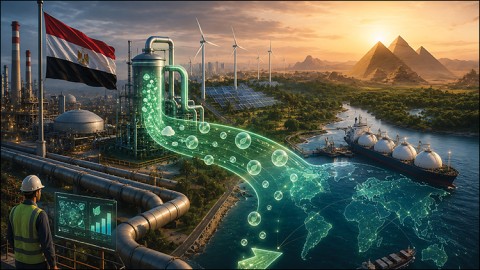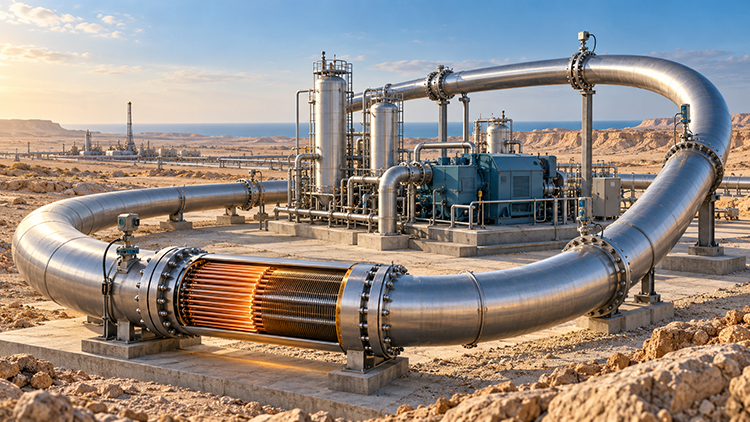
Decarbonizing Egypt’s downstream energy processes begins with the midstream “field‑to‑market” bridge. This includes gathering systems, treatment plants, compressor stations, pipelines, and LNG infrastructure that turn hydrocarbons into usable energy. These facilities are central to Egypt’s energy strategy but also contribute significantly to emissions from flaring, methane leaks, and energy‑intensive operations. Improving this infrastructure can increase the value of existing resources while reducing carbon output. At the same time, as Egypt works to restore natural gas production and strengthen its role as a regional energy hub, the midstream sector remains both a driver of growth and a challenge to clean‑energy goals.
Maximizing Egypt’s Existing Infrastructure
Egypt’s push to accelerate natural gas production makes decarbonizing downstream operations essential to curb emissions and cut the sector’s carbon footprint. Since early 2026, announcements of new exploration projects have become more frequent, with the government fast‑tracking upstream activity to close the supply–demand gap. In 2026, EGAS reported nine new development projects and 28 wells added with $1.12 billion in investment, while the Ministry of Petroleum stressed faster field development and integration into existing infrastructure. The development of Fayoum North‑4 demonstrates the value of connecting new production to established infrastructure. Brought online in August 2026, the West Delta well adds around 80 million cubic feet per day of natural gas through the existing Giza‑Fayoum pipeline.
At the same time, brownfield expansions such as GASCO’s upgrade of the Western Desert Gas Complex, which lifted processing capacity to 1.5 billion cubic feet per day(bcf/d), highlight how upgrading facilities can add value without duplicating infrastructure.
Brownfield expansion offers Egypt a way to add capacity without duplicating infrastructure, provided each project is assessed carefully. Comparing retrofit costs, operating expenses, asset life, and emissions performance against the footprint of new facilities ensures upgrades deliver both economic and environmental value. Established gathering and processing networks already give Egypt a strong base for targeted improvements that can boost output while cutting carbon intensity.
At the same time, the national transmission system is being modernized with efficiency in mind. GASCO moved about 2.3 trillion cubic feet(tcf) of gas through the grid in 2025, and the Dahshour compressor station is being expanded with two new units adding 18 million cubic meters per day (mmcm/d)of capacity. Crucially, the project includes waste‑heat recovery technology expected to generate around 24 megawatts of electricity without burning extra fuel, underscoring how infrastructure upgrades can support a greener downstream.
.Cutting Emissions Across the Field-to-Market Chain
Additionally, flare-gas recovery represents one of the most direct ways to combine emissions reduction with resource utilization. Egypt’s updated Nationally Determined Contribution targets a 65% reduction in greenhouse gas emissions from the oil and gas sector by 2030 compared with business as usual. The plan identifies associated-gas recovery as a mitigation measure, allowing recovered gas to be directed toward processing and used to produce natural gas, LPG, and condensates.
Notably, Egypt has cut gas flaring over the past decade, with World Bank data showing a drop from 2.7billion cubic meters (bcm) in 2012 to 2.0 bcm in 2022, highlighting scope for infrastructure expansion. Equally, methane detection and repair can complement infrastructure investment. Methane can escape through valves, compressors, pipelines, tanks, and other equipment, making leak detection and repair an important component of emissions management. Satellite observations, infrared cameras, and continuous monitoring systems can increasingly help operators identify emissions sources and prioritize maintenance, depending on facility requirements.
Therefore, measurement is becoming an important part of Egypt’s emissions-management framework. The International Monetary Fund reported in 2026 that Egypt was developing a measurement, reporting, and verification framework covering flaring, fugitive methane, and vented methane emissions at the operator or project level. Consistent measurement can provide the data required to identify high-emitting assets, evaluate mitigation projects, and track progress against emissions targets.
At the same time, Compressor and plant‑efficiency upgrades can cut energy use in gas processing. Egypt’s Dahshour project shows waste‑heat recovery, while future projects may adopt variable‑speed drives, advanced controls, electrification, and efficient utilities.. Where electricity is increasingly supplied from lower-carbon sources, electrification can also reduce the direct fuel consumption associated with some midstream operations.
Furthermore, gas conditioning and treatment closer to producing fields can facilitate pipeline tie-ins and optimize the movement of hydrocarbons into Egypt’s established network. The objective is not simply to add processing capacity, but to optimize where gathering, separation, compression, and treatment take place so that resources can move efficiently from producing assets into the market.
Decarbonizing Midstream, Challenges and Fast Wins
Decarbonizing Egypt’s midstream faces a mix of technical, commercial, and institutional hurdles that must be managed deliberately. Technically, many gathering lines, compressor stations, and processing trains were designed for throughput rather than low emissions, so retrofits to reduce methane leaks, electrify compression, or add waste‑heat recovery can be complex and costly; projects must weigh retrofit capex against remaining asset life and expected efficiency gains.
Commercially, midstream assets link multiple operators and contracts, so aligning incentives for leak detection, gas capture instead of flaring, and shared upgrades requires clear commercial terms and coordinated scheduling. Financing is another constraint: lenders and investors need predictable regulatory signals, robust emissions baselines, and measurable outcomes to underwrite performance‑linked loans or blended finance. Finally, capacity gaps in local engineering, LDAR (leak detection and repair) deployment, and supply chains can slow roll‑out unless paired with training and procurement strategies.
At the same time, the sector offers high‑value, near‑term opportunities to cut carbon intensity while preserving or increasing throughput. Brownfield upgrades—targeted compressor electrification, control‑system modernization, additional processing trains, and waste‑heat recovery—can deliver rapid emissions and fuel‑use reductions with lower capital and land footprints than greenfield builds; the Dahshour compressor expansion’s waste‑heat recovery and recent brownfield increases in processing capacity illustrate this approach. Systematic methane detection using satellites, drones, and continuous monitors can quickly identify the largest leaks and improve product recovery, turning lost gas into revenue. Connecting new wells to existing pipelines and plants, as with recent field‑to‑market tie‑ins, concentrates emissions‑reduction efforts on fewer nodes and avoids duplicative infrastructure. To realize these gains at scale, Egypt needs project‑level economic screening that includes emissions performance, stronger regulatory and commercial frameworks that reward lower carbon intensity, and blended financing that bridges retrofit costs—measures that together make green downstream upgrades the default, not the exception.
Decarbonizing Egypt’s downstream hinges on upgrading the midstream “field‑to‑market” bridge. Targeted brownfield upgrades, systematic methane detection and repair, and efficiency measures such as waste‑heat recovery and electrification can cut emissions quickly while preserving throughput. Project‑level economic screening that factors retrofit capex, operating costs, asset life, and emissions performance will ensure upgrades deliver both environmental and commercial value. Coordinated commercial terms, stronger regulatory signals, and blended finance are needed to mobilize investment, while capacity building and supply‑chain development will speed deployment. With examples like Fayoum North‑4 and Dahshour showing what’s possible, Egypt can make green downstream the default by prioritizing high‑impact retrofits and measurement‑driven mitigation across its midstream network.