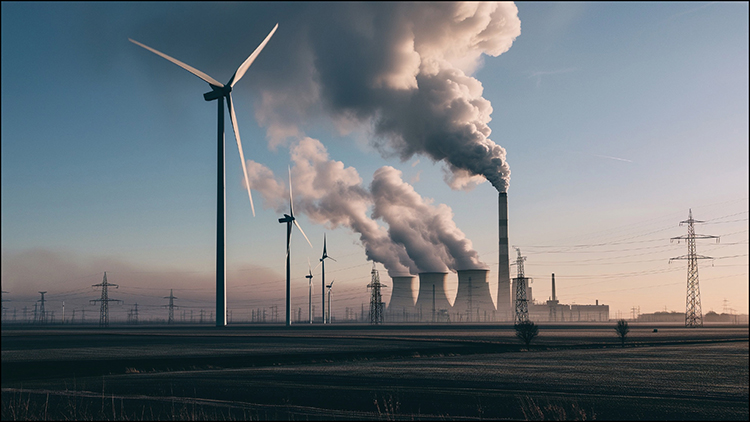
The global energy transition is advancing at a pace that would have seemed improbable just a decade ago. Solar and wind capacity additions continue to break records year after year, and clean energy is now the primary driver of growth in electricity generation worldwide. Yet this progress coexists with a less visible but critical reality: fossil fuels remain dominant across the broader energy system. In 2024, global energy demand grew by approximately 2.2%, with oil, gas, and coal all increasing in absolute terms. Thus, fossil fuels still account for roughly 80–81% of total primary energy consumption. This persistent dominance highlights a structural imbalance; renewables are scaling rapidly, but not fast enough to displace fossil fuels across all sectors.
Power Shift, But Fossils Still Anchor
Electricity is the most advanced front of the transition. Renewables accounted for more than 80% of new power generation capacity added globally in 2024, and they now supply close to one third of total electricity demand. In Europe, wind and solar have overtaken coal, with Germany regularly hitting 50% renewable generation.
But fossil fuels remain essential stabilizers. Coal still provides around 35% of global electricity, while natural gas contributes over 20%. These sources balance grids, cover intermittency, and meet peak demand. Even in countries with strong renewable penetration, fossil fuels act as the backbone of reliability. This duality underscores the paradox: renewables are cutting emissions, but they have not eliminated fossil based backup.
Beyond power, the transition slows dramatically. Transport remains overwhelmingly dependent on oil, which grew by 0.8% in 2024, driven by demand of aviation, shipping, and petrochemicals industries. Electric vehicle (EV) adoption is accelerating—17 million units sold globally in 2024—but EVs still represent a small fraction of transport energy use.
Heavy trucks, planes, and ships rely almost entirely on liquid fuels due to energy density and infrastructure constraints. While passenger EVs are gaining ground globally, freight and long-haul transport remain tethered to petroleum—a challenge particularly acute in developing markets.
Dr. Farah Shoukry, Research Associate at the American University in Cairo, emphasizes that these hurdles extend beyond technology. She notes: “From an Egyptian market perspective, decarbonising transport, heavy industry, and heating is significantly more complex than decarbonising electricity due to structural, financial, and technological constraints.”
This complexity is evident in Egypt’s current energy landscape. Despite notable progress in renewable power—anchored by the Benban Solar Park—the transport sector remains fossil-bound. Even with megaprojects like the Cairo Monorail and LRT, the shift is slowed by limited charging infrastructure, high upfront EV costs, and a deep-seated reliance on road-based logistics.
Industry, Heating: Where Fossil Fuel Dominate
Industrial activity is the hardest barrier to deep decarbonization. Steel, cement, chemicals, and refining are energy intensive and fossil dependent. In 2024, global natural gas demand rose 2.7%, largely from industry, while coal demand increased 1%.
Unlike electricity, industrial processes often require high temperature heat or fossil feedstocks. Blast furnaces, kilns, and petrochemical crackers cannot easily switch to renewables. Green hydrogen and carbon capture are emerging solutions, but they remain costly and small scale. Industrial emissions continue to rise even as power sector emissions fall.
Egypt’s industrial base reflects this challenge. Fertilizer, cement, and petrochemical plants rely heavily on natural gas, both as fuel and feedstock. Transitioning these sectors requires not just new technologies but also re engineering entire production chains—a task far more complex than adding solar panels to the grid.
Buildings add another entrenched challenge. Natural gas dominates heating in many countries, supported by decades of pipeline infrastructure. Transitioning requires electrification, heat pumps, insulation, and district heating—investments that remain uneven and slow.
In colder climates, alternatives are not yet universally affordable or accessible, keeping fossil fuels central to residential and commercial heating. Even in warmer regions, gas remains the default for cooking and water heating. Egypt’s urban expansion has locked in gas distribution networks, making electrification of heating a long term project rather than a quick fix.
Why the Transition Crawls
The experiences of leading energy transition countries provide valuable insights into the realities of decarbonisation. In both Germany and Brazil, renewable energy has significantly reduced emissions in electricity generation. Brazil, for example, generates the majority of its electricity from hydropower, while Germany has rapidly expanded wind and solar capacity. However, in both cases, fossil fuels remain critical in other sectors. Oil continues to dominate transport, while gas and coal are still used in industry and heating. These examples demonstrate that even the most advanced energy systems cannot eliminate fossil fuels quickly.
Even advanced systems cannot eliminate fossil fuels quickly. Decarbonization is sectoral, requiring tailored strategies for each part of the economy.
Shoukry added: “A realistic timeline for deep decarbonization across all sectors in Egypt extends over the next two to three decades. By 2030, progress will likely be concentrated in the power sector and selected public transport systems, while electric vehicle adoption and industrial decarbonization remain limited.”
Structural barriers explain fossil persistence. Infrastructure such as refineries, pipelines, and industrial plants represent trillions in sunk costs. Emerging technologies for hard to abate sectors—hydrogen, carbon capture—remain expensive.
Energy security complicates the shift, especially in regions where fossil fuels provide reliable, affordable energy. For Egypt, balancing decarbonization with growth, jobs, and access adds another layer of complexity. The country’s economic development strategy depends on energy affordability, making a rapid fossil exit politically and socially difficult.
The slow pace also brings benefits. A phased approach avoids economic shocks, manages investment cycles, and maintains energy security. It allows time to scale new technologies, build infrastructure, and strengthen institutions.
Renewables in power are already delivering gains: lower emissions, cheaper electricity in many markets, and greater diversification. For Egypt, solar and wind reduce fuel import dependence, attract foreign investment, and position the country as a regional clean energy hub.
Realism Over Rhetoric
Even under ambitious climate scenarios, fossil fuels are projected to supply 41–55% of global energy by 2050. Existing infrastructure, asset lifespans, and deployment timelines make rapid displacement unrealistic. Managing the transition carefully is essential to avoid disruption.
Egypt’s trajectory reflects this reality. The country targets 42% renewable electricity by 2035, with large scale solar projects leading the way. Yet natural gas still dominates power generation, and oil products underpin transport and industry. Rising demand from population growth and economic development adds pressure to maintain reliable, affordable energy.
The evidence is clear: the energy transition is not an immediate fossil fuel phase out, but a gradual, sector by sector transformation. Renewables are reshaping electricity systems at speed, but transport, industry, and heating remain fossil bound without complementary technologies and infrastructure.
The lesson from international experience—and Egypt’s own path—is realism. Deep decarbonization requires sustained investment, innovation, and integrated policy frameworks tailored to each sector. Until these conditions are met at scale, fossil fuels will remain not relics of the past, but active pillars of the present and near future energy system.