For decades, Egypt’s phosphate resources have represented a significant but underutilized component of the country’s mineral wealth. With phosphate reserves estimated at more than 3 billion tons, Egypt possesses one of the world’s largest reserves portfolio. Yet the strategic question is no longer simply how much phosphate Egypt can extract. It is how much economic value the country can capture before that phosphate leaves its borders.
The distinction is critical. Exporting phosphate rock generates revenue from the extraction of a finite natural resource, but processing that rock into phosphoric acid, fertilizers, animal-feed products and specialized chemicals creates a much broader economic ecosystem. This requires engineering, transport, energy, chemicals, logistics, packaging and technical services while creating opportunities for skilled employment and industrial exports. As suggested by Khaled Aboul Makarem, Chairman of the Chemicals and Fertilizers Export Council, “Processing phosphate locally shifts Egypt from exporting raw minerals to producing higher‑value goods, capturing more value and boosting export revenues. The choice is clear: supplier of ore or producer of industrial products.”
The Value Hidden in the Rock
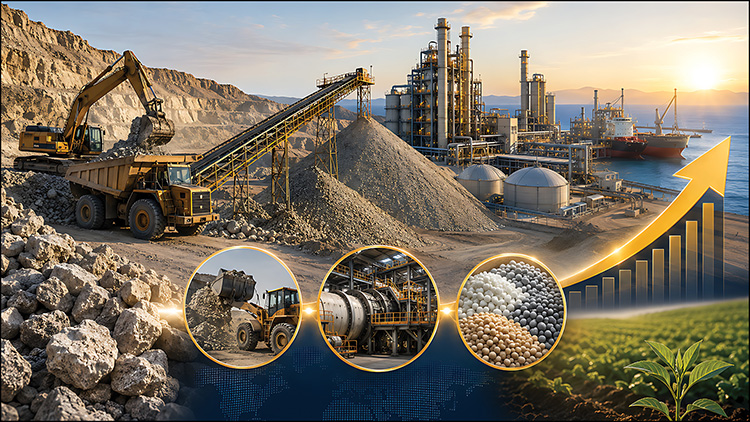
It is important to note that phosphate rock is only the starting point of a much larger value chain. Through beneficiation and chemical processing, the ore can be converted into phosphoric acid, which subsequently becomes an input for products such as monoammonium phosphate (MAP), diammonium phosphate (DAP), triple superphosphate (TSP), compound fertilizers and specialized agricultural nutrients. Further processing can also produce purified phosphoric acid, animal-feed additives and industrial chemicals.
This distinction matters because each additional stage introduces new economic activity. Mining requires extraction equipment, workers and transport. Processing adds chemical engineering, utilities and industrial infrastructure. Fertilizer production adds blending, granulation, packaging, storage and distribution. Specialized products introduce further research, quality control, technology and international marketing requirements.
In fact, Egypt has already demonstrated elements of this model at Ain Sokhna. The Phosphatic and Compound Fertilizers Complex, inaugurated in 2019, comprises nine factories and was designed to maximize the value of Egyptian phosphate. The complex was reported to provide around 1,500 direct and 20,000 indirect jobs, illustrating how downstream mineral industries can create employment well beyond the mine itself.
Abu Tartour: Moving Downstream
Perhaps the clearest illustration of Egypt’s changing approach is the development of the Abu Tartour phosphoric acid complex in New Valley Governorate.
On August 19, 2026, the Ministry of Petroleum and Mineral Resources announced the groundbreaking of the first industrial complex for producing phosphoric acid from Egyptian phosphate ore at Abu Tartour. The project carries investments of $658 million and is planned to produce 250,000 tons per year of high-concentration commercial phosphoric acid in its first phase. The project is expected to create more than 3,000 direct and indirect employment opportunities, with production destined for export through Safaga Port.
As a matter of fact, the significance of Abu Tartour extends beyond its production capacity. Phosphoric acid is a strategic intermediate product rather than simply another commodity. It forms the foundation for manufacturing phosphate fertilizers and a wider range of downstream chemical products. The project therefore creates a bridge between Egypt’s mining resources and its industrial and export ambitions. Aboul Makarem emphasized that, “Projects such as Abu Tartour Phosphate complex are strategically important because they represent a shift toward integrated mining and industrial development, helping Egypt maximize the economic value of its mineral resources.”
SCZONE and the Industrial Cluster Model
At the other end of the value chain, the Suez Canal Economic Zone (SCZONE) is emerging as a natural platform for converting Egypt’s phosphate resources into export-oriented industrial products.
In April 2026, Egypt signed a phosphate ore supply agreement between Misr Phosphate Company and Indorama Corporation for a new phosphate fertilizer complex in Sokhna. The first phase is planned at 600,000 tons per year, supported by approximately $525 million in investment. The project is explicitly designed around greater integration between mining and industrial activities.
Moreover, another planned SCZONE phosphatic chemical complex demonstrates the potential for going even further downstream. The project, with total investments of approximately $1 billion across three phases, is planned to produce phosphoric acid as well as DAP and TSP fertilizers in its first phase. Later phases are expected to introduce purified phosphoric acid and specialized phosphate chemicals, including products for industrial and food applications. The project is expected to generate approximately 10,000 direct and indirect jobs.
Lessons from Morocco and Beyond
Nevertheless, Egypt is not alone in recognizing that the greatest economic opportunity in mineral wealth often lies downstream. Morocco provides perhaps the clearest phosphate example. The Office Chérifien des Phosphates (OCP) in Morocco has developed an integrated model spanning mining, beneficiation, phosphoric acid and fertilizer production. Its Jorf Lasfar complex is described by OCP as the world’s largest integrated phosphate fertilizer production complex, while its industrial platforms produce phosphoric acid, fertilizers, plant-nutrition products and animal-feed additives.
On that note, the evolution of Morocco’s phosphate sector demonstrates what can happen when mining becomes the foundation for an industrial ecosystem rather than the end point of production. OCP has continued expanding downstream capabilities, including specialty products and customized fertilizers, allowing phosphate resources to support a much broader portfolio than raw rock exports alone.
Additionally, Saudi Arabia is pursuing a similar strategy. Its phosphate industry has increasingly emphasized integration across the value chain, while Ma’aden reported phosphate fertilizer sales of 6.7 million tons in 2025, up from 6.2 million tons in 2024. The company has also expanded its fertilizer product portfolio and focused on improving efficiency across the integrated chain.
From Resource Holder to Industrial Producer
For Egypt, the opportunity is therefore larger than increasing phosphate exports. It is about determining what kind of mining sector the country wants to build.
The government has set an ambition to increase mining’s contribution to GDP from less than 1% currently to around 5–6% in the coming years. The Ministry has specifically identified value-added mineral industries as a central part of this transformation. Phosphate can become one of the clearest vehicles for achieving that objective. However, realizing the opportunity will require more than establishing individual fertilizer plants. Egypt will need reliable energy and water supplies, efficient transport connections, modern ports, competitive financing, skilled technical labor and stronger links between mining companies, manufacturers, universities and research institutions.
Ultimately, Egypt’s phosphate wealth presents a strategic choice. The country can continue to treat phosphate primarily as an extractive commodity, capturing value at the first stage of the chain. Or it can use its reserves as the foundation for a wider industrial ecosystem that produces fertilizers, phosphoric acid, specialty chemicals and other downstream products. The emerging projects at Abu Tartour and SCZONE suggest that Egypt is increasingly choosing the latter path. If implemented effectively, the transition could turn phosphate from an exported mineral into an industrial platform; generating foreign currency, supporting agriculture, creating skilled employment and strengthening domestic supply chains. The real value of Egypt’s phosphate wealth, therefore, may not lie beneath the desert alone. It lies in what the country builds around it.