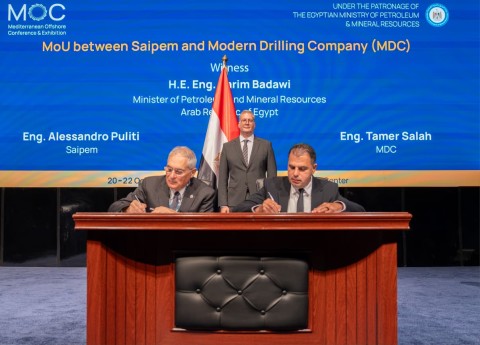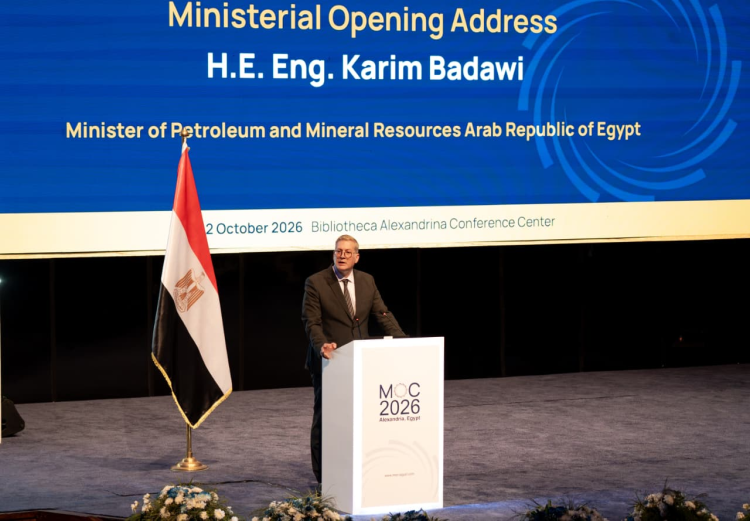
Egypt brought 591 new wells into production and made 113 discoveries from the period of July 2024 to June 2026, said Karim Badawi, Minister of Petroleum and Mineral Resources, at the opening ceremony of the Mediterranean Oil and Gas Conference and Exhibition (MOC 2026).
This came as part of a broader initiative to bolster domestic production and offset the natural decline in field output, alongside expanding exploration activities, developing existing fields, and refining investment models to encourage the influx of new capital, Badawi noted.
He also highlighted the successful settlement of all outstanding dues owed to investment partners in exploration, discovery, and production activities, a sum that had reached about $6.1 billion over two years.
This achievement paves the way for a new phase of partnership built on trust and mutual commitment, while strengthening the sector’s ability to attract investment and accelerate the development of oil and gas resources, Badawi noted.
During his speech, Badawi highlighted Alexandria’s role as a major hub for Egypt’s oil and gas industry, with activities spanning production, processing, refining, petrochemicals, and petroleum product transportation and distribution.
Alexandria has four oil refineries accounting for about 45% of Egypt’s total refining capacity, as well as five petrochemical complexes, Badawi said.
Badawi said Egypt has the potential to strengthen its position as a regional energy hub, supported by its strategic location, gas transportation networks, processing facilities, and liquefied natural gas (LNG) export terminals in Idku and Damietta, as well as its refining and petrochemical industries.
Badawi identified opportunities to expand cooperation with Cyprus, Greece, Italy, and Libya through projects linking regional resources to Egypt’s infrastructure and consumer markets, improving project economics and strengthening regional energy security.
The minister said the next phase would focus on moving to project implementation, from discoveries to production, and from investment opportunities to commercially viable partnerships.
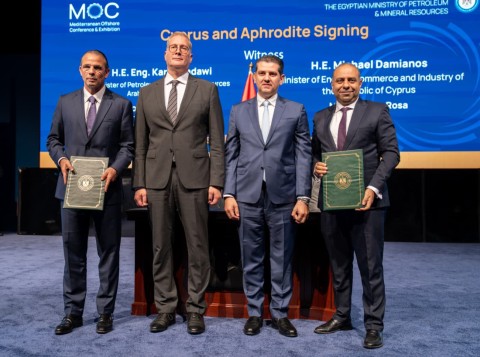
The opening ceremony was attended by Cyprus Energy Minister Michael Damianos, who emphasized that regional cooperation is essential to developing Eastern Mediterranean resources, given the complexity of offshore projects, the high capital requirements, and the need for infrastructure connecting production fields to markets.
Linking Cypriot gas resources to Egypt’s existing infrastructure provides a practical model for regional integration, helping accelerate project development, improve commercial viability, and strengthen Egypt’s position as a regional energy hub, Damianos said.
Cronos field reached the final investment decision (FID) in July by the Italian Eni and French TotalEnergies consortium, with gas production from the field, equivalent to around 2.8 million tons per year (mmt/y) of liquefied natural gas (LNG), targeted to begin in 2028.
Meanwhile, the Aphrodite gas field remains on track to reach a FID in 2027, with first gas targeted for around 2030-2031. The field’s development has an estimated cost of around $4 billion and envisages a production facility with a maximum capacity of around 800 million cubic feet of gas per day (mmcf/d).
During the conference, the Ministry of Petroleum and Mineral Resources and Chevron have initialed a financial framework agreement for the project to connect the Aphrodite gas field to Egypt’s gas infrastructure, marking another step toward developing the cross-border gas link.
The natural gas produced from both fields would be transported through a subsea connection to infrastructure serving Egypt’s Zohr field before reaching the LNG facilities terminal for export.