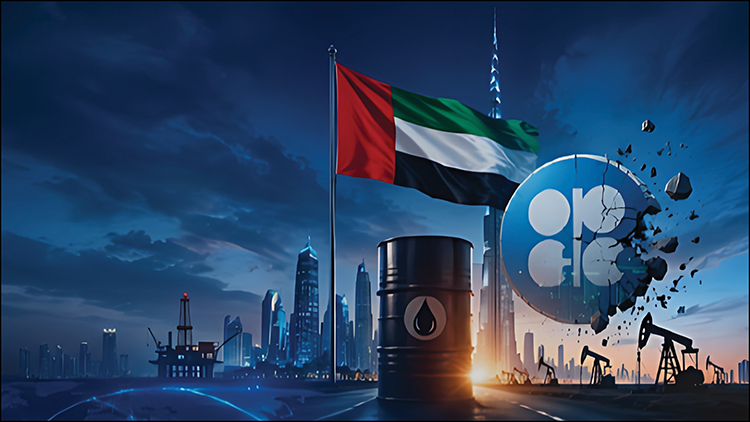
The United Arab Emirates (UAE) was part of the Organization of the Petroleum Exporting Countries (OPEC) for 59 years, accepting collective quotas in exchange for the price stability they were designed to deliver. On May 1, that arrangement ended. The UAE’s departure from OPEC and OPEC+ was significant because it removed one of the few producers capable of shifting global supply, a state with capacity, the infrastructure, and now the sovereign freedom to produce on its own terms.
At the center of this shift is Abu Dhabi National Oil Company (ADNOC), the UAE’s state‑owned energy giant and the driver of the nation’s hydrocarbon strategy. For decades, ADNOC’s output was bound by OPEC quotas, meaning barrels it could produce but was barred from selling came at a direct cost to Abu Dhabi’s energy policy. That tension sharpened when ADNOC unveiled a $150 billion expansion plan in November 2025 to lift capacity to 5 million barrels per (mmbbl/d) volumes the cartel’s quota system would not allow it to use.
The market’s initial reaction was muted. Brent crude spiked about 4% on the news before quickly retreating, reflecting short‑term uncertainty rather than a clear trend. The limited impact was largely due to the closure of the Strait of Hormuz, which had already locked regional supply in place. Yet behind this brief calm lie deeper questions: how ADNOC will deploy its new capacity, whether OPEC+ can survive structurally, and what prices will look like once Hormuz reopens.
Sovereign Flexibility Replacing Cartel Restraints
Under its previous OPEC agreement, the UAE’s production was limited to 3.2 (mmbbl/d) despite holding a capacity of 4.85 (mmbbl/d), leaving a gap of roughly 1.65 million bbl/d idle by contractual obligation, according to an analysis published by the Middle East Institute. To eliminate this restriction, ADNOC’s five-year capital expenditure plan aims for a 47% capacity increase over pre-program baselines to hit the 5 (mmbbl/d) target by 2027. Ebtesam Al Ketbi, the Emirates Policy Center’s President, told the National that the OPEC exit marks a transition from collective quota-based commitments to sovereign flexibility in managing production, enabling a faster response to market disruptions.
While the regional conflict did not spark this decision, it accelerated it. The UAE had spent years consistently pushing for higher baseline targets, creating challenging internal dynamics within OPEC. The current crisis merely provided the ideal structural window to break free.
Unconstrained Logistics Driving the Asian Strategy
ADNOC immediately moved from declaration to deployment, fast-tracking $55 billion in upstream and downstream project awards between 2026 and 2028 as the first major tranche of its capital plan, according to an official company press release. The company’s immediate focus is bypassing maritime bottlenecks via the Abu Dhabi Crude Oil Pipeline (ADCOP). This 400-kilometer Habshan-Fujairah route can carry 1.5 (mmbbl/d), offering a Hormuz-independent export artery that no other quota-constrained Gulf producer controls. Naveen Das, senior oil analyst at the trade intelligence firm Kpler, told American outlet CNBC that ADCOP currently operates at 71% utilization, leaving 440,000 bbl/d of immediate spare bypass capacity, with the ability to surge to 1.8 (mmbbl/d) if required.
This infrastructure feeds ADNOC’s primary commercial target: Asia. Data from the US Energy Information Administration (EIA) confirms that China, India, South Korea, and Japan consume over 75% of Middle East Gulf exports. To secure long-term demand, ADNOC has heavily prioritized these Asian downstream partnerships.
Underpinning this strategy is ADNOC’s flagship Murban crude, a premium light, sweet onshore grade physically deliverable at Fujairah and traded under the ICE Futures Abu Dhabi (IFAD) exchange. Reuter’s data shows Fujairah currently handles 1.07 (mmbbl/d) of Murban exports, drastically outpacing the 320,000 bbl/d shipped from Jebel Dhanna inside the Gulf. Market analysts from EIA have flagged Murban’s potential to rival the Gulf Mercantile Exchange (GME), the primary benchmark for pricing Middle Eastern sour crude oil exported to Asian markets. Unbound by quotas, a sustained volume surge will solidify Murban as an independent regional pricing benchmark, structurally reshaping how Gulf crude is valued.
OPEC+ Diminished Leverage
The cartel’s first post-exit response highlighted its eroding leverage. The seven remaining OPEC+ members met virtually on May 3 and agreed to a marginal production increase of just 188,000 bbl/d for June. This minor adjustment stands in stark contrast to the heavy, multi-million-barrel market interventions historically deployed by the group. Furthermore, the OPEC+ statement made no mention of the UAE whatsoever, a glaring omission that underscores the fracturing of regional cohesion.
More fundamentally, the group has lost its structural buffer. Losing a member with nearly 5 million bbl/d of capacity deprives the cartel of a vital stabilization tool. Alongside Saudi Arabia, the UAE was the only member holding meaningful spare capacity that could be deployed within 30 days. Without this shock absorber, Saudi Arabia is left to shoulder the heavy lifting of price defense alone, which can be a huge burden.
There represents real danger that other countries will follow the UAE’s lead and leave the oil alliance. As noted by Vandana Hari, chief executive of Singapore-based Vanda Insights (a research firm that analyzes global oil markets and prices), the UAE’s decision to quit has severely weakened OPEC+. This move makes it politically much easier for countries that manipulate their production limits—such as Iraq and Kazakhstan—to leave the group as well. While neither country has stated they plan to exit just yet, the UAE has set an example.
Evaluating this diplomatic fallout, Eitan Charnoff, Founder and CEO of Potomac Strategy, a GCC-based geopolitical risk advisory firm, told Egypt Oil & Gas: “The UAE’s departure signals a profound realignment in regional energy diplomacy. By prioritizing sovereign commercial interests and local infrastructural advantages over collective cartel compliance, Abu Dhabi has effectively decentralized Gulf oil politics. This sets a significant precedent, as neighboring producers will now increasingly weigh the diminishing returns of strict quota conformity against the immediate economic rewards of independent, volume-driven strategies.”
Market Scenarios for the Post-Crisis Reopening
In a sudden reopening of the Hormuz Strait, major Gulf countries will rush to pump as much oil as they can, causing global oil prices to become highly unstable. According to analysis from the Syz Group (a Swiss wealth and asset management firm), the UAE could easily pump about 1 million more barrels of oil per day in the near future.
This situation will badly affect Saudi Arabia. The International Monetary Fund (IMF) notes that Saudi Arabia needs oil prices at around $88 per barrel to pay for its government budget, while the UAE only needs $45. Because of these tight financial limits, Saudi Arabia cannot afford to flood the market with more oil or compete with the UAE in a price war.
Reflecting on this long-term structural volatility, Hamzeh Al Gaaod, MENA Independent Economist, told Egypt Oil & Gas:
“If other producers follow the UAE’s lead, global oil markets could become more fragmented and volatile, with pricing mechanisms increasingly resembling LNG’s—less centralized and more responsive to localized, short-term supply-demand dynamics.”
The UAE’s exit from OPEC is not, at its core, a story about one country’s quota frustration. It is the first institutional confirmation of a new competitive architecture in Gulf oil,one in which national production strategies take precedence over collective discipline, and in which the ability to export independently of a single maritime chokepoint is a strategic asset, not merely a contingency.