Egypt’s Red Sea offshore province is moving from a long-neglected frontier into a strategic exploration target. Long overshadowed by the mature, fragmented brownfields of the Gulf of Suez and the Western Desert, the basin now sits at the intersection of geology, policy, and investment strategy. Through this alignment, Egypt seeks to transform a high-risk, technically challenging deepwater province into a commercially credible exploration play.
The subsurface challenge
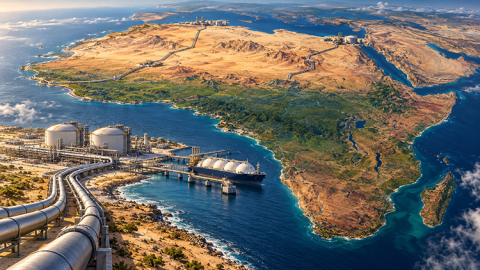
Geographically, the exploration area offshore the Red Sea stretches from the southern mouth of the Gulf of Suez below Hurghada to Egypt’s maritime border with Saudi Arabia near Halayeb and Shalateen. The contrast with Egypt’s mature producing provinces is clear. While the Gulf of Suez consists of tightly packed and heavily drilled blocks, the Red Sea remains largely undeveloped, with large frontier acreage still awaiting definition.
The Red Sea is a deep underwater basin formed when the African and Arabian plates separated. That movement created a basin with strong oil and gas potential, but it also left behind thick layers of underground salt that made it very hard to see what was below the seabed. For years, those salt layers distorted seismic images, which led companies to drill in the wrong places and get weak results, causing the basin’s real potential to be underestimated, according to a 2025 peer-reviewed study in Scientific Nature.
Abdelaziz Khlaifat, Professor of petroleum engineering and chair of the Petroleum and Energy Engineering Department at The American University in Cairo (AUC), said these salt layers also affect how reservoirs behave. He explained that they act like seals, trapping pressure underground and limiting the movement of fluids. As a result, hydrocarbons are more likely to move along faults, salt edges, and other limited pathways, unlike in the Gulf of Suez, where faulting plays the main role in how fluids move and how reservoirs are split up.
This reservoir physics distinction is commercially critical: it means that explorers coming from the Gulf of Suez cannot simply apply familiar analogues to the Red Sea. Each sub-salt prospect demands its own pressure architecture assessment, elevating the value of the newly reprocessed seismic library and making pre-drill engineering more demanding, but also more decisive.
The Area’s Potential
The dominant strategic target in the deepwater southern and central blocks is natural gas and condensates. Structurally, the basin is widely expected to mirror the sub-salt gas trends of the prolific East Mediterranean — the same geological logic that yielded the 30 tcf Zohr giant off Egypt’s northern coast. Oil remains relevant in the northernmost shallows near the Gulf of Suez transition zone, where natural hydrocarbon seepages documented at Jabal al-Zeit confirm an active petroleum system is firmly in place.
The leading global energy data and intelligence company TGS’s multi-client seismic library estimates that the Egyptian Red Sea holds a mean undiscovered recoverable resource of 5 billion barrels of oil and 112 trillion cubic feet (tcf) of natural gas.
However, exploration activity remains limited. Although the offshore basin covers around 70,000 square kilometers, only 14 exploration wells have been drilled by six companies, according to SLB’s Egyptian Red Sea seismic program overview. Yet approximately 77% of these wells reportedly encountered hydrocarbon indicators, suggesting that the basin’s issue has been less about a lack of promise and more about a lack of clear imaging and sustained investment appetite.
But what does that ratio actually mean at the reservoir scale? Khlaifat cautions against over-reading it as proof of basin-wide commercial continuity: “The high percentage of wells encountering hydrocarbon shows, despite the very low drilling density, suggests that an active petroleum system is present across much of the Egyptian Red Sea. However, this does not necessarily mean that commercial accumulations are continuous. Given the area’s complex faulting and salt-related structures, hydrocarbons are likely concentrated within individual structural or stratigraphic traps.”
For explorers, this means seismic imaging becomes a critical determinant of drilling success.
The E&P Landscape: IOCs, Blocks, and the Bid Round
The basin’s strong international presence reflects the confidence major companies still place in its long-term potential. British Shell operates Blocks 3 and 4 with QatarEnergy holding 17% interests, alongside Australian BHP and Egypt’s Tharwa Petroleum, while British Petroleum (bp) operates Block 6. All three blocks are located in Egypt’s northwest Red Sea offshore area, just south of the Gulf of Suez, and so far they remain exploration blocks with no reported commercial production yet.
Egypt has also accelerated licensing efforts. In November 2025, Karim Badawi, Minister of Petroleum and Mineral Resources, announced a new international bid round covering four offshore blocks across approximately 23,000 square kilometers. Managed through Ganope and the Egypt Upstream Gateway (EUG) platform, the round attracted increased interest prompting an extension of the submission deadline. The bid has four offshore blocks, RS-1 through RS-4, offered across a large frontier area, signaling Egypt’s intention to position the basin as a long-term strategic province rather than a speculative opportunity. At the same time, Ganope signed agreements with bp and SLB at Egypt Energy Show (EGYPES) 2026 to expand exploration activity and deploy advanced seismic technologies across the basin.
All of those steps suggest that this area could be promising and attractive to foreign investors. Moreover, market adjustments, including farm-outs and extended deadlines, should not necessarily be viewed as signs of weakness. Frontier basins commonly undergo periods of risk reassessment and capital reallocation before exploration activity accelerates.
Data, imaging, and cost
The biggest shift in the Red Sea story is better subsurface imaging. A 2022 seismic campaign gathered narrow-azimuth (NAZ) data across the basin, later reprocessed in 2023 with elastic full-waveform inversion (eFWI) technology and supported by gravity and magnetic surveys, giving a clearer view beneath the salt layer. SLB and energy data company TGS now offer more than 28,000 kilometers of 2D seismic data and about 4,000 square kilometers of 3D coverage, helping reduce uncertainty before drilling and making the basin look less like a blind gamble.
For the first time in Egypt’s upstream sector, the latest Red Sea bid round also introduced the R-Factor model, a profitability-based production-sharing system that adjusts the state and contractor split according to project returns. As Khlaifat noted, “The southern Red Sea presents significant technical challenges due to its deepwater setting, complex salt structures, and limited exploration history. Drilling operations must address pressure uncertainty, wellbore stability, and subsalt imaging difficulties. Completion design is complicated by high-pressure conditions and limited reservoir information.” It is precisely this engineering complexity that makes the R-Factor a structural necessity rather than a negotiating concession.
The route to market
Any Red Sea discovery will still need a commercial path to market, and that is where Egypt’s infrastructure becomes a strategic advantage. For oil, proximity to the Suez Canal and the Suez-Mediterranean (SUMED) pipeline offers access to export routes and domestic processing infrastructure. The pipeline, linking Ain Sokhna and Sidi Kerir, provides transport capacity of approximately 2.5 million barrels per day.
Gas is even more closely tied to Egypt’s broader energy system. A major offshore gas discovery in the southern Red Sea would likely need to be tied into the national grid and, depending on scale and location, connected to LNG infrastructure at Idku or Damietta.
In the end, infrastructure does not remove exploration risk, but it lowers the commercial barrier if a find is made. For deepwater frontiers, that can be just as decisive as geology.
A more viable basin
The next phase of Red Sea development will depend on whether Egypt can continue converting geological potential into investment opportunities. Sparse drilling activity, difficult salt imaging, and high costs have historically slowed exploration. However, improvements in seismic data, clearer licensing structures, and fiscal reforms suggest a more practical framework is emerging.
The Red Sea remains a frontier basin, but it is increasingly becoming one that operators can evaluate with greater confidence.