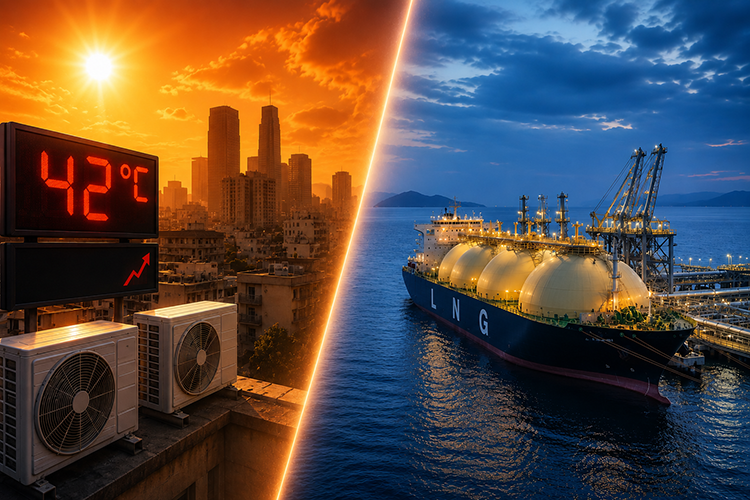
Europe’s latest heatwave is doing more than straining electricity grids; it is reshaping the fundamentals of gas markets and exposing the vulnerabilities of the continent’s energy system. As temperatures soar, electricity demand has surged across major economies. In Germany, daily power consumption increased by 10.18% from 1,267 gigawatt-hours (GWh) to 1,396 GWh within a fortnight, according to Eurelectric, the association representing the European electricity industry. Meanwhile, wholesale electricity prices climbed to nearly €160 per megawatt-hour (MWh) in France and exceeded €200 per MWh in Germany, with intraday spikes surpassing €600 per MWh at the height of the crisis, according to the European Gas Hub.
Recurring heatwaves are turning the European summer into a decisive season for energy security. Rising temperatures are reshaping both demand and supply, making proximity, flexibility, and reliability as critical as price. In this new landscape, climate pressures are emerging as one of the strongest forces redefining Europe’s energy ties—and Egypt sits at the centre of these shifting dependencies.
Cooling Demand, Supply Stress
“Heatwaves in Europe are increasing demand while also reducing supply… air cooling demand has significantly risen… meanwhile, supply risks have also heightened, especially for nuclear and hydropower generation, leading to a supply output decline.” Jessica Obeid, Founding Partner, New Energy Consult, told Egypt Oil & Gas.
The surge in cooling demand is also reshaping Europe’s electricity consumption patterns. Summer demand builds rapidly and peaks after sunset, when solar generation declines. According to the International Energy Agency (IEA), more than 40 countries accounting for nearly 70% of global electricity demand set new peak demand records during heatwaves in 2024. European air-conditioning ownership has also risen by about 50% over the past decade, reflecting a broader rise in cooling needs.
One immediate consequence is a shift in buyer behavior. As recurring heatwaves drive up cooling demand, buyers are increasingly turning to short-term LNG contracts to secure additional supply. However, Obeid warns that this trend comes at a particularly challenging time: “European buyers are increasingly seeking liquefied natural gas (LNG) cargoes in short-term contracts. Yet, this is happening at a difficult time as LNG exports from the Gulf have been negatively impacted by the conflict and have increased global market volatility.”
The real weakness exposed by heatwaves is not a lack of overall generating capacity, but the shortage of flexible capacity exactly when demand peaks. France offers the clearest example. During the June 2026 heatwave, river temperatures rose so high that nuclear plants could no longer discharge cooling water without breaching environmental limits designed to protect aquatic ecosystems. As a result, output from eight reactors was cut by 6.3 gigawatts—around 14% of national demand at the time, according to Reuters. In such conditions, gas plants become indispensable for stabilizing the grid. The European Gas Hub notes that gas‑fired generation, together with price‑insensitive LNG imports via the Suez Canal, provided the critical flexibility needed to meet peak summer demand.
Who Is Filling the Supply-Demand Gap?
Europe’s growing reliance on LNG has reshaped its supplier landscape since Russia’s invasion of Ukraine in 2022. According to the European Council, Russia’s share of EU piped gas imports fell from around 40% in 2021 to about 6% in 2025, while the United States became the bloc’s largest LNG supplier, accounting for nearly 58% of imports. Norway remained the leading pipeline gas supplier, followed by Algeria, according to Eurostat.
In this shifting landscape, North Africa’s geographic proximity gives it a strategic advantage in meeting Europe’s seasonal demand. While Algeria supplies Italy and Spain via pipelines, Qatar has secured long-term LNG contracts, and the United States remains Europe’s flexible swing supplier. According to think tank Bruegel, Egypt competes alongside these players, helping diversify the EU’s gas imports within an increasingly competitive regional market.
Egypt’s Hub Potential, Supply Limits
Egypt is well positioned to benefit from Europe’s growing demand for flexible LNG supplies. Its strategic location, access to the Suez Canal, and the existence of the Idku and Damietta LNG plants give it a unique role in the Eastern Mediterranean. As the US Energy Information Administration (EIA) notes, Egypt is the region’s only country capable of importing natural gas from neighboring states, liquefying it, and re-exporting it as LNG. Obeid notes that these assets “mean that, in theory, Egypt should be able to respond quickly to market signals.”
That opportunity, however, depends on having sufficient gas to export. As Obeid explains, “The key challenge remains in the availability of gas. Supply security starts with production security. The summer’s soaring temperatures also increase domestic demand for gas for power generation. Thus, Egypt faces the dilemma of balancing domestic energy security with export needs during periods of peak demand.”
Egypt’s position will depend largely on the pace of its domestic production recovery. According to the Arab Center DC, Egypt produced an average of 4.6 billion cubic feet per day (bcf/d) of natural gas in 2024 against consumption of 5.8 bcf/d, making it a net importer. While production fell to 43.1 billion cubic meters (bcm) in 2025, Fitch Solutions expects output to rebound to 46.6 bcm in 2026 as drilling resumes at the Zohr field and the second phase of the Raven project comes online. To support this balance, Egypt is also expanding imports of Israeli natural gas. Blue Ocean Energy signed a $35 billion agreement in 2025 to double imports from the Leviathan field to approximately 1.25 bcf/d, reinforcing Egypt’s role as a regional gas hub.
Europe’s evolving energy needs extend beyond securing additional gas volumes. According to the Oxford Institute for Energy Studies, from 2027, EU importers must demonstrate that imported gas complies with methane monitoring, reporting, and verification (MRV) requirements equivalent to those under the EU Methane Regulation, making methane performance an increasingly critical competitive factor.
Capitalizing on the Strategic Opening
Europe’s increasingly frequent heatwaves are becoming a structural driver of gas markets, boosting demand for flexible LNG supplies while exposing the limits of low-carbon power generation. For Egypt, this creates a strategic opening, but capitalizing on today’s market conditions will depend on reliable production, competitive emissions performance, and the ability to consistently balance domestic demand with export commitments.
As the European Environment Agency has estimated, the impacts of extreme weather events on Europe’s power systems are measured in the tens of billions of euros annually—a figure that will only grow as the climate warms. Europe will continue needing flexible energy partners, and Egypt’s opportunity does not expire with the season. However, as Obeid’s analysis makes clear, these advantages are necessary conditions, not sufficient ones. The ultimate determinant of success will be a long-term strategy, on production, carbon credentials, and hub positioning, that outlasts the heatwaves that created the opening.