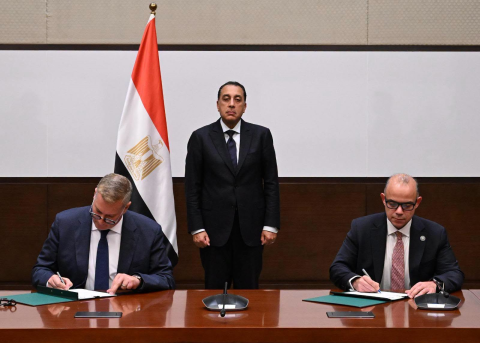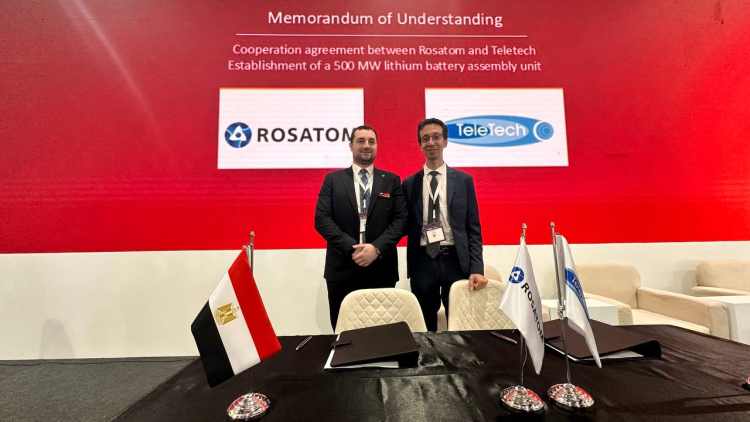
Russia’s Rosatom and Egypt’s Telecom and Technology Co. (Teletech) have signed an agreement to establish local battery energy storage system (BESS) assembly facilities in Egypt, with a potential annual production capacity of 500 megawatt-hours (MWh).
The agreement, signed during the Egypt Energy 2026 Exhibition and Conference, covers personnel training and the gradual expansion of production capacity, according to a press release by Rosatom.
“Teletech’s partnership with Rosatom represents a timely step toward strengthening Egypt’s energy infrastructure: we are combining advanced lithium-ion battery storage technology with local implementation capabilities,” said Ihab Saad, Chief Technology Officer of Teletech.
The partnership aims to support the deployment of energy storage solutions across several sectors, including electricity, telecommunications, data centers, oil and gas, and other industries.
“Egypt’s energy transition increasingly depends on the ability to combine a diversified energy mix with resilient infrastructure and stronger local industrial capabilities. Building local capacity for energy storage systems can support grid stability as renewable energy expands, reduce dependence on imported technologies and external supply chains, and develop domestic technical expertise,” said Murad Aslanov, Director of Rosatom’s Country Office in Egypt.
Rosatom’s Energy Storage business unit develops lithium-ion energy storage systems for backup power supplies, renewable energy applications, and electric vehicles.
Teletech is an Egyptian technology and telecommunications company specializing in technology design and implementation, procurement, logistics, and project execution.
Egypt is rapidly expanding its battery energy storage systems (BESS) to stabilize its grid, shift daytime solar power to evening peaks, and achieve its updated target of 42% renewable energy generation by 2030.
In August, Egypt laid the foundation stone for China’s Sungrow’s $50 million energy storage assembly plant in the Suez Canal Economic Zone (SCZONE), with a planned annual capacity of 10 gigawatt-hours (GWh) and operations expected to begin in April 2027. The project, which spans an area of 50,000 square meters (m²), is expected to have an annual production capacity of 10 gigawatt-hours (GWh) at full operation.
In July, the Cabinet granted golden licenses for two BESS projects operated by Nefertiti Energy Storage Batteries Company and Horus Energy Storage Batteries in the Benban area in Aswan Governorate.