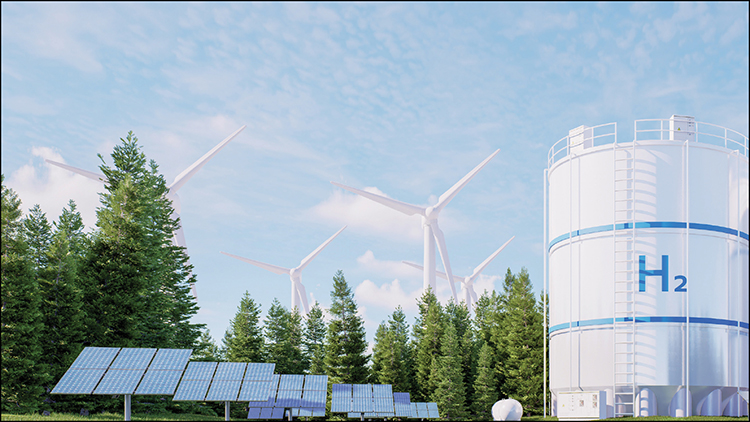
The global energy transition is entering a new phase defined less by ambition and more by constraint. What was once framed as an inevitable march toward net-zero, anchored in hydrogen and renewables, has collided with the realities of high inflation, elevated interest rates, and intensifying geopolitical rivalries.
By 2025–2026, reality has diverged sharply from ambition. Major international giants, for instance, Shell, British Petroleum, and Fortescue, have scaled back hydrogen ventures, citing poor economics and lack of buyers as reported by Financial Times. The so-called “Green Premium”, the extra cost of clean energy compared to fossil fuels, has become politically and economically untenable.
Before the current strategic pivot, hydrogen was prioritized as the “silver bullet” of the energy transition due to its unique ability to decarbonize “hard-to-abate” sectors, such as heavy industry, maritime shipping, and aviation, where battery-based electrification remains technically unfeasible. During the initial phase of the transition, European policymakers viewed hydrogen as a dual-purpose solution for energy security and industrial leadership.
From Silver Bullet to Bankability Crisis
The economic feasibility of green hydrogen remains a primary obstacle to its adoption as a silver bullet for the energy transition. According to the International Energy Agency (IEA), green hydrogen production costs currently range between $6 and $12 per kilogram (kg). While grey hydrogen, produced from natural gas, is more affordable at approximately $2/kg, it remains uncompetitive against conventional energy benchmarks.
On an energy equivalent basis (MMBtu), the price gap is striking. Green hydrogen is estimated at $45–90 per MMBtu, far above grey hydrogen at around $15 per MMBtu. Compared with traditional hydrocarbons, the disparity widens further: natural gas at the Henry Hub trades between $2.50 and $4.00 per MMBtu, while Brent crude carries an equivalent cost of only $12–14 per MMBtu. Consequently, green hydrogen remains nearly four times more expensive than crude oil and 18 times more expensive than natural gas at current market rates. This extreme valuation gap explains why few off-takers are willing to commit to the long-term contracts necessary to fund large-scale hydrogen infrastructure.
Moreover, transporting hydrogen requires compression or liquefaction, both energy-intensive processes that trigger leakage and pipeline embrittlement. Consequently, most projects remain in pilot phases; Rystad Energy, the Norwegian energy research firm, reports that 99% of announced green hydrogen projects have not advanced beyond the concept stage.
In mid-2025, mining giant Fortescue abandoned several flagship green hydrogen projects, including the $550 million Buckeye hub, citing shifting political landscapes and a lack of market viability, according to global industrial and energy market intelligence provider Industrial Info Resources. Similarly, bp exited the massive 26 gigawatt (GW) Australian Renewable Energy Hub, signaling a “strategy reset” that prioritizes disciplined investment in upstream oil and gas over high-risk experiments, as reported by Reuters.
Mohamed Jameel Al Ramahi, CEO of Masdar, UAE’s flagship renewable energy and green hydrogen developer CEO, revealed that a planned 6 GW renewable project, originally intended for green ammonia production, has been repurposed as a $6 billion solar and battery venture to serve data centers. In an interview with Bloomberg, Al Ramahi stated that “today, green hydrogen is under pressure and the market is shrinking.”
Geopolitical Realism: Security Over Sustainability
The geopolitical disruptions stemming from the conflicts in Ukraine and the Middle East have underscored the role of energy as a strategic lever. In 2026, governments are increasingly prioritizing “molecule security”, ensuring reliable access to natural gas, over “carbon-neutral electricity sources,” which refers to the strict focus on renewable-only power generation. India and China exemplify this shift by intensifying their reliance on coal and natural gas to fuel AI data centers and industrial expansion, effectively treating climate targets as secondary to economic stability. Concurrently, the US has emerged as a liquefied natural gas (LNG) superpower; its exports now serve as a vital security buffer for Europe, a trend that has slowed the planned phase-out of natural gas infrastructure, as mentioned by Reuters.
The US–Iran Conflict: A New Flashpoint
The recalibration is also shaped by geopolitical flashpoints. Rising US assertiveness in the Persian Gulf and hostility toward Iran have heightened tensions, adding volatility to energy markets. Regional enmities, between Saudi Arabia and the UAE, the struggles for state unity in Syria, and the Sudanese Civil War, merge to create multiple energy-linked flashpoints. As Francesco Sassi, an Assistant Professor and Postdoctoral Fellow in Energy Geopolitics at the University of Oslo’s Department of Political Science, told Egypt Oil & Gas, “The current regional geopolitical standoffs, from the Israel-Palestine conflict to US assertiveness in the Persian Gulf and hostility towards Iran, merge to create multiple flashpoints whose development is intertwined with regional energy relationships.” This underscores how energy reliability, particularly via Mediterranean gas, is overtaking decarbonization speed in strategic dialogue between North Africa and the EU.
Bridging Ambition and Reality
For the Global South, the energy transition is fundamentally constrained by financing. The World Bank notes that countries such as Egypt face borrowing costs three times higher than those in Europe, rendering large scale renewable projects prohibitively expensive. As a result, Egypt has turned to natural gas as a strategic bridge to safeguard fiscal and energy security. A clear example of this recalibration is bp’s Mediterranean strategy: while the company initially explored large scale green hydrogen exports, its current focus has shifted to expanding the Raven and West Nile Delta gas fields to secure immediate supply for the domestic market and European LNG terminals.
Sassi argues that the economic foundation for North African hydrogen is shifting. He explains that the European Union had subsidized projects in Egypt and Algeria to secure affordable clean energy imports, diversify away from Russian gas, and advance its climate goals. But as political pressure in Europe reduces these subsidies, the support that once made Egyptian and Algerian hydrogen competitive is disappearing. Without this financial cushion, the high cost of green hydrogen compared to natural gas becomes a barrier, discouraging investors from committing to multi billion dollar projects. Sassi warns that unless guaranteed buyers step in, these facilities risk becoming stranded assets—expensive infrastructure that fails to operate profitably
Economics, geopolitics, and technology are forcing a multi-speed transition where hydrocarbons remain central longer than anticipated. Robin Mills, CEO of Qamar Energy, a Dubai-based energy consultancy specializing in Middle Eastern energy strategy and market analysis, told Egypt Oil & Gas: “I don’t think this is the end of green hydrogen export dreams, as Saudi Arabia continues to push ahead with Neom’s mega hydrogen plant and Yanbu’s planned hub. But it does show the realism that these export schemes need large-scale reliable offtakers at premium prices.”
The 2026 landscape proves that the world is converging on a pragmatic, multi-speed transition, where hydrocarbons provide the stability needed to fund the green future. As Sassi concluded, “Building an economically resilient energy system without sufficient political stability, or vice versa, would simply render the creation of a regional energy hub unfeasible”. The “Great Recalibration” ensures that the energy transition remains grounded in reality—even if the path to net-zero is longer than originally hoped.