Egypt’s ambitions to strengthen its position as an Eastern Mediterranean energy hub increasingly depend on maximizing the use of existing infrastructure that connects hydrocarbons with domestic and international markets. Its gas-processing facilities, pipelines, liquefied natural gas (LNG) terminals, and floating storage and regasification units (FSRUs) provide a platform to import gas to meet domestic demand and export Egyptian and regional resources to global markets.
The Ministry of Petroleum and Mineral Resources (MoPMR) has identified infrastructure and regional connectivity as key components of its strategy, with links to neighboring producers, particularly Cyprus, forming an important part of this approach. Damietta and Idku provide established LNG export infrastructure for monetizing domestic and regional gas.
LNG: Egypt’s Gateway to Global Markets
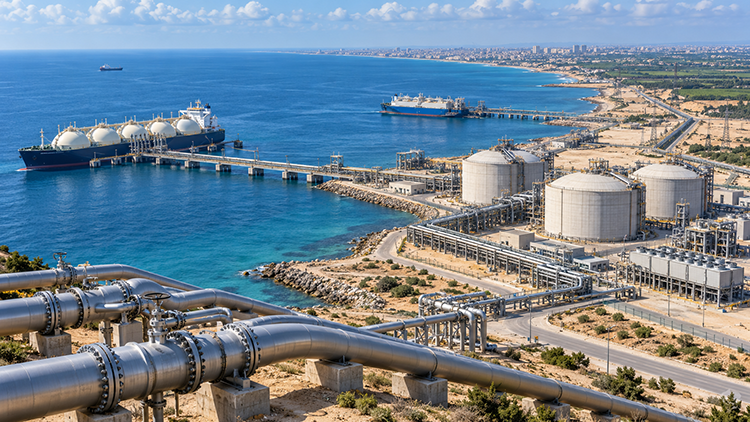
Damietta and Idku form the backbone of Egypt’s LNG export system. The Damietta LNG plant has a liquefaction capacity of about 5 million tons per year (mt/y), while Idku’s two trains together provide roughly 7.2 mt/y.
The potential of the LNG plants depends on reliable feed gas. Tharwat Hassane, Petrophysical Advisor and Operational General Manager at Sahara Oil and Gas Company, told Egypt Oil and Gas (EOG) that “the potential to increase LNG exports therefore depends primarily on securing sufficient and reliable feed gas.”
Allowing third parties to access the terminals, where commercially and contractually feasible, could also help optimize utilization of full capacity, Hatem Mahmoud, Energy Expert, told EOG.
Reinforcing the importance of an integrated approach, Mohamed Mahmoud Ateya, Projects Director of Oil and Gas Projects Management at Egyptian Natural Gas Company (GASCO), said, “the LNG plants should be viewed as part of an integrated regional system linking offshore fields, pipelines, processing facilities, the national gas grid, and export terminals.”
Pipelines: Connecting the Region
Pipelines provide the physical link between production, processing facilities, LNG plants, and consumers. Egypt’s national gas network transmitted approximately 2,300 billion cubic feet (bcf) of gas during 2025, according to GASCO, while infrastructure connecting FSRUs to the national gas grid and compression capacity has also expanded.
Egypt’s regional connectivity also builds on established infrastructure such as the Arab Gas Pipeline (AGP), which has provided a corridor for transporting Egyptian natural gas to Jordan and, through the wider network, to Syria and Lebanon. The pipeline remains part of Egypt’s regional gas cooperation, with the Ministry following up in 2026 on a gas-supply agreement with Syria through the AGP.
At the same time, new cross-border connections are being developed to bring Eastern Mediterranean gas into Egypt’s existing infrastructure. Under the Cronos development plan, gas from the Cypriot field is planned to be transported to Egypt, processed through the Zohr facilities, and then transferred to the Damietta LNG plant for liquefaction and export. The Ministry has similarly highlighted the planned connection of Cyprus’ Aphrodite field to Egyptian infrastructure, with the project intended to support the processing and re-export of Cypriot gas through Egypt. The Ministry has described the Cronos and Aphrodite projects as important components of Egypt’s efforts to maximize its existing infrastructure and strengthen its role as a regional gas hub.
Ateya said future growth would depend on more than the overall size of the network. “What matters increasingly is system flexibility, available capacity, hydraulic performance, compression capacity and the ability to manage changing flow patterns,” he said.
He further emphasized that increasing cross-border flows would require “targeted looping and pipeline reinforcement, additional or upgraded compressor stations, advanced SCADA and leak-detection systems, and greater operational flexibility.”
Flexibility for Gas Supply
While LNG terminals provide export capacity, FSRUs provide flexibility on the import side. Egypt currently operates four FSRUs – three at Ain Sokhna and one at Damietta – with combined regasification capacity of approximately 2.7 billion cubic feet per day (bcf/d).
The units receive imported LNG, regasify it, and inject gas into the national grid, supporting power generation, industry, and other consumers. Their importance has increased with seasonal electricity demand, which exceeded 40,000 megawatts during summer 2025. The Ministry highlighted FSRUs as part of efforts to secure gas supplies during peak-demand periods.
Turning Oil Into Value
The expansion of the Middle East Oil Refinery (MIDOR), Egypt’s flagship modern refinery located in Alexandria, has raised operating capacity to 160,000 b/d, with the upgraded facility producing Euro 5-compliant products and supplying around 17%-20% of Egypt’s diesel and gasoline requirements. The Assiut National Oil Processing Company (ANOPC) complex for diesel and high-value petroleum-products, reached around 90% completion by September 2026, with start-up targeted for the first quarter of 2027.
In 2026, refinery operating rates increased to more than 80%, while the Ministry upgraded crude and petroleum-product pipelines and expanded storage capacity. The strategy aims to increase value-added processing, reduce the import bill, and support Egypt’s development as a regional petroleum-product trading center.
Hassane stressed the need to combine downstream investment with stronger domestic production: “The most effective model is an integrated approach that increases domestic production, maximizes processing and refining efficiency, and ensures flexible infrastructure to move energy efficiently from production to demand centers.”
Mahmoud similarly emphasized the importance of aligning infrastructure expansion with supply availability, saying, “Reliable gas supplies are essential to maximize existing capacity, while future expansion should be aligned with new gas availability to ensure efficient and sustainable investment.”
From LNG to Pipelines, One System
Looking ahead, Egypt’s hub ambitions will increasingly depend on integrating LNG terminals, cross-border pipelines, FSRUs, the national gas grid, refineries, and petroleum-product logistics.
“I believe the next stage should focus on integration rather than individual projects,” said Hassane, noting that some parts of today’s natural-gas infrastructure may potentially support future hydrogen or hydrogen-blended gas transportation.
Ateya adopted a similar view, emphasizing that “a regional energy hub must be capable not only of receiving energy, but also of processing, transporting, storing, liquefying and exporting it efficiently.”
The development of Cyprus’ gas resources could test this model. If Aphrodite and Cronos progress as planned, Egypt could increasingly serve as a processing and liquefaction platform for Eastern Mediterranean gas, while FSRUs provide flexibility when domestic supply is insufficient.
Commercial arrangements will also influence future infrastructure. Mahmoud agreed on the importance of linking infrastructure expansion with secure gas supplies, saying expansion should be “considered in conjunction with long-term gas supply contracts to ensure reliable feedstock, improve utilization rates, and strengthen the economics of both operation and investment.”
Assets united, energy amplified
Beyond gas infrastructure, Hassane also highlighted the need for deeper downstream integration. “Looking ahead, Egypt should focus on integrated refinery-petrochemical complexes and consider fuel-oil-to-diesel units at SOPC and NPC to maximize value from every molecule processed, while expanding and upgrading refining capacity,” he said.
At the regional level, Mahmoud also highlighted that “Egypt should focus on strengthening regional interconnections with neighboring countries such as Saudi Arabia and Libya to enhance flexibility, security of supply, and energy cooperation.”
The infrastructure agenda may also increasingly intersect with the energy transition. Extending this integration beyond conventional oil and gas infrastructure, Mahmoud said, “infrastructure and regulatory frameworks should be prepared to accommodate emerging energy sources, including hydrogen, biomethane, and other renewable gases.”
Ultimately, Egypt’s position as an Eastern Mediterranean energy hub will depend not only on gas resources, but on its ability to connect, process, transport, import, liquefy, and export energy through an integrated infrastructure network.
Ateya summed up this proposition by saying “Egypt’s greatest advantage is not any single pipeline, refinery or LNG terminal. It is the ability to integrate these assets into one flexible energy system.”