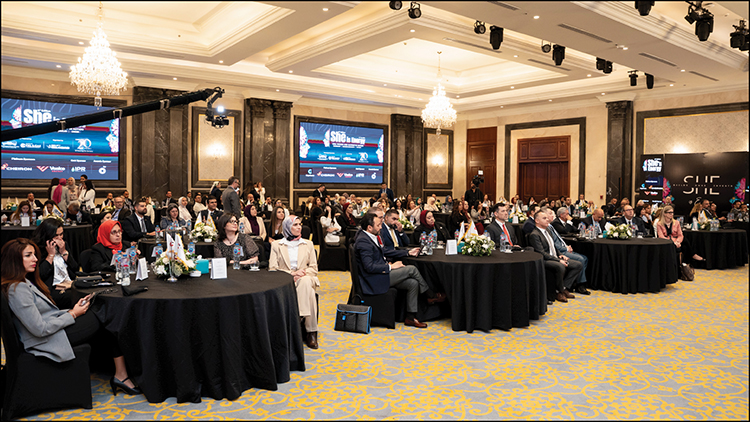
In a sector navigating a difficult energy transition amid global uncertainty, tapping the full breadth of the talent pool has become essential for resilience and growth. Against this backdrop, this year’s She Is Energy event delivered a clear and timely message: gender inclusion in oil and gas is no longer a side issue or a symbolic gesture, it is central to the industry’s future.
Organized by Egypt Oil & Gas (EOG) and the Egypt Women in Energy Network (EWiEN), and EOG committee, the fifth edition of the She Is Energy seminar established a core truth: building an inclusive industry is fundamentally inseparable from building a competitive one.
The 2026 edition carried the theme “Men, Women and Allyship in Action,” and that framing was reflected throughout the day’s discussions. Rather than approaching gender inclusion as a women-only issue, the event positioned it as a shared responsibility that requires engagement from all sides of the industry. Across two high-level executive panels and a landmark awards ceremony, and senior multinational operators repeatedly returned to a central idea: organizations become stronger when they make room for different voices, develop talent more deliberately, and create leadership pathways that are visible and accessible.
When industry conversations stop at broad statements of support, they fail to impact the corporate balance sheet. By contrast, when diversity is reframed from an administrative metric into a strong business tool, the effect is transformative. When company leaders focus on developing all their talent, the whole organization runs better. Nicolas Katcharov, CEO of Energean International and Country Manager for Egypt, reinforced this strategic baseline by linking inclusivity directly to institutional health and real progress.
“Supporting and empowering women is not only the right thing to do, but also essential for stronger organizations, better leadership, and real progress,” Katcharov noted. “Women should be recognized and given opportunities based on their talent, capability, and potential to lead and succeed.” The seminar underscored that treating people fairly and hitting production targets are deeply intertwined.
Moving Beyond Advice to Active Executive Sponsorship
The transition from a passive supporter to an active corporate sponsor is what separates intention from impact. During the discussions, leaders explored how executive teams can move past static workplace policies to construct active pathways that allow women to step into leadership with confidence. A critical component of this transition involves addressing the “sponsorship gap.” While mentorship offers valuable advice, intentional sponsorship provides the institutional backing required to place female professionals into key decision-making roles.
This point was underscored by Heba Rezk, Regional Manager of Eastern Mediterranean (EMED) Gas Marketing at Chevron, who outlined how intentional sponsorship translates from concept into practice. Rezk outlined the mechanics of this deliberate strategy during the discussion explaining that, “the most impactful support comes when leadership is intentional about sponsorship; creating visibility, advocating at key moments, and backing potential,” Rezk emphasized. “When done consistently, it broadens opportunity and reshapes expectations of who leads.”
This structural shift directly counters the industry tendency to isolate female talent within corporate silos. Amr Abou Eita, Chairman and Managing Director of ExxonMobil Egypt, addressed this dynamic directly, identifying the lack of upward mobility into core operational spaces as a critical vulnerability for the sector. “One of the clearest barriers to Females’ advancement in leading roles is the absence of role models,” Abou Eita observed. “We must ensure we have women in the right positions to break the pattern that confines female talent to traditional roles such as HR and administration.”
Asserting this idea, Hany Esmat, Country Chair & CEO of PETRONAS Egypt, shared that diverse leadership directly improves corporate collaboration and the quality of business decisions, stating that “allyship is not defined by intention alone , it is measured through action, accountability, and genuine commitment,” Esmat stated. “It starts with building a culture where every voice feels safe, valued, and empowered to speak up. True representation cannot exist when women are absent from the decision-making table.”
Overcoming Legacy Barriers
Expanding access also means enabling women to move beyond traditional comfort zones and transition directly into frontline engineering roles, industrial plants, and remote concession zones. Khaled Gad, General Manager & Managing Director of Rashid Petroleum Company (Rashpetco), highlighted how adjusting operational frameworks can successfully integrate talent into field operations, stating that “allyship is about helping women unlock their potential, master their skills, and step beyond their comfort zone”. He noted that he has seen women make the transition from office to site for the first time when the right engagement and family arrangements are in place, making it leadership’s role to help them recognize their potential and take that step with confidence.
Commenting on the same idea, Eleanor Rowley, Managing Director for Egypt at Capricorn Energy PLC, highlighted that businesses perform better when women are in the room, reflecting that many leaders are consciously taking steps to open doors, create opportunities, and improve access for their female colleagues. She added that, “I was genuinely encouraged by how many senior male leaders stepped forward to share their perspectives on male allyship, and importantly, on how to actively sponsor women to reach their full potential,” Rowley reflected after the sessions. ”
A Strategic Vision for the Future
As the seminar drew to a close, the evening concluded with a formal dinner. Delivering the final remarks of the event, Mohamed Fouad, CEO of Egypt Oil and Gas and EOG Committee Co-Chairman, brought the conversation back to the industry’s long-term outlook.
“She Is Energy is part of a larger mission,” Fouad stated during his pre-dinner address. “It is not a side event. It is a strategic statement — that building an inclusive industry is not separate from building a competitive one. They are the same thing.”
The insights gathered at the 2026 summit show that building a resilient energy economy requires an industry-wide refusal to relegate female talent to non-operational roles. She Is Energy 2026 has provided a clear roadmap for the modern energy market to trust diverse leadership teams to drive the industry forward.