The 9th edition of the Egypt Energy Show (EGYPES 2026), held in Cairo from March 30 to April 1, unfolded at a defining moment for the global energy landscape. With the Strait of Hormuz disrupted and regional energy infrastructure under strain, markets were already reacting to supply shocks and surging prices, creating an atmosphere where urgency replaced routine dialogue. Against this backdrop, EGYPES 2026 became a critical platform not just for exchange, but for strategic alignment in the face of mounting uncertainty.
Anchored by the theme “Transforming Energy Through Collaboration, Action and Realism,” the conference reflected a decisive shift in how the industry approaches its most pressing challenges. The prevailing narrative moved beyond conventional transition pathways toward a more grounded and immediate framework, one that recognizes the constraints of a fragmented and volatile world. Discussions throughout the event highlighted the growing consensus that energy systems must evolve through expansion rather than substitution, integrating diverse sources to meet rising demand while safeguarding stability.
This shift toward what many termed “energy addition” was one of the defining features of EGYPES 2026. This approach aims to address projected demand growth, particularly across Africa and the Mediterranean, while maintaining momentum toward long term sustainability goals.
Three interconnected priorities shaped the discussions. Energy security emerged as an immediate and enduring concern, underscored by warnings of severe price volatility if supply routes and infrastructure remain vulnerable. Alongside this, the concept of energy addition reframed the pathway forward, emphasizing the need for inclusive growth in energy supply to support development and resilience. The third pillar, sustaining low cost supply, reflected the mounting pressure on economies, particularly in developing regions, to access reliable and affordable energy as a foundation for stability.
The event bridges acted as bridge for the gap between the high-level diplomatic warnings of heads of state and the technical breakthroughs shared by industry CEOs. By merging regional cooperation frameworks, such as the landmark Egypt-Cyprus agreement, with localized industrial strategies and the rapid integration of Artificial Intelligence, EGYPES 2026 has provided a credible, realistic roadmap for an industry navigating a volatile decade.
Energy Security in a Volatile World
In an era defined by intensifying geopolitical volatility and increasingly fragile global supply chains, the development of integrated and resilient energy systems has transitioned from a technical goal to a cornerstone of national security. The EGYPES 2026 served as a critical platform for this urgent dialogue, emphasizing that the “new normal” for the energy industry requires a trifecta of collaboration, diversification, and immediate, decisive action to ensure stability in an unpredictable global landscape.
The urgency of this mission was underscored during the opening ceremony by President Abdel Fattah El-Sisi, who issued a stark warning regarding the physical and economic vulnerability of the global energy grid. The President linked regional stability directly to the global wallet, stating: “I am afraid that the attacks on energy plants, whether it is production or the existing grid, will have a very serious impact on the global economy and on the prices of fuel, which may be more than $200 per barrel.”
This warning provided the essential context for the subsequent strategic sessions. In the context of the ongoing regional conflict, energy infrastructure has become a primary target. Consequently, “resilience” cannot just be a corporate buzzword; it must be a physical and financial reality. This high-stakes reality bridges the gap between high-level policy and the ground-level priorities outlined by energy ministers. Reinforcing this, Egypt’s Minister of Petroleum and Mineral Resources, Karim Badawi, explained that for a nation of over 100 million people, energy security requires a “full ecosystem” approach. He noted that geopolitical pressures are currently reshaping energy flows across the Mediterranean, requiring Egypt to double down on local production, expand refining and petrochemical capacity, and aggressively cut reliance on imports. “It’s about creating an infrastructure that ensures energy flows where it’s needed most,” Badawi added, framing partnerships as the ultimate tool for navigating geopolitical uncertainty.
Khaled Abu Bakr, TAQA Arabia Chairman and Vice President of the International Gas Union (IGU), sharpened the point, arguing that the sector is navigating a security driven crisis that has made energy logistics both difficult and costly, rather than a deficit in actual supply. “Gas remains a critical energy source with the technology to move globally. What we face today is a security crisis, not an energy one—yet its repercussions cut deep across the sector and the entire value chain.”He added.
From a regional perspective, the dialogue shifted toward the practical hurdles of Mediterranean cooperation. Houda Ben Jannet Allal, General Director of the Mediterranean Observatory for Energy and Climate (OMEC) ,a key regional organization tasked with fostering cooperation between energy stakeholders, highlighted a persistent gap between political ambition and actual implementation. While there is a strong consensus on the need for regional unity, Allal noted that the market is still waiting for tangible progress. “What we are missing is implementation. What we need now is to move from these MOUs into concrete, bankable projects,” she stated. She clarified that the global investment community is not short on capital; rather, it is short on structured, “de-risked,” and finance-ready opportunities. In her view, the true metric of cooperation is the condition of implementation, not the initial intention.
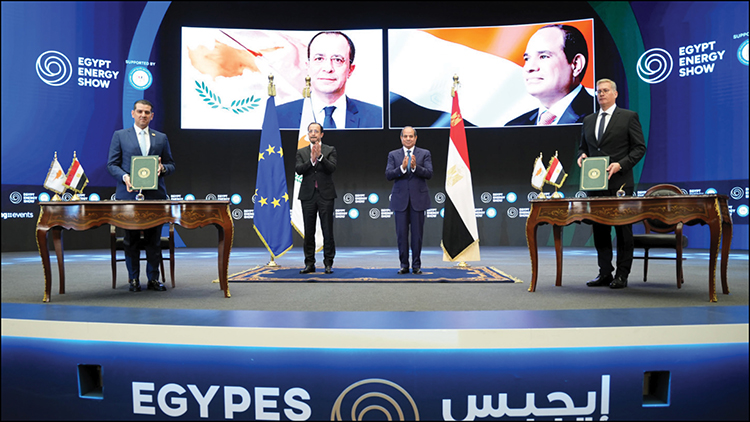
Cyprus provided a unique case study in energy resilience. As an island nation, Cyprus faces “unique constraints” because it is an “energy island”—it is not currently connected to the mainland European or Middle Eastern power grids. This geographical isolation means that any disruption in fuel supply or grid stability could be catastrophic. Michael Damianos, the Cypriot Minister of Energy, Commerce, and Industry, explained that Cyprus is navigating this by prioritizing a mix of renewables—predominantly solar—balanced with natural gas integration. By expanding storage and advancing subsea interconnection projects, Cyprus aims to end its isolation and secure a stable, diversified energy future. A major milestone in this effort was the signing of a Framework Agreement between Egypt and Cyprus at EGYPES, which establishes the commercial principles for selling Cypriot hydrocarbons to Egypt, effectively paving the way for the commercialization of Cyprus’s offshore resources.
At the European level, the 2022 energy crisis remains the primary teacher, now exacerbated by the current regional volatility. Ditte Juul Jørgensen, Director General for Energy at the European Commission, reflected on how a high degree of dependence on a single supplier proved to be a significant risk to both EU security and its economy. The East Mediterranean has since emerged as a critical partner in the EU’s diversification strategy, providing a new corridor for LNG and piped gas that reduces the risk of future supply shocks.
Industry leaders emphasized that navigating these crises requires a total reassessment of long-term strategy. Abdulkarim Almaazmi, CEO of Dragon Oil, urged the sector to revisit business continuity plans, while Maurizio Coratella CEO of McDermott International pointed to the sheer scale of the opportunity. With Europe consuming 320 billion Cubic meters (bcm) of gas per year, the unlocked resources of the Eastern Mediterranean represent the most logical solution to the continent’s energy deficit. Ultimately, the Technical Conference, which showcased the engineering breakthroughs—from autonomous operations to smart exploration—that make these high-level goals possible. Together, these perspectives reinforced a singular, clear message: energy security in a volatile world depends on the ability to turn high-level ambition into rapid, cost-effective, and collaborative action.
The Realistic Path of Energy Addition
The discussions at EGYPES 2026 provided a sobering look at the realities of global energy demand, investment, and the strategic pathways toward a resilient energy future. A singular, recurring theme resonated throughout the sessions: the world does not simply need a different kind of energy; it needs more energy, derived from more sources, delivered with higher levels of responsibility.
The dialogue underscored a fundamental shift in industry philosophy. The energy transition is no longer being viewed as a binary “either-or” switch from hydrocarbons to renewables. Instead, leaders advocated for an integrated process of “Energy Addition” coupled with aggressive decarbonization. This approach acknowledges that to meet the soaring global demand, the world must expand clean energy sources while simultaneously reducing the carbon footprint of existing oil and gas assets. In this framework, growth and sustainability are not competing interests—they are advancing together.
This reality is felt most acutely in specific national contexts. Michael Damianos, the Minister of Energy, Commerce, and Industry of Cyprus, highlighted the inherent vulnerabilities of his nation. “Energy leaders must secure supply, yet renewables remain intermittent. We need round the clock electricity, so our priorities are clear: integrate natural gas within two years and invest heavily in storage to fully harness solar potential.” For Cyprus, energy addition means balancing immediate reliability with longer-term flexibility through a mix of gas, storage, and regional interconnections.
Expanding the lens to a global level, Olivier Le Peuch, CEO of SLB, noted that every nation’s energy choices are dictated by its unique resource wealth and sovereign policies. He distinguished between the “energy addition” path—where hydrocarbons and renewables grow in tandem—and a narrow “energy transition” path that seeks to choose one over the other. Le Peuch argued that technology is the indispensable bridge that makes these diverse energy systems efficient and resilient.
Lorenzo Simonelli, Chairman and CEO of Baker Hughes, reinforced this pragmatic outlook. “The transition is not an either-or equation; it is an ‘and’ reality,” Simonelli noted. “Multiple energy systems will need to coexist, and the real challenge is execution. We are currently in an ‘energy demand decade,’ both in the developing and developed worlds. You cannot simply flip a switch from hydrocarbons to renewables; it is a gradual shift.” Crucially, Simonelli pushed back on the idea of gas as a temporary bridge. “Natural gas is not just a transition fuel—it is a destination,” he argued, citing its abundance, lower costs, and significantly lower emissions profile. His emphasis on execution serves as a reminder that while the vision for a green future is essential, the reality of the 2020s and 2030s is one of coexistence.
The conversation turned toward the unique challenges of the African continent, where the conversation about emissions often clashes with the reality of energy poverty. Sara Elhag, Head of the Energy Division at the African Union Commission, offered a powerful perspective on the ethics of the transition. She argued that it is unreasonable to discuss the next phase of the energy transition solely through the lens of emission reductions when 600 million people in Africa still lack basic access to electricity. For Africa, energy addition is a matter of social and economic justice.
Dele Kuti, Global Head, Energy & Infrastructure, Standard Bank Group added that achieving this addition requires a total reimagining of financial structures. He noted that scaling renewables in developing markets is as much about “financial architecture” as it is about technology. “No single institution can do this alone,” Kuti explained. “It requires commercial banks, development finance institutions (DFIs), multilaterals, and insurers working together to structure risk and unlock the capital necessary for the continent’s growth.” Finally, Manuel Coxe, Secretary General of MARCOGAZ, the technical association of the European Gas Industry, reminded the audience that transition strategies must be grounded in local infrastructure. “What really matters is how we generate energy, transport it, distribute it, and how efficiently we use it,” Coxe noted adding “This transition will not look the same everywhere.”
Sustainable Growth through Innovation and Value Addition
In a volatile energy market, managing operational costs in oil and gas projects is critical for long-term viability. Industry leaders at EGYPES 2026 focused on resilience and technological innovation as the primary drivers to maintain profitability amidst global fluctuations and high capital expenditures (CAPEX).
Adriano Mongini, CEO for Drilling and Sonsub at Saipem-Italy’s premier global oilfield services major-emphasized the importance of adaptability in delivering complex offshore projects. Speaking on behalf of the contracting and service sector, Mongini stated: “Over the last five years, global developments have heavily impacted the contracting sector, both financially and operationally. We must become more resilient by reducing costs, investing in technology, and delivering exactly what the operator requires. Our role is to serve the operator by offering integrated solutions that reduce both costs and the time to market.”
Strategic solutions can also significantly reduce CAPEX in onshore operations. A prime example is the strategy implemented by National Energy Services Reunited Corp. (NESR) at Saudi Arabia’s Jafurah field. Sherif Foda, Chairman and CEO of NESR, shared his perspective on the critical role of cost competitiveness and supply chain transformation in unconventional gas fields. “The cost curve must come down; you cannot continue to increase supply chain costs as technical complexity grows,” Foda explained. “We initiated a supply chain transformation to lower costs and enable customers to produce oil and gas more economically. A key example is Saudi Arabia’s unconventional Jafurah field, where we challenged the stereotype that Middle Eastern unconventional fields cannot compete with the United States. Today, Jafurah is more cost-effective than the Permian Basin in the U.S., and costs have decreased by approximately 90% since initial exploration. That is how we broke down the cost curve and enabled large-scale development to happen.”
Despite regional geopolitical volatility, a global consensus remains :natural gas is a cornerstone of the energy landscape. Nicolas Katcharov, CEO of Energean International, highlighted the significant imbalances governing global gas markets, noting a contrast between European markets—where high energy pricing is stifling industrial demand—and nations like Egypt, where gas is often underpriced. “We must find a balance between these two extremes through smarter policies and increased regional cooperation,” Katcharov stated.
Mohamed Shindy, Managing Director of Methanex Egypt, stressed that natural gas delivers its real economic value when used as feedstock for downstream industries. “Exporting raw gas is the least profitable option. Its true worth comes when it fuels industries that create secondary products. Localizing these value added sectors generates 2.5 to 3 times more value than direct exports.” He pointed to Egypt’s methanol sector as proof, with output rising from 20,000 to 200,000 tons per year over 15 years, supplying formaldehyde for the furniture and housing industries.
Artificial Intelligence Takes the Controls
Sessions at EGYPES 2026 also highlighted the transformative impact of Artificial Intelligence (AI). Ahmed Zahed, Division Manager of Digital & Innovation at SLB, illustrated a shift where AI is moving from a passive advisor into an active operator. “It’s not just about providing a recommendation; these AI platforms are now capable of taking direct action. They identify bottlenecks and implement solutions immediately,” Zahed explained. He cited results from the Shaya field in Ecuador, where AI-powered workflows reduced tasks that once took days down to mere minutes, while significantly improving safety via real-time monitoring.
As AI adoption accelerates, industry leaders addressed concerns regarding job displacement, stressing that AI will reshape roles into more sophisticated positions requiring collaboration across data science and engineering. Experts urged youth to build relevant skills early through internships and specialized courses. “By 2030, we aim to have 30,000 specialized AI experts qualified by the government,” said Ahmed Hefnawy, AI Governance Expert at the Egyptian Center for Responsible AI. To ensure this deployment is responsible, leaders stressed the need for robust governance frameworks, secure-by-design systems, and constant monitoring to protect sensitive industrial data. Across every session, the message was clear: energy security and sustainability in a volatile world depend on the ability to turn high-level technological ambition into rapid, cost-effective action.
EGYPES 2026 drew to a close on April 1 after three days of intense dialogue on the energy trilemma—security, affordability, and sustainability. Across more than 100 high level sessions spanning the Strategic and Technical Conferences, the summit expanded its horizons with the launch of the Innovation & AI Hub and specialized Pitch Competitions, spotlighting digital breakthroughs and startups driving efficiency across the energy value chain.
The show also celebrated the sector’s pioneers through the EGYPES Energy Awards, honoring visionary efforts that are shaping a sustainable future. Yet the undisputed highlight was the unforgettable Gala at the breathtaking Grand Egyptian Museum, a fitting finale that underscored EGYPES’ stature as not only a forum for policy and technology but also a showcase of Egypt’s cultural heritage.
EGYPES 2026 thus concluded as more than a conference—it stood as a strategic assembly bridging innovation, recognition, and diplomacy, reinforcing Cairo’s role at the heart of the global energy conversation.