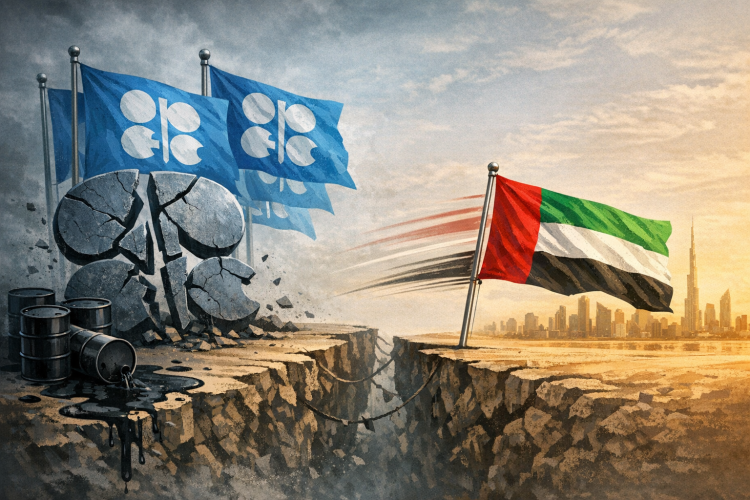
The United Arab Emirates (UAE) has officially left the Organization of the Petroleum Exporting Countries (OPEC) after almost six decades of membership, ending on 1 May 2026. This move is a watershed in global energy politics, foreshadowing the unraveling of OPEC’s cohesion and the emergence of a more fractured, competitive oil market.
The exit of one of OPEC’s most disciplined producers from the group sets the stage for new trajectories in oil supply and pricing, whether gradual adjustments or aggressive expansions, with profound implications for global markets.
The result is a landscape of greater volatility, more dramatic swings, and less collective power.
111 Billion Barrels in Play
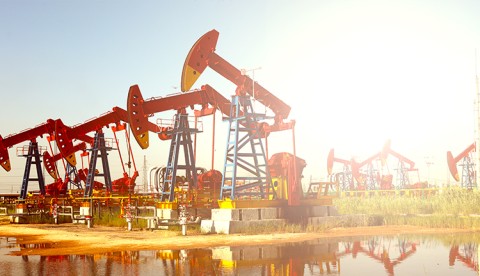
The UAE holds 111 billion barrels of proven reserves, according to the US Energy Information Administration (EIA), and has steadily increased production to around 3.4 million barrels per day (mmbbl/d).
UAE -through its stated owned company- Abu Dhabi National Oil Company (ADNOC), has ambitions to increase output reach 5 mmbbl/d by 2027. Roughly 80–90% of its crude output is exported to Asia, making it a critical supplier in global trade flows.
Within OPEC, the UAE ranked fourth in production after Saudi Arabia, Iraq, and Iran, accounting for 11.4% of OPEC’s total output, or 3.1 mmbbl/d in 2025, according to OPEC data. Its exit, therefore, removes one of the cartel’s most significant spare-capacity holders.
Reasons to Say Goodbye
The decision was driven by a combination of economic, geopolitical, and fiscal factors. As Salah Hafez, former Vice Chairman of the Egyptian General Petroleum Corporation (EGPC), tells Egypt Oil & Gas, OPEC’s quota system is inherently flawed; based on reserves, capacity, or political bargaining, it often penalizes members with spare capacity. The UAE, having invested heavily in ADNOC’s $150 billion expansion program, grew frustrated with ceilings that left 1.5–2 mmbbl/d of unused capacity.
The UAE has invested heavily in production capacity, wants greater freedom to monetize that capacity, and has increasingly viewed OPEC+ quotas as too restrictive for its national energy strategy, according to Eitan Charnoff, Founder and CEO of Potomac Strategy, a GCC-based geopolitical and public affairs firm.
Meanwhile, Hamzeh Al Gaaod, MENA Independent Economist, highlights that “greater output flexibility may help offset slowdowns in sectors such as tourism, trade, and real estate while maximizing hydrocarbon revenues and capitalizing on market-disruption opportunities after the Strait is fully open.”
Another reason driving the UAE’s decision is fiscal divergence. The UAE’s breakeven oil price is around $45 per barrel, far lower than Saudi Arabia’s $88 per barrel, giving it room to pursue high-volume sales without jeopardizing fiscal stability, according to the International Monetary Fund (IMF) data. Additionally, regional security tensions and strained GCC coordination pushed the UAE to seek autonomy in energy policy.
The Iran war and disruption in the Gulf and Strait of Hormuz appear to have created the perfect moment for Abu Dhabi to act unilaterally, according to Charnoff.
In public remarks, senior UAE presidential adviser Anwar Gargash, criticized Gulf allies for their “weak” military and political response to Iranian attacks during the Israel‑US war on Iran, highlighting the UAE’s disappointment with the Gulf Cooperation Council’s stance.
The UAE is essentially saying: in a world where security considerations are now paramount, it cannot subordinate national decision-making to any external parties, Charnoff told Egypt Oil & Gas.
“I believe the UAE’s move away from OPEC was inevitable, but the US–Iran confrontation likely influenced the timing of the UAE’s decision, but I would not reduce the decision to the war alone by any means.” He added.
Fears of Oversupply, Price Wars
The UAE’s departure introduces several possible scenarios. The first is the gradual adjustment, with output rising slowly to ~4.5 mmbbl/d, with informal coordination continuing, according to Reuters. Thus, Prices face moderate downside pressure, but volatility remains manageable.
The second course is a delayed supply as logistics or geopolitical risks delay expansion, supporting prices in the near term. Meanwhile, the UAE ramps up aggressively, triggering oversupply dynamics and potential price wars.
In the long term, some believe the UAE’s exit from OPEC to be a sustained move toward non-coordinated supply, leading to structurally lower prices and persistent volatility.
However, Salah Hafez warns, the UAE’s exit from OPEC “will destabilize the market; prices will swing up and down.”
He adds that being the largest producer and consumer of oil, the US will play a bigger role: It can impose arbitrary sanctions, increase production, and ramp up shale oil output, causing prices to fluctuate sharply in the coming period.
Ripples Across Oil Markets
The UAE’s exit erodes OPEC’s spare‑capacity buffer, weakening its ability to steady markets in crises and setting a precedent for quota‑bound members like Iraq or Nigeria. Al Gaaod warns that wider fragmentation could make oil pricing resemble that of Gas —less centralized, more volatile, and highly sensitive to short‑term shifts.
Near‑term price effects remain limited, as dynamics are dominated by disruptions in the Strait of Hormuz. Charnoff notes the market’s immediate fear is supply interruption, not oversupply, with war risk and restricted flows supporting prices.
Medhat Youssef, Former EGPC Vice President and Petroleum Expert adds that the impact will only be felt once conditions normalize, when OPEC can counter UAE output by trimming quotas.
Longer term, the exit further dilutes OPEC’s influence, already weakened by surging US production above 13 mmbbl/d compared to Saudi Arabia’s pre‑war 10 mmbbl/d.
Charnoff cautions the real shock will come when Hormuz reopens and the UAE is unconstrained by OPEC+. Hafez underscores the instability, citing a global shortfall of 13 mmbbl/d and recalling OPEC’s historic cycles of control, collapse, and reinvention. Until balance returns, he expects repeated swings in prices and sanctions.
Impact on Egypt
For Egypt, an oil importer, the impact depends on price direction, according to Hafez. Lower import costs ease pressure on foreign reserves and improve the current account, while higher energy costs fuel inflation, strain subsidies, and widen the trade deficit.
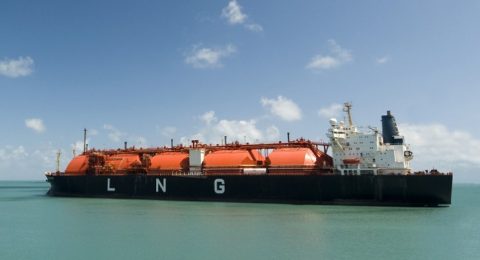
In terms of natural gas, Youssef points out that “the UAE’s withdrawal has no impact on Egypt’s natural gas export receipts, since the UAE’s production and exports of liquefied natural gas are not governed by decisions of international organizations. However, natural gas prices are linked to global oil price fluctuations, as gas is considered an optimal substitute for certain uses of oil derivatives such as diesel and fuel oil, and partially for gasoline and butane.”
Meanwhile, “foreign companies’ investments in Egypt and other countries are primarily tied to global oil and natural gas prices: higher prices serve as a strong incentive for foreign companies to invest in exploration and production, while lower prices have the opposite effect,” according to Youssef.
The UAE’s departure from OPEC is more than the end of a long membership; it is a decisive break that reshapes the foundations of global oil governance. Abu Dhabi has abandoned the quota system, paving the way for a future where national strategies are more important than collective discipline, and OPEC’s ability to stabilize markets is reduced.
In the short term, Gulf disruptions may mask the impact, but when conditions normalize, the absence of coordinated restraint will be felt in the form of sharper price swings, increased volatility, and a more competitive supply landscape. The UAE’s move signals a broader reordering of energy politics: authorities are diluting, market control is breaking down, and the influence of outside players, notably the United States, is likely to grow. This new era will require greater resilience from both producers and importers as the boom-and-bust cycles become more frequent and less predictable.