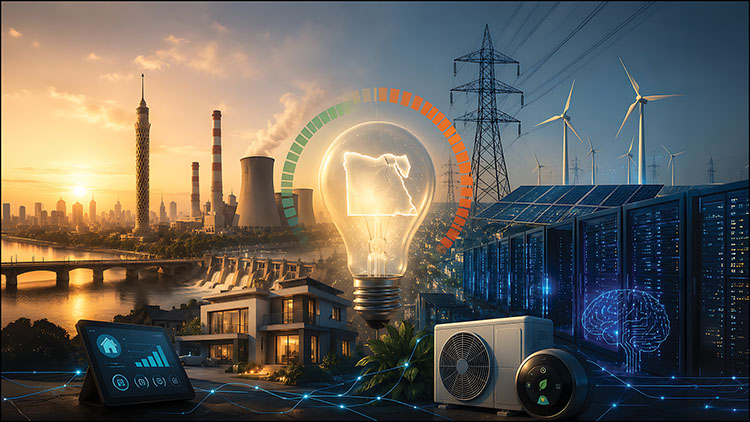
Dynamic growth in electricity demand continues to reshape the global energy system. According to the International Energy Agency’s (IEA) World Energy Outlook 2025, electricity will play an increasingly important role in meeting future energy needs, driven by the rapid expansion of renewable energy. At the same time, artificial intelligence (AI), data centers, rising temperatures, and urbanization are accelerating electricity consumption, with cooling emerging as one of the fastest-growing sources of demand, particularly in emerging economies. The IEA projects global peak electricity demand could increase by around 40% by 2035, largely due to higher cooling requirements.
For Egypt, where summer peaks already strain the grid and swallow billions of dollars in imported liquefied natural gas, electricity generation remains the single largest consumer of natural gas. In this context, improving efficiency is no less critical than expanding capacity. Smarter technologies and sharper energy management can ease the burden, helping the grid withstand demand surges while reducing the country’s costly dependence on imported fuel.
Passive Cooling
Buildings account for around 30% of global final energy consumption, according to the IEA, with cooling, heating, lighting, and household appliances representing the largest share. Electricity use for space cooling has more than tripled since 1990 and is expected to continue rising as temperatures increase.
This trend is particularly relevant for Egypt, where prolonged heatwaves have driven higher summer electricity demand. Egypt Vision 2030 identifies energy efficiency as a key pillar of sustainable development, while the Ministry of Electricity and Renewable Energy continues to promote demand-side management to enhance grid reliability and support the country’s energy transition.
Reducing the need for air conditioning is one of the most effective ways to improve energy efficiency. According to the World Economic Forum (WEF), passive cooling relies on building materials and design techniques that reduce heat gain without consuming electricity.
Emerging solutions include radiative cooling materials that reflect sunlight while releasing heat into the atmosphere, phase-change materials (PCMs) that absorb heat during the day and release it at night, and hydrogel-based materials that provide evaporative cooling. Established approaches, such as cool roofs, reflective coatings, insulation, natural ventilation, external shading, and green roofs, also lower cooling demand, improve indoor comfort, and reduce electricity consumption.
Inverter Air Conditioners (AC): The Biggest Opportunity
Among household technologies, inverter air conditioners offer one of the greatest opportunities to reduce electricity consumption. Unlike traditional air conditioners that constantly turn their compressor on and off, inverter ACs automatically speed up or slow down to keep your room at a steady temperature. This smooth, continuous adjustment saves power, reduces wear and tear, and keeps the unit running much more quietly.
The IEA considers high-efficiency inverter ACs among the most effective technologies for limiting future cooling demand, helping households reduce electricity bills while improving comfort.
However, technology alone is not enough. Mostafa Madbouly, an expert in Smart Grids, CCPP, and Intelligent Energy Systems at Petrojet, believes affordability remains the biggest obstacle.
“Inverter air conditioners save about 40% per unit, but nearly 60% of the Egyptian market is still using cheaper non-inverter models, so the main barrier is the upfront cost rather than the technology itself,” Madbouly said.
Behavior also plays a key role. Japan’s “Cool Biz” campaign promotes lighter clothing and higher thermostat settings during summer, while Spain and Italy adopted similar measures during the 2022 energy crisis. In Egypt, the Egyptian Electricity Holding Company (EEHC) requires manufacturers to display energy‑efficiency labels and meet minimum performance standards for air conditioners. Alongside these obligations, it also recommends consumer practices such as setting thermostats no lower than 25°C, carrying out regular maintenance, and keeping doors and windows closed while cooling.
Madbouly noted that thermostat policies work best where compliance can be monitored. “Japan’s Cool Biz campaign recommends a thermostat setting of 28°C, while Egypt already applies 25°C in shopping malls and public buildings. Such measures are most effective where compliance can be observed, rather than inside private homes,” he said.
Smart Meters: Modernizing Energy Consumption
Digital technologies are reshaping energy management. Smart meters provide consumers with real-time information while allowing utilities to monitor consumption remotely, improve billing accuracy, detect outages faster, and manage peak demand more effectively.
Countries including Italy, Spain, Sweden, and the UK have integrated smart meters into broader smart-grid strategies, supporting time-of-use pricing and greater consumer awareness. Egypt is also replacing conventional electricity meters with smart and prepaid digital meters. According to the International Trade Administration (ITA), around 12 million smart prepaid meters had been installed in Egyptian homes by mid-2025, moving toward the government’s target of replacing 38 million traditional meters.
Madbouly believes the rollout has already produced tangible benefits. ” The clearest results so far have been better billing accuracy, lower losses, and improved visibility for the grid operator. The next priorities are expanding the supporting data and communications infrastructure and introducing time-of-use tariffs that encourage consumers to shift their electricity consumption,” he said.
Smart metering can also improve natural gas efficiency. Attia Elsayed, General Manager of Technical Affairs and Business Development at Town Gas, believes upgrading Egypt’s gas metering infrastructure would reduce losses and improve resource management.
“Replacing outdated mechanical gas meters with modern smart meters would allow Egypt to recover large volumes of natural gas lost through declining measurement accuracy, while ensuring customers’ consumption is recorded with far greater precision,” Elsayed said.
He added “Equipping smart natural gas meters with AI would help eliminate gas losses resulting from unauthorized increases in consumption, theft, tampering, and manipulation of conventional mechanical meters, which lack the technological capabilities to detect or prevent such practices.”
Together, smart electricity and gas metering can strengthen operational efficiency and support Egypt’s wider digital transformation.
Smart Homes: Using Technology to Reduce Waste
Smart home technologies, including automated lighting, intelligent thermostats, and energy management systems,optimize electricity use based on occupancy and household habits. AI enhances this efficiency by tailoring cooling schedules to local weather patterns. Because air conditioning accounts for the largest share of summer electricity use, smart cooling controllers offer the greatest potential for low-cost, high-impact savings.
Globally, smart buildings are core to modern energy policy. Egypt is advancing this transition through its digital transformation agenda and the Ministry of Housing’s National Smart Cities Strategy, launched in October 2025 to accelerate intelligent building adoption.
Looking Ahead
Meeting Egypt’s future electricity needs will require more than expanding generation capacity. Improving efficiency across homes and buildings will be essential to lowering electricity consumption, reducing energy costs, and maintaining grid reliability.
Passive cooling, inverter air conditioners, smart meters, smart homes, and battery storage each address different aspects of the challenge. Together, they provide a practical pathway toward a more efficient, resilient, and sustainable electricity system.
Elsayed believes these efforts should be complemented by expanding distributed renewable energy. “Future plans should also promote the installation of rooftop solar photovoltaic systems on residential, commercial, and administrative buildings, while legislation should require all newly constructed residential, commercial, and industrial buildings to incorporate solar photovoltaic systems,” he said.
Supported by government policies, consumer awareness, and continued investment in renewable energy, these measures can help Egypt meet rising electricity demand while advancing Egypt Vision 2030 and strengthening the country’s energy security.