Egypt’s deepwater exploration is becoming increasingly important to securing future gas supplies, attracting investment, and reversing declining domestic production. Karim Badawi, Minister of Petroleum and Mineral Resources, said that the natural gas industry, particularly in the deepwater areas of the Mediterranean, requires substantial long-term investment for further exploration to replenish reserves and meet rising demand. With domestic production falling short of consumption, Egypt has been more dependent on imported gas for the last three years.
Deepwater exploration offers an opportunity to discover new resources and strengthen energy security. However, success will depend not only on making new discoveries but also on developing them into commercially viable projects. This will require advanced technologies, substantial investment, and competitive petroleum agreements that encourage international companies to take on the high costs and risks of deepwater exploration.
Unlocking the Mediterranean’s Potential
Egypt’s deepwater exploration is concentrated mainly in the Mediterranean Sea, where major discoveries have demonstrated significant gas potential and encouraged further investment. The Red Sea, by contrast, remains a less-explored frontier due to its limited geological data, complex tectonic structures, and challenging offshore conditions. Further seismic surveys and exploratory drilling are needed to improve understanding of its geological formations and determine whether they contain commercially viable oil and gas resources.
According to Ahmed Elsayed, Drilling Engineer at Cherion: “Egypt’s deepwater investment is longstanding but costs, geological complexity and commercial uncertainty constrained expansion”. He also noted that geological evidence from the Mediterranean generally points to natural gas as the main exploration target, with oil discoveries being less common. In contrast, the Red Sea has the potential to contain both oil and gas, with geological conditions more favorable to oil accumulation.
Zohr and Beyond
The Mediterranean’s potential became particularly evident in 2015, when Eni discovered the Zohr gas field in the Shorouk concession. One of the largest natural gas discoveries in the Mediterranean, Zohr was brought on stream in December 2017, less than three years after its discovery with estimated gas resources of approximately 30 trillion cubic feet (tcf) in place, according to Eni’s initial assessment in 2015. Its rapid development demonstrated the potential of Egypt’s offshore resources and the role of advanced technology and international partnerships in developing major deepwater fields.
The Complexities of Going Deeper
Egypt’s deepwater gas ambitions face significant technical and financial challenges. Offshore projects in the Eastern Mediterranean require advanced technology, substantial capital, and long development timelines. The MoPMR has highlighted the high costs and risks of deepwater development, making investment incentives and flexible contractual frameworks key to attracting operators.
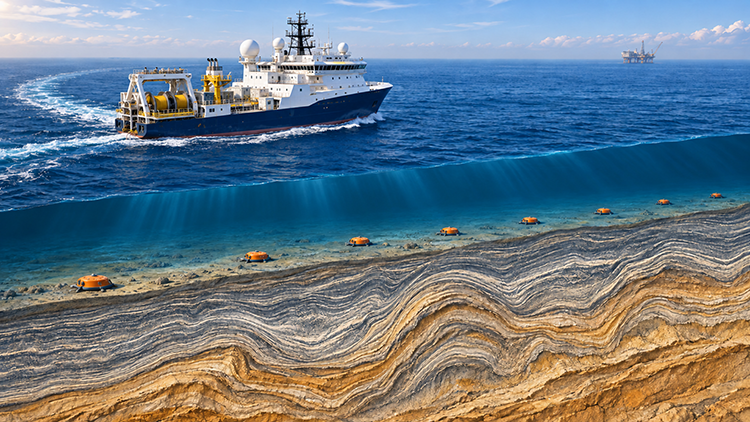
A core challenge is improving subsurface imaging to reduce exploration uncertainty and identify viable geological targets. The MoPMR’s adoption of OBN seismic technology reflects the growing importance of high-resolution data in supporting exploration decisions.
Commenting on the technologies required to advance deepwater exploration, Elsayed emphasized the need for advanced geological analysis alongside reliable drilling and production systems.
“Advanced seismic imaging, including full-waveform inversion, and integrated geological models can reveal subsalt opportunities. Reliable well construction, subsea tiebacks and flow assurance are essential to commercializing discoveries,” he explained.
Beyond exploration, deepwater projects require specialized drilling rigs, subsea production systems, and supporting infrastructure. These requirements increase complexity and capital expenditure, particularly in ultra-deepwater areas where harsh operating conditions and distance from existing infrastructure pose additional challenges.
Commercial considerations are equally important. Deepwater developments require substantial upfront investment, lengthy lead times, and carry exploration risk. According to Elsayed, stable contractual terms, commercially viable gas prices, and reliable payment mechanisms remain critical to attracting investment.
“Phased appraisal, shared infrastructure and partnerships can reduce costs and exposure in deep water; commercial success ultimately means delivering gas competitively,” he said.
Elsayed also stressed that environmental and operational safeguards must accompany offshore expansion. These include independently verified well barriers, competent crews, emergency response arrangements, and plans for capping and relief-well mobilization. Marine baseline studies, habitat protection, discharge controls, and methane monitoring should also be incorporated from the earliest stages of development.
Deepwater: What Lies Ahead
Egypt’s deepwater gas outlook will depend on the sector’s ability to translate improved geological data and exploration activity into commercially viable discoveries and sustained production. The MoPMR is prioritizing expanded exploration, faster development of existing discoveries, and increased investment to strengthen domestic gas supplies.
Elsayed emphasized that realizing the country’s deepwater potential will require a combination of geological understanding, technological capabilities, and commercially sustainable investment. Continued exploration and appraisal of promising areas, particularly around established petroleum systems, could help identify new opportunities while reducing uncertainty for international operators.
Ultimately, Egypt’s ability to expand its deepwater gas resource base will depend on successful exploration, effective project development, and the ability to deliver newly discovered resources competitively. Sustained investment, technological advancement, and a supportive operating environment will remain central to turning offshore prospects into future production.