Not every well reaches its full potential on the first attempt. A well may encounter a problem, miss its target, or reach a stage where the reservoir is no longer delivering the expected volumes. In mature fields, operators may know that hydrocarbons remain in the reservoir but lack the economic means to drill a completely new well. This is where sidetrack drilling technology can provide another option.
What is sidetrack drilling?
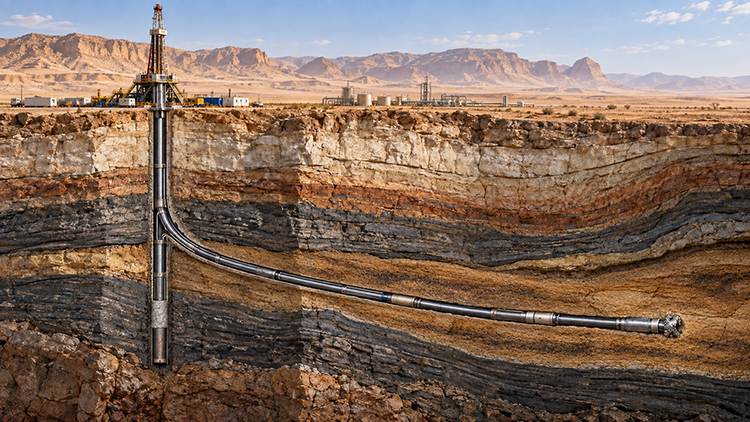
Sidetrack drilling is essentially a way of giving a well a second chance. Rather than starting over at the surface, engineers steer the drill bit away from the original borehole at a chosen depth, creating a new path underground. This allows them to reach zones that were missed the first time or to bypass a blockage.
“A sidetrack can reach a new geological target, bypass unusable sections, or correct poor trajectories. By reusing the upper wellbore, it sharply reduces drilling scope and cost while boosting efficiency,” said Hesham Al Khateeb, Founder and Subsurface General Manager for HCS, a geo-engineering consultancy firm.
Sidetracking was introduced at times when directional drilling techniques were integral to the oil and gas industry since the 1920s, according to the International Association of Drilling Contractors (IADC)’s historical review.
The technique became particularly famous during the 1934 Conroe oilfield disaster in Texas, in which a gas kick from a high-pressure zone ignited, and the entire rig was engulfed in flames. After many months and attempts to bring the fire under control, other nearby rigs had to be closed down, and the field as a whole was threatened. Then H. John Eastman, who introduced directional drilling to the world in 1929, used this technique to create a relief well that intersected the problematic well, killing the blowout on the first attempt and helped bring the uncontrolled flow under control.
Breathing New Life into Aging Wells
Al Khateeb, who is a geoscientist in the oil and gas exploration and production field, noted that sidetrack drilling offers a viable solution for wells that have been temporarily abandoned or are underperforming. “Instead of permanent abandonment, a sidetrack can be drilled to access new reserves when the original zone is depleted.”
The technology improves production by correcting wellbore deviations or targeting more permeable zones. It can also be used to increase the contact area with the reservoir, thereby enhancing hydrocarbon recovery, he explained.
“Sidetracking can significantly boost production rates, extend asset life. This strategy effectively breathes new life into aging wells, maximizing their economic viability and prolonging field production,” he said to Egypt Oil and Gas.
Al Khateeb emphasized the benefit of using this technique in high-cost environments, particularly in offshore operations or remote onshore locations, where the capital expenditure for new wells can be astronomical. “Estimates suggest sidetracking can save 30-60% of the total well cost.”
In offshore areas, where oil and gas operational costs are inherently higher, technology approaches for deepening an existing well through sidetrack drilling are often more economical than drilling a new one.
“This allows operators to extend the same casing string deeper or to add a lateral leg to access new reserves, all while leveraging the already established offshore platform or drilling rig. It reduces the need for additional costly rig moves and significantly impacts the overall project economics. Many oil and gas projects FID can’t be approved for its high operational cost,” he explained.
Inside the Mechanics of Sidetracking
The process varies depending on the well and the reason for the sidetrack, but a typical cased-hole operation begins by selecting a suitable depth and direction for the new wellbore.
A whipstock, a downhole deflection tool, is then set at the selected depth. It directs the drilling assembly toward the side of the existing wellbore.
Specialized milling tools are used to cut a window through the casing and prepare an exit for the new wellbore. Once the window is created, the drilling assembly enters the formation and begins building the new trajectory.
Modern measurement-while-drilling (MWD) tools provide real-time information on the well’s direction and position, while rotary steerable systems (RSS) can provide greater control over the trajectory.
The new well can then be directed toward a different reservoir target, a previously bypassed interval, or another planned bottomhole location.
Advances in equipment including whipstock systems, rotary steerable drilling as well as surveys and digital well planning have made modern sidetracking faster, more precise and more economically attractive.
Applications in Egypt
One recent example of sidetrack drilling in Egypt is British Petroleum (bp)’s Fayoum-4 well in the West Nile Delta.
“Fayoum gas field is a good case for the value of sidetrack drilling for deepening existing wells to add reserve and enhance production from deeper reservoirs avoiding high-cost marine wells,” said Al Khateb.
“This approach allows operators to extend the same casing string deeper to add a deeper leg to access new reserves, all while leveraging the already established offshore platform or drilling rig. This improves the overall project economics and extend asset’s life,” he added.
bp brought Fayoum-4 onstream in August 2026 two years ahead, with the well adding an estimated 80 million cubic feet per day (mmcf/d) to Egypt’s natural gas supply.
The company reached additional Messinian reservoir layers by drilling a sidetrack from an existing wellbore at a depth of around 3,000 meters (m). Production is being routed through the existing Giza-Fayoum pipeline to West Nile Delta processing facilities.
Wail Shaheen, President of bp Egypt, said that the start-up of production from the Fayoum 4 well reflects the company’s continued support for the Ministry of Petroleum and Mineral Resources (MoPMR)’s strategy to accelerate field development activities, maximize the utilization of existing infrastructure, and deploy the latest technologies to increase domestic natural gas production in Egypt.
Sidetracking technology is also being used as part of efforts to expand exploration and production activity in Egypt’s mature fields.
El Hamra Oil Company began its 2026 exploration drilling campaign with the Zain-1X Sidetrack appraisal well in July. The company also planned to drill the NE Yidma#01X Sidetrack appraisal well in September as part of its exploration program.
Another example was in the Gulf of Suez where a sidetrack was drilled to the bottom of the Nubia-M1 reservoir. Open-hole logging confirmed oil saturation in the targeted intervals, and the well was completed at an initial production rate of approximately 1,600 barrels of oil per day (bbl/d).
In another case, a sidetrack from an old plugged-and-abandoned well was used to access remaining reserves in the Nubia and Matulla reservoirs. The well initially produced about 4,500 bbl/d before being choked back to around 3,000 bbl/d for reservoir management.
These examples highlight another role for sidetracking: rather than simply solving a drilling problem, the technique can be used to revisit mature reservoirs and access volumes that were not effectively drained during the original development.
Sidetrack drilling may be more than a century old, but advances in drilling and downhole technology are giving it a new role in the industry’s effort to unlock more value from wells that have already been drilled.