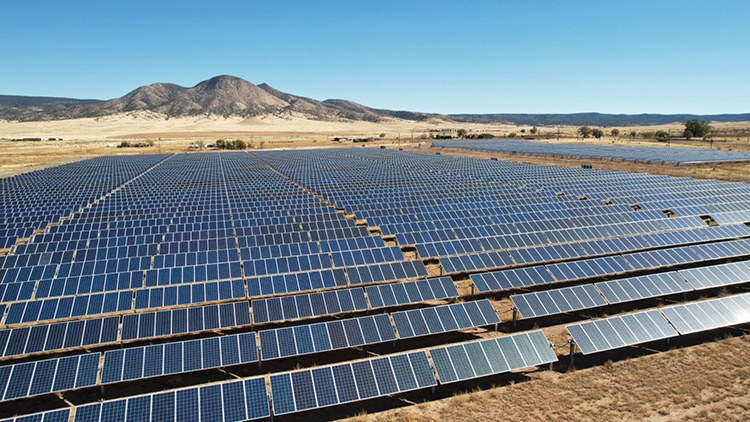
Egypt’s exotic Western Desert makes up nearly 68% of its total land area. This vast stretch has proven to be more than just sand and sun throughout history, and in energy, it certainly plays an undeniable role, especially in renewables, thanks to its generous sunlight and sweeping winds.
Geography Powers Energy
The Western Desert is the immense area of the Sahara that lies west of the Nile, stretching from the Mediterranean coast south to Egypt’s border with Sudan, and from the river valley all the way to the Libyan frontier. It spans a chain of Governorates, including the area around Benban, home to one of the world’s largest solar parks.
Benban Solar Park is located on a plateau 40 km northwest of Aswan Governorate. It is a clustered solar complex made up of dozens of independent plants with a combined capacity of about 1.65 gigawatt (GW), and is located roughly 650 km south of Cairo. It produces around 3.8 terrawatt-hours (TWh) of solar power.
Beyond Benban, Gabal El Zeit, also located in the Western Desert, is the largest wind complex in the entire MENA region, with a total installed capacity of 580 megawatt (MW). It has generated about 3 TWh of electricity over its three years of operation, an average of approximately 1 TWh/year, saving massive amounts of fossil fuel and significantly reducing greenhouse gas (GHG) emissions.
Another major renewable energy project in the Western Desert is the Ras Ghareb wind farm. It is a 262.5 MW near-shore wind project developed close to the Gulf of Suez, approximately 30 km north-west of Ras Ghareb. It is the first independent power producer (IPP) project in the country.
Scatec, the Norwegian developer already active in Benban, has reached financial close on its large “Obelisk” solar-plus-storage project, which combines solar panels with a battery energy storage system (BESS) to capture solar energy and store it for later use. Furthermore, both ENGIE, the French energy major, and Scatec have secured rights for multi-gigawatt wind developments in Sohag in 2024.
But the Western Desert has room for more than just mega projects. Several small- to mid-scale renewable energy projects, many led by private developers such as KarmSolar, a multi-utility company specialized in solar-integrated solutions, are also growing and helping meet the needs of farms and remote communities there, standing in contrast to projects the size of Benban.
In Farafra, KarmSolar operates a hybrid grid that combines about 3.4 MW of solar Photovoltaic (PV), MWh (megawatt-hours) of batteries, and diesel backup.
Though modest in scale compared to Egypt’s mega-projects, these initiatives show how developers are tailoring renewable energy to the Western Desert’s off-grid and agricultural needs.
Why the Western Desert?
“The solar radiation in Egypt’s Western Desert is among the highest in the world, making it a prime site for the production of solar energy. In Europe, a solar plant will use perhaps 15% of its capacity, in Egypt it will use 90%”, says Salah Soliman, researcher at Alexandria University in a research paper titled “Science and Innovation in Egypt”. However, land availability and sunlight is only the tip of the iceberg in terms of potential.
KarmSolar’s Commercial Director, Mohamed El Maraghy, noted that the Western Desert enjoys abundant solar resources, clear skies, and high irradiance; all of which translate into higher solar generation efficiency. He added that the region’s proximity to high-value off-takers in isolated areas, such as large agri-farms, offers a major advantage. “These farms often face high diesel fuel costs, which makes solar-plus-storage an attractive alternative. This is a key benefit for export-oriented businesses,” he explained.
The Renewables Ambition
At COP29 that took place in 2024, Prime Minister Mostafa Madbouly said that “Egypt reaffirms its goal for renewable energy to constitute 42% of its electricity generation by 2030, despite the current share being just 11.5%.”
For his part, El Maraghy believes that ensuring the growth of renewable energy in Egypt will depend on decentralized, off-grid solar solutions such as KarmSolar’s hybrid PV and storage microgrids. “These systems deliver reliable, affordable power directly to where it’s needed, while offering lower lifetime costs than diesel or other fossil-fuel alternatives,” he said.
This model not only expands access to clean energy in underserved regions, but also supports Egypt’s long-term sustainability objectives without adding strain to the central grid, according to El Maraghy.
Challenges Ahead
But obstacles remain.To El Maraghy, the challenges are manageable with the right approach. A big one is storage and hybrid integration. “To replace diesel and provide a reliable base-load in isolated sites, you need well-sized BESS and robust hybrid control (PV, diesel, and BESS). That adds capital expenditures (CAPEX) and technical complexity”, stated El Maraghy. However, he noted that to overcome these challenges, KarmSolar deployments explicitly include BESS in many areas, such as Abu Minqar.
Water scarcity presents another challenge in Egypt’s Western Desert. “Our technical team has mastered dry-cleaning techniques, using minimal water only when necessary,” said El Maraghy.
He added that financing remains another constraint. “Banks and investors require confidence in operations and maintenance performance, demand stability, and a supportive policy environment,” he explained. “This, in turn, means that off-takers must provide sufficient documentation and financial data to demonstrate an acceptable risk profile. As a result, KarmSolar’s ability to serve smaller end-users is limited, as many lack the required credit history or financial records.”
Despite its challenges, Egypt’s Western Desert stands out as both a testing ground and a symbol of the country’s renewable transition. From mega-projects like Benban and Obelisk to smaller decentralized systems powering farms and remote communities, the desert is proving that clean energy can thrive even in harsh conditions.