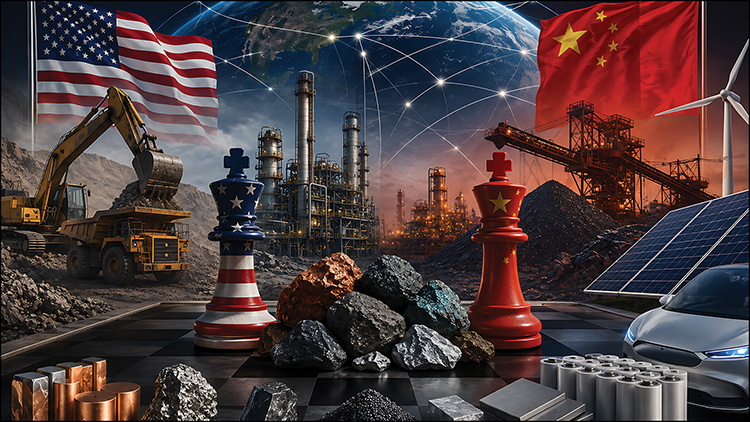
Critical minerals have become the latest arena of geopolitical competition, with the US and China at the center of their race to control the global economy and supply chains. It is not simply about who has the largest mineral reserves but increasingly about who controls mining, refining, processing, technology, and downstream manufacturing.
Critical minerals are non-fuel minerals, elements, or substances essential to the future of the energy industry. For example, copper and aluminum are increasingly important for AI, data centers, and digitization. At the same time, copper and battery raw materials are central to electrification, electric vehicles, renewable energy, and energy storage. Moreover, some rare earth elements (REEs), as well as antimony, gallium (Ga), and Germanium (Ge), are critical to defense, semiconductors, and other advanced technologies.
China’s Monopoly
As Wael Jaber, Vice President of Wood Mackenzie for Mining & Metals, put it, “The catalyst for rising interest in critical minerals appears increasingly supply‑side, driven by export bans and friendshoring strategies to secure supply chains, rather than purely by demand growth.”
China has shown it will use its processing dominance as leverage, as seen in 2023 when it banned trade in gallium and germanium before reversing the move last year. The United States, meanwhile, is restricting black mass exports from August 2026 to retain critical minerals domestically, Jaber told Egypt Oil & Gas. Black mass refers to shipments of shredded lithium‑ion battery scrap containing minerals such as lithium, cobalt, nickel, and manganese.
According to Wood Mackenzie, China accounts for around 70% of REEs mining and about 90% of its processing. It also controls the technologies required to process some rare earth.
China, via its mining companies in Africa, controls a large share of Congo’s cobalt, which forms around 80% of the world’s mined cobalt supply. Moreover, Chinese companies are on course to control 39% of all lithium extracted globally by 2030, becoming the rival to Australia, a long-dominant force in lithium supply.
Other minerals, including tungsten, gallium and germanium, are particularly vulnerable because supply is highly concentrated in China, while production is difficult to scale quickly and substitution is limited.
Between 2023 and 2025, China deployed about $120 billion in outbound mining investment and, from 2001 to 2025, financed roughly $24 billion across 363 port projects,around half of them dedicated to energy and mineral supply chains. Sixty-three of these projects are located within 500 km of a China-financed mines, anchoring the upstream supply chain, according to the International Energy Agency (IEA)’s Critical Minerals Outlook 2026 report.
This has transformed critical minerals into a monopoly game, with China holding the strongest position in many parts of the supply chain, while the United States attempts to build an alternative network.
The US’ Diversification Race
US has reserves of most critical minerals but lacks sufficient mining and processing capacity, the cause why it is still dependent on China’s supply market.
However, since the start of his second term, President Donald Trump has worked on reducing his country’s dependence by pumping tens of billions of dollars into nearly 150 minerals companies.
He also set a January 1, 2027, deadline for defense and other manufacturers to stop sourcing REEs, magnets, tungsten, molybdenum and tantalum from China, Russia, Iran and North Korea.
However, this is colliding with the reality of American miners and processors unreadiness for such a step. Washington has been trying to limit such imports for years but has routinely granted companies waivers because the US supply of these minerals can not meet the growing demand.
Trump railed against such waivers in a May 10 post on his Truth Social platform, saying: “all federal agencies must buy American , no excuses!” and then signed an executive order making it even harder for defense contractors to obtain waivers, according to Reuters.
On August 7, Trump announced plans to spend $3 billion on critical minerals and battery projects for the purpose of reclaiming America’s rightful place as the mineral’s superpower of the world.
“Critical minerals are the raw materials of American strength that power everything from advanced weaponry to automobiles, and we want these essential products to be mined, refined, and made right here in the USA,” he said during a roundtable at the State Department.
Since 2023, the United States has signed multiple memorandum of understanding across Central Asia, Africa, and Latin America to secure alternative supply chains for these minerals outside China’s orbit.
Yet many of these agreements have struggled to move beyond signaling. Announcements have outpaced implementation to a degree that exceeds the expected delays from negotiation or logistics. Frameworks have multiplied, while financing, capacity upgrades, infrastructure, and downstream industrial development have lagged. The gap between rhetoric and deployed capital is becoming increasingly evident to partner governments and markets.
Meanwhile, China’s monopoly in critical mineral refining was built over decades (as part of the Belt and Road Initiative) through coordinated industrial policy, subsidized infrastructure, and vertically integrated processing systems. The United States cannot realistically recreate that dominance overnight even if the political will existed.
This could be why the International Energy Agency warned that $6.5 trillion of global manufacturing is at risk if Beijing imposes export restrictions on rare earths, as it has periodically done in recent years.
Rewinding Events
The economic conflict between the US and China began in 2018 under the first Trump administration when the US imposed sweeping tariffs on hundreds of billions of dollars’ worth of Chinese imports, initiating a tit-for-tat escalation.
The trade war expanded significantly into the technology sector as the US implemented strict export controls on advanced semiconductors and semiconductor manufacturing equipment, aiming to curb China’s technological and military advancement. In tandem, the Biden administration maintained the original tariffs and sharply increased levies on strategic green technologies, doubling tariffs on solar cells and significantly raising duties on lithium-ion electric vehicle batteries and critical minerals imported from China.
However, the conflict escalated drastically in 2025 under the second Trump administration, resulting in a severe tariff surge where the US imposed levies reaching up to 145% on Chinese goods, prompting China to retaliate with 125% duties on American products.
Besides, China began to leverage its own infrastructure advantage and transition from traditional tariff retaliation to export controls to pressure US defense, high-tech, and green energy sectors.
Between 2023 and 2025, Beijing steadily widened its export licensing regimes and trade restrictions across strategic minor metals such as gallium, germanium, tungsten, and antimony, as well as battery-grade graphite and heavy rare earth elements indispensable to defense hardware, electric vehicles, and semiconductors. Although a diplomatic truce during a presidential summit in November 2025 in Busan led China to suspend export controls over REEs and other minerals related to lithium-ion battery materials for one year.
Amid the ongoing geopolitical rivalry between the US and China, recent disruptions in the Middle East have exposed critical vulnerabilities in the global supply of essential minerals including Beijing.
The Arabian Gulf region serves as a vital production hub, supplying approximately 33% of global helium, which is essential for medical devices and advanced technologies, and 9% of primary aluminum, crucial for the aerospace and defense sectors. The region also accounts for 50% of the seaborne sulphur trade, a mandatory agent for producing sulphuric acid, a chemical heavily utilized in fertilizer manufacturing and processing copper, lithium, cobalt, nickel, and rare earths. This prompted China, a net importer of sulphur, to ban its domestic sulphuric acid exports from May 2026 through the end of the year.
Ultimately, the primary lesson drawn from recent energy security crises is that diversification must directly target these exact bottlenecks. Developing numerous additional mines offers little strategic advantage if the extracted resources continue to feed into the same concentrated refineries.