Egypt’s energy future is defined by the dual challenge of satisfying fast-rising domestic demand while preserving its export capacity. To navigate this balance, the country is turning decisively toward brownfield expansion by revitalizing mature reservoirs, modernizing processing facilities, and deploying near-field tiebacks that convert marginal discoveries into commercial reserves. This infrastructure-led approach reduces capital intensity, shortens project cycles, and maximizes the value of existing assets, potentially offering stronger returns than high-risk frontier exploration.
Infrastructure Driving Growth
A mature reservoir may still contain commercially recoverable hydrocarbons, yet production can be constrained by surface infrastructure rather than subsurface reserves. A case study of a mature offshore field, published by the Society of Petroleum Engineers (SPE) and Journal of Petroleum Technology (JPT), found that produced-water handling was limiting output. By installing partial water-processing systems, operators increased oil production by 80% while reducing in-field transfer volumes by 62%. This underscores that in brownfields, the bottleneck is often processing, transportation, or pressure-management capacity rather than the absence of hydrocarbons.
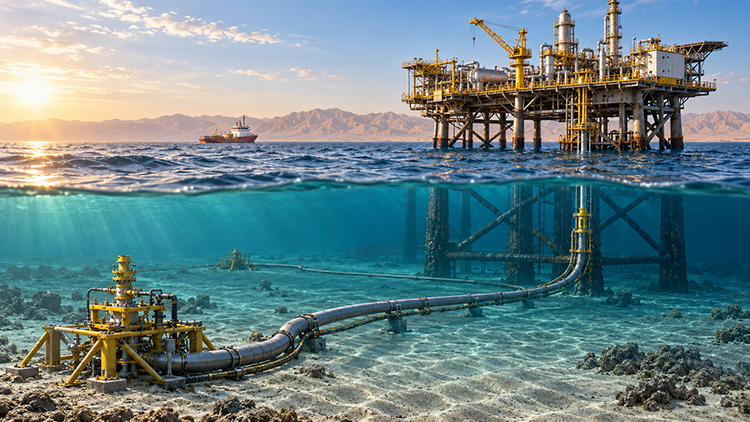
Building on this, near-field facilities transform small discoveries into viable projects. A minor find may not justify its own processing plant, export pipeline, compression system, storage facilities, utilities, accommodation, or offshore production platform. However, proximity to an existing brownfield hub allows operators to deploy tiebacks, paying only for incremental infrastructure to connect the new well.
Near-field tiebacks further enhance economics by converting marginal discoveries into commercial reserves. Atef Moussa, Project Director, Oil and Gas and Renewable Energy Expert, explains: “Utilizing existing oil, gas, and produced-water treatment capacity bypasses the high fixed costs of greenfield host facilities. Capital deployment is restricted to subsea tiebacks, short flowlines, or minimal wellhead platforms.”
In contrast, “greenfield developments typically require 3 to 5 years from final investment decision (FID) to first production. Near-field tiebacks leveraging spare host capacity reduce execution cycles to 6–18 months,” Moussa points out. This efficiency strengthens IOC cash-flow confidence, aligns with Egypt’s five-year energy strategy, and reduces exposure to high-risk frontier exploration. “The strategic proximity of existing processing infrastructure to near-field producing assets fundamentally alters the economics of field development by converting sub-economic or marginal discoveries into commercial reserves,” Moussa adds.
Unlocking Value from Mature Assets
Egypt is reinforcing its production base to meet rising domestic demand and export ambitions. Against this backdrop, brownfield expansion is emerging as the economic backbone of Egypt’s petroleum strategy. “Brownfield expansion lets Egypt maximize existing infrastructure, cutting capital costs versus greenfields. This strategy accelerates basin recovery, leverages logistics, and reduces environmental impact by reusing operational facilities already in place,” Mohamed Ghanim, Senior Geologist at SLB, tells Egypt Oil & Gas. “From an economic standpoint, the value lies in shorter payback periods and improved project internal rates of return (IRRs). By deploying advanced secondary and tertiary recovery techniques, as well as digital oilfield technologies and AI-driven production optimization, operators can unlock trapped reserves efficiently. This cost-effective extraction translates directly into sustained state revenues, optimized asset life cycles, and localized job creation without the heavy financial exposure associated with high-risk frontier exploration,” Ghanim adds.
Balancing Demand and Supply
Despite these gains, Egypt’s hydrocarbon balance remains strained. Natural gas consumption was 77.67% higher than production in June 2026, according to the Central Agency for Public Mobilization and Statistics (CAPMAS) Monthly Statistical Bulletin.
On the oil front, consumption in June was approximately 24.88% higher than output. Therefore, developing brownfields is of paramount importance in boosting production.
By revitalizing mature assets and integrating near-field discoveries, Egypt can narrow the supply-demand imbalance, reduce reliance on imports, and sustain its role as a Mediterranean energy hub.
The Abu Sennan field in Egypt’s Western Desert illustrates how changing exploration and development concepts can unlock value from mature or challenging assets. Once considered a declining concession, Abu Sennan has been revitalized through integrated reservoir characterization, advanced seismic interpretation, and targeted drilling programs.
The field’s Abu Roash and Bahariya formations presented complex geology, limiting continuity and recovery. However, recent studies applied multidisciplinary 3D geological and petrophysical modeling, combining well logs, seismic data, and core analysis to better map reservoir quality and distribution.
The study entitled “Changing Exploration and Development Concept Has Revived Brown Fields of Abu Sennan, Western Desert of Egypt” highlighted that “modernization of the structural and geological concepts in the old development area of Abu Sennan resulted in discovering two medium-size oil and gas fields in an area thought before as of lost interest.”
Capacity Upgrades and Market Resilience
Egypt’s brownfield strategy focuses not only on reusing existing facilities but also on modernizing infrastructure to unlock constrained production. Fiscal and contractual reforms now target mature assets, with tailored bid rounds in the Gulf of Suez and Eastern Desert signaling a regulatory shift designed to attract investment through the Egypt Upstream Gateway (EUG).
The real bottleneck in brownfields lies in surface systems, and Egypt is addressing this directly. Digital transformation is being applied to debottleneck facilities, with integrated digital twin models and predictive analytics optimizing throughput and reducing downtime. As Moussa notes, machine learning driven closed loop controls can dynamically adjust chemical injection rates and separator retention times to match shifting fluid characteristics. These infrastructure upgrades ensure that mature reservoirs continue to deliver, proving that modernized processing and transport capacity are just as critical as the hydrocarbons themselves.
These upgrades extend the life of mature facilities, absorb operational costs across higher throughput, and maintain efficiency even as reservoirs decline. Moreover, “injecting fresh, higher-pressure production into mature host facilities offsets naturally declining reservoir pressures, maintaining plant operating efficiency above minimum turndown limits,” Moussa notes. By integrating advanced technologies, Egypt is positioning its brownfields as digitally resilient assets capable of handling new discoveries.
Modern Infrastructure, Lasting Stability
Brownfield expansion also strengthens Egypt’s resilience against regional instability. By maintaining a reliable baseline of hydrocarbons, Egypt can balance soaring domestic consumption with its role as a Mediterranean energy hub. “Securing this stable domestic baseline is what ultimately preserves export capacity, particularly via Egypt’s strategic LNG facilities,” Ghanim notes.
In this sense, “Egypt’s brownfield strategy serves as a critical bridge for balancing soaring local energy consumption with its aspirations as a regional Mediterranean energy hub. As greenfield mega-discoveries face natural depletion curves, optimizing brownfields ensures a steady, reliable baseline of hydrocarbons to fuel domestic power generation and industrial feedstock requirements,” he adds.
Nevertheless, Moussa cautions that executing brownfield expansions on active, aging offshore or onshore facilities introduces severe technical, safety, and logistical risks. Additionally, “inaccurate historical laser scans, incomplete structural integrity logs, and non-conforming engineering documentation frequently lead to unexpected site clashes during physical offshore/onshore installation. Meanwhile, debottlenecking processing trains often triggers updated environmental compliance standards, requiring strict limits on flaring, fugitive methane emissions, and produced-water discharge limits (ppm oil-in-water) that older separation equipment cannot meet without secondary treatment units,” he adds.
Egypt’s energy future depends on bridging rising domestic demand with export ambitions, and brownfield expansion has become the cornerstone of that balance. By revitalizing mature reservoirs, deploying near field tiebacks, and modernizing processing facilities, Egypt is unlocking trapped reserves at lower cost and faster cycles than frontier exploration. Despite risks tied to aging facilities and stricter environmental standards, brownfields provide a resilient production base that narrows supply demand gaps, reduces import reliance, and secures Egypt’s role as a Mediterranean energy hub.