The energy industry is experiencing one of the most complex periods in its history. Geopolitical tensions, shifting supply chains, economic uncertainty are redefining how companies operate and compete. In this environment, building resilient organizations requires more than technical expertise and financial strength, it demands leadership that embraces diverse perspectives and unlocks the full potential of its workforce.
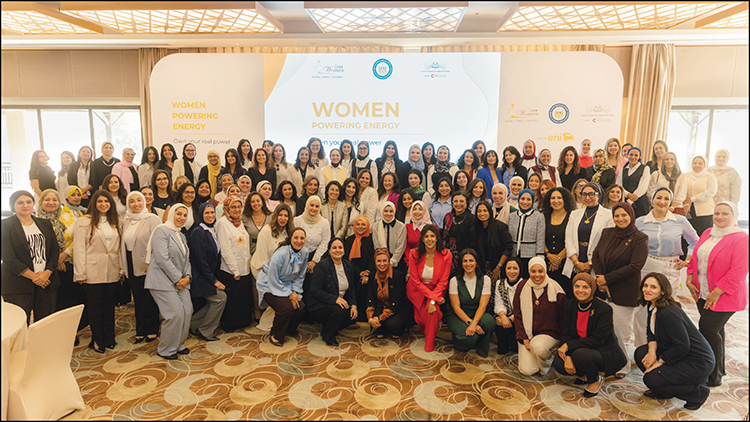
Against this backdrop, Egypt’s Women in Energy Network (EWiEN) held in June its second edition of its Lead Woman event, hosted by Italian energy company Eni.
Established in 2022 under the Egypt Oil & Gas Committee, the EWiEN network has rapidly expanded its reach while remaining focused on one core objective: enabling women across the energy value chain to achieve their full potential.
“EWiEN has been here since 2022, and has been growing and evolving very rapidly. However, its vision remains the same: that every woman in the energy industry achieves her full potential,” said Eleanor Rowley, Managing Director of Capricorn Energy Egypt and Chair of EWiEN, in her opening speech.
Running under the theme “Women Powering Energy: Own Your Real Power”, the event gathered energy industry leaders in high level discussions that aimed at empowering women leaders to shape outcomes, engage stakeholders, and lead with confidence in complex environments.
“The leaders who endure are those who govern with empathy and resolve, who look beyond quarters to longer horizons, who build consensus instead of issuing commandments, and who make space at the table for voices unlike their own.” said Hala El Said, Economic Advisor to President Abdel Fattah El Sisi and former Minister of Planning and Economic Development.
“These are the qualities women bring to leadership in abundance. What they have too often been denied is not the capacity to lead, but the invitation,” she added.
Currently, Egyptian women enroll in universities at rates far higher than men. Also, between 2016 and 2024, women’s financial inclusion rose nearly 300% with 24 million Egyptian women now hold accounts of their own, El Said noted in her opening speech.
As El Said sees it, these achievements did not happen by chance. They were built patiently and deliberately through institutions such as the National Council for Women and the National Training Academy, which are preparing a new generation of women to lead in government, business, and technology.
Diversity as a Competitive Advantage
The event featured a powerful discussion titled “Evolving Leadership in Energy: Unlocking Impact and Shaping the Path Forward,” where the debate revolved around how diversity of leaders shapes better decisions, stronger governance, and more resilient future.
Drawing on nearly three decades of international experience in US Chevron, Channa Kurukulasuriya, Country Manager of Chevron Egypt, reflected on his experience working across different cultures that shaped his perspective on leadership and inclusion.
In an industry defined by technical complexity and multiple stakeholders, Kurukulasuriya explained that gender diversity brings different perspectives, and a greater degree of emotional intelligence which helps to build stronger teams. These diverse perspectives enrich the work experience for everyone and ultimately drive more durable and sustainable outcomes.
A keynote to achieve that, Channa added that “we all have superpowers , and our voice is the most powerful of them all. Skills, competency, and distinguished careers matter, but without a voice that is heard, they lose significance. Whether you are just starting out or already in a leading role, recognize the strength of your voice and use it to communicate, to influence, and more importantly to be heard.”
Reiterating on that, Francesco Gasparri, Managing Director of IEOC, Eni’s subsidiary in Egypt, emphasized that diversity delivers value only through having the right leadership characteristics. He noted three characteristics that leaders should have: to listen, to treat all people with fairness, and to create space for everybody to express their thoughts.
He also reflected on the qualities that enable leaders to grow over time, arguing that leadership is shaped through consistent habits rather than talent alone.
Beyond Representation: Rethinking Governance
While diversity strengthens day-to-day leadership, its impact is even more significant in the boardroom. Hala Barakat, Director of the Entrepreneurship and Innovation Center and Women on Boards Observatory at The American University in Cairo (AUC), explained that homogeneous boards are more vulnerable to groupthink, while diversity of gender, age, and professional background strengthens strategic decision-making and governance.
She emphasized that board diversity is not simply about increasing women’s representation but about improving governance. She noted that bringing together diverse perspectives helps boards make more balanced, informed decisions, particularly in complex, capital-intensive sectors such as oil and gas.
Citing a McKinsey study, Barakat noted that companies with more diverse boards are 25% more likely to outperform financially than those with less diverse boards. She added that Egyptian research reached similar conclusions, demonstrating that diverse boards strengthen governance, improve risk management, and enhance investor confidence, particularly as environmental, social, and governance (ESG) considerations play an increasingly important role in investment decisions.
Despite this progress, Barakat argued that the challenge is no longer finding qualified women for leadership roles. More than 1,200 women have already been trained to serve on corporate boards through AUC’s Women on Boards Observatory. The greater challenge now, she said, is expanding opportunities beyond the familiar faces who repeatedly occupy leadership positions.
As a key takeaway message, she stated that “My advice for women: don’t be shy. Champion yourself. Showcase what you can do because you can do a lot, even more than you realize. For companies, real change requires culture and a full leadership pipeline. Invest in women leaders so they can reach their highest potential.”
Leading with Courage, Authenticity, and Purpose
During the panel, Mona Al Adawy, Founder and CEO of GeoEnergy, shared her leadership journey. Stepping away from her career as a geologist to care for her first child became the catalyst for building her own company, one that has since grown into a regional group serving clients across the Middle East and Africa.
Al-Adawy said success is driven not only by technical expertise and business knowledge but also by resilience and the willingness to embrace uncertainty. She emphasized the importance of making decisions even when the direction is not fully clear, adding that true leadership is about maintaining momentum, remaining committed to a long-term vision, and turning challenges into opportunities.
Highlighting the qualities women bring to leadership, Al-Adawy said that: “Commitment, emotional intelligence, attention to details, and the ability to see the bigger picture, these are qualities women bring to leadership. They build relationships, engage stakeholders, and create collaborative moments filled with empathy.”
The event concluded with an inspiring Leadership Development Training Session led by Rania Abu Rabia, Executive Leadership Facilitator and Coach at AUC and Founder of THINK, THINK is a company specialized in offering leadership and well-being programs.
Participants were engaged in dynamic activities, reflecting on their leadership journeys, exchanging experiences, and gaining practical insights on driving change with confidence and authenticity.
By the end, they were equipped with concrete tools and approaches to apply immediately in their day-to-day leadership situations, strengthening their voice and moving from simply being part of the system to actively shaping outcomes.