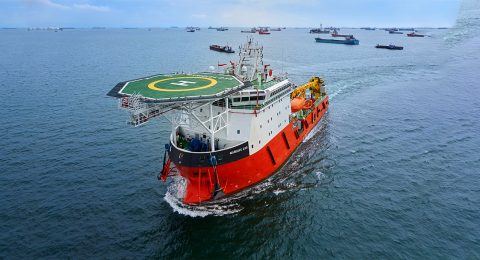
Türkiye’s Oruc Reis seismic research vessel will begin hydrocarbon exploration activities in offshore Pakistan, conducting two- and three-dimensional (2D and 3D) seismic surveys in the Indus and Makran basins, Turkish Energy Minister Alparslan Bayraktar announced.
Speaking during a welcoming ceremony at Karachi Port alongside Pakistan’s Foreign Minister Ishaq Dar and Petroleum Minister Ali Pervaiz Malik, Bayraktar said the surveys would help assess the hydrocarbon potential of the two offshore basins, adding that drilling operations were expected to begin in 2027.
Bayraktar described the vessel’s deployment as a “strong turning point” in energy cooperation between Turkey and Pakistan, particularly amid turbulence in global oil and gas markets.
The offshore exploration campaign builds on agreements signed last year between Turkey’s state-owned Turkish Petroleum Corporation (TPAO) and Pakistani energy companies, including Mari Energies, Fatima, Oil and Gas Development Company Limited (OGDCL), Pakistan Petroleum Limited (PPL), Prime, and GHP Limited (GHDL).
The agreements cover hydrocarbon exploration and production activities across three offshore and two onshore blocks in Pakistan.
The deployment follows a delay of approximately six months in the planned offshore operations. In October, Bayraktar attributed the postponement to the war in Iran, which affected the original exploration schedule.
The seismic surveys are expected to provide geological data to support the identification of potential hydrocarbon resources and guide subsequent exploration drilling.
Pakistan is seeking to unlock its offshore hydrocarbon potential after nearly two decades of limited exploration activity. In 2025, the government launched its first offshore bidding round in 18 years, offering 40 blocks across the Indus and Makran basins. The round attracted bids for 23 blocks covering approximately 53,510 square kilometers (km²), with successful bidders including local companies Oil and Gas Development Company Limited (OGDCL), Pakistan Petroleum Limited (PPL), and Mari Energies, alongside international partners such as Turkey’s TPAO