The Organization of the Petroleum Exporting Countries (OPEC) has reported that crude oil production by OPEC+ members increased by 900,000 barrels per day (bbl/d) month on month (MoM) to average 39.07 million barrels per day (mmbbl/d) in September, driven primarily by higher output from Saudi Arabia, according to its Monthly Oil Market Report (MOMR).
Released on October 13, the report highlighted that the increase in the output of the OPEC+ bloc came amid ongoing disruptions to oil shipments through the Strait of Hormuz, as geopolitical tensions in the Middle East continued to affect regional crude flows and shipping activity.
According to secondary sources cited in the report, OPEC member countries increased their combined crude oil production by 920,000 bbl/d to 25.10 mmbbl/d in September. Production from non-OPEC countries participating in the Declaration of Cooperation (DoC) declined by 20,000 bbl/d to 13.97 mmbbl/d.
Saudi Arabia recorded the largest increase among OPEC members. Data based on direct communications showed that the kingdom’s crude oil production reached 8.37 mmbbl/d in September, compared with 6.24 mmbbl/d in August. Its supply to the market increased by 866,000 bbl/d MoM to 7.99 mmbbl/d.
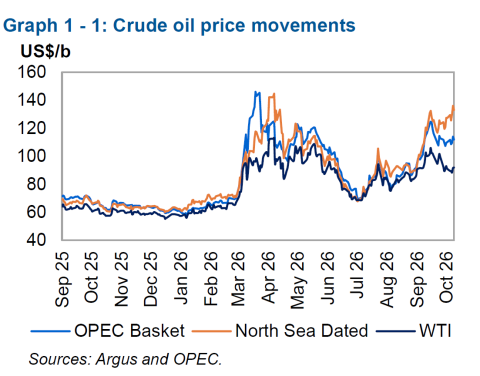
The production increase coincided with a sharp rise in oil prices. OPEC’s Reference Basket climbed by $24.15 per barrel MoM to average $110.59 per barrel in September. Brent crude futures rose by $13.94 per barrel to $102.02, while West Texas Intermediate (WTI) futures increased by $13.24 to $95.69.
OPEC attributed the price gains to heightened geopolitical tensions, disruptions to regional crude flows, and strong demand for prompt deliveries.
The report also highlighted a surge in tanker freight rates as disrupted trade flows, longer voyages, and reduced vessel availability tightened shipping capacity.
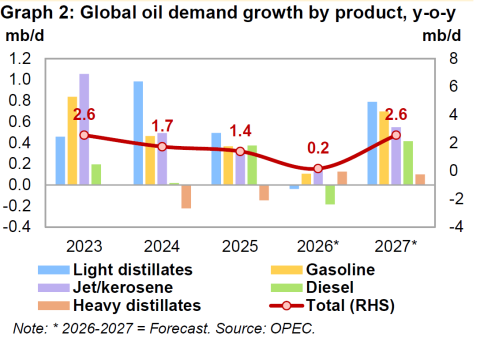
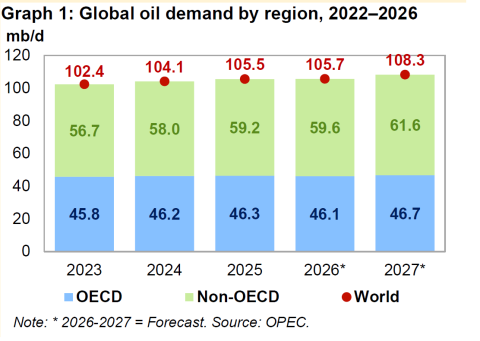
Meanwhile, OPEC revised its global oil demand growth forecast for 2026 slightly downward to 200,000 bbl/d, bringing average demand to 105.7 mmbbl/d.
The organization expects demand to rebound in 2027, increasing by 2.6 mmbbl/d to 108.3 mmbbl/d, partly reflecting anticipated inventory replenishment.
On the supply side, liquids production from countries outside the DoC is forecast to increase by 600,000 bbl/d in both 2026 and 2027. Brazil, the United States, Canada, and Argentina are expected to lead growth in 2026.
OPEC+ is an alliance of OPEC and non-OPEC oil-producing countries, including Russia, that coordinate oil production policies to support oil market stability. Established in 2016 under the DoC, OPEC+ seeks to promote cooperation among participating countries on oil market management.