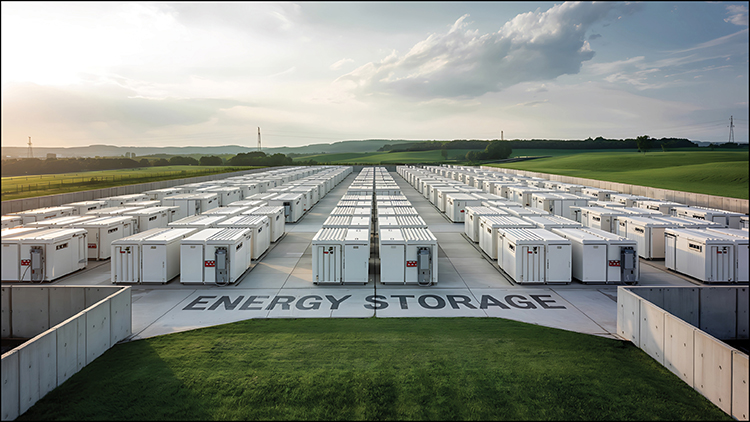
Mahmoud Esmat, Minister of Electricity and Renewable Energy, witnessed the signing of two agreements to establish separate Battery Energy Storage Systems(BESS) with a combined capacity of 1,500 megawatt-hour (MWh) in the Zafarana and Benban areas. The ceremony also included the signing of an agreement to build a factory for producing storage batteries with an annual capacity of 3,000 MWh, according to a statement by the Ministry of Electricity and Renewable Energy.
The signing was attended by Sheikh Hussein Al Nowais, Chairman of UAE-based AlNowais Investments and its subsidiary AMEA Power, and Ni Jin, Chairman of China Energy Engineering Corp CEEC). The contracts cover Engineering, Procurement, and Construction (EPC) works for the Horus standalone battery project with a capacity of 500 MWh at Zafarana and the Nefertiti standalone battery project at Benban with a capacity of 1,000 MWh.
The signing comes within the framework of Egypt’s plan to accelerate both grid‑connected and standalone energy storage projects to ensure network stability, uninterrupted electricity supply, maximize returns from renewable energy, and reduce reliance on fossil fuels in line with the country’s energy transition strategy.
Energy storage systems were first introduced in Egypt’s national electricity grid last year, according to Esmat, who explained that reliance on solar and wind power requires expanding battery storage to safeguard grid security and ensure a sustainable supply. He pointed out that specific projects are being implemented under set timelines to raise storage capacity to 14,320 MWh by 2028.
He emphasized the importance of localizing industry and transferring technology through partnerships with the private sector to maximize resources and consolidate Egypt’s position as a regional hub for renewable energy equipment manufacturing.
Egypt has witnessed finalizing several major deals to set renewable and BESS projects. In January, Scatec, a leading renewable energy solutions provider, signed a Power Purchase Agreement PPA with the Egyptian Electricity Transmission Company (EETC) to develop a solar power plant with a total capacity of 1.95 gigawatts (GW) and a Battery Energy Storage System (BESS) to store the generated power with a capacity of 3.9 gigawatt-hours (GWh). The combined capacity will represent the largest solar and BESS installation in Africa and the largest investment in Scatec’s history.