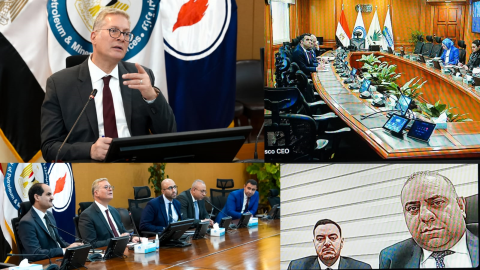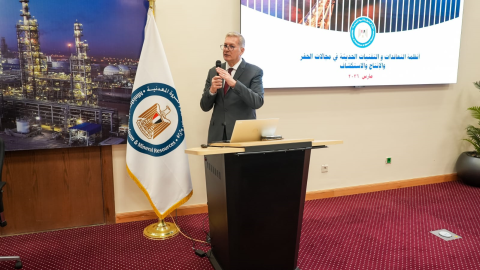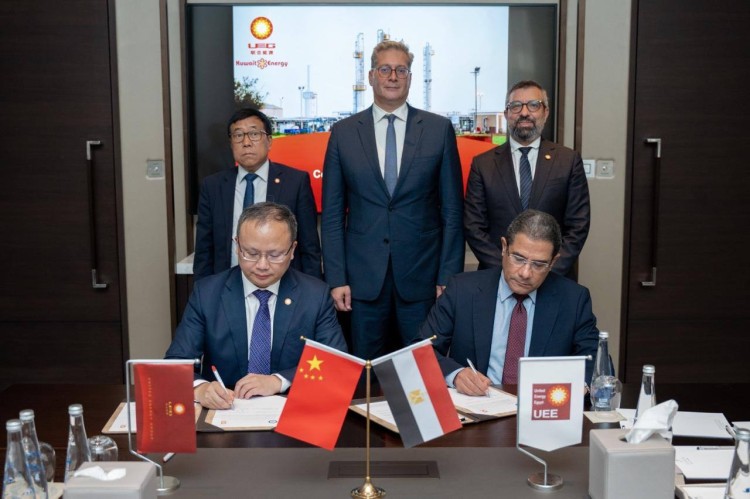
During his visit to the UAE, Karim Badawi, the Minister of Petroleum and Mineral Resources, met with his counterpart and the Chair of the International Affairs Office at the Presidential Court to discuss deepening regional cooperation between Egypt and the UAE. These two meetings were among others held with key industry leaders that concluded with signing two Memorandum of Understandings (MoUs) in the maritime and energy sectors.
The first MoU was signed between the MoPMR and Chinese United Energy Group (UEG). Its objective is to set a cooperation framework to explore investment opportunities in oil and gas sector within Egypt and across international markets, as well as expand in renewable energy and energy trading projects.
The ministry also signed a second MoU with Abu Dhabi Ports Group and TCM Project Manager LLC to explore joint operation and development of crude oil storage facilities as well as exploring cooperation at other fields with mutual interests.
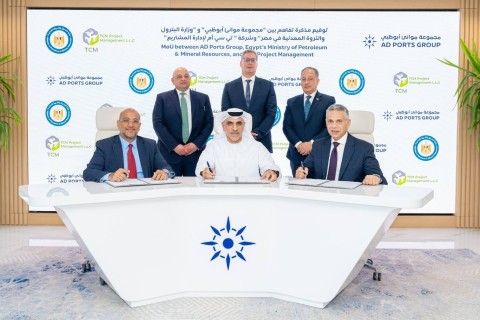
Commenting on the MoU, Badawi said: “We are pleased to sign a Memorandum of Understanding with both AD Ports Group, one of our most important partners in trade and infrastructure, and TCM, to explore opportunities to maximize the value of Egypt’s advanced petroleum sector assets, particularly the strategic crude oil storage facilities, as well as to identify other areas of mutual interest. This targeted partnership falls under the second and sixth pillars of our Ministry’s integrated strategy, maximizing the added value of Egypt’s petroleum sector assets and enhancing regional cooperation, especially with the United Arab Emirates, with whom we share deep and diverse ties across all energy domains, from upstream extraction and production to downstream transport, distribution, and marketing.”
For his part, Mohamed Juma El Shamisi, Managing Director and Group CEO, AD Ports Group, said: “This Memorandum of Understanding highlight our Group’s strategic interest in Egypt, a nation with which the United Arab Emirates enjoys deep and enduring ties. The potential joint operation and development of Egypt’s extensive crude oil storage network reflects our commitment to bringing the full strength of AD Ports Group’s integrated business model—spanning ports, maritime, logistics, economic zones, and digital solutions, through forging long-term strategic partnerships, supporting the economic and industrial objectives of the Egyptian government. Guided by the vision of our wise leadership in the UAE, we are dedicated to advancing a closer, mutually beneficial economic relationship with our partners in Egypt, to deliver tangible benefits to the Egyptian and Emirati peoples, and supporting the success of our strategic partners.”
Following this, Badawi met with Ahmed Al Mutawa, CEO of Abu Dhabi Ports Group; Saif Al Mazrouei, Head of Ports Sector; and Mahmoud Farag Omran, General Manager of TCM Project Management as a follow up on the signed MoU.
In this respect, the minister and his accompanying delegation toured Abu Dhabi Port and were briefed on its operational mechanisms. The ministry aims to integrate Abu Dhabi Ports Group’s advanced digital capabilities and operational expertise with Egypt’s modern petroleum infrastructure.
Abu Dhabi Ports Group (AD Ports Group) is involved in the management, operation, and development of multiple ports in Egypt, including Safaga, Alexandria, and East Port Said.
In January, Abu Dhabi Ports Group signed a MoU with Egyptian Holding Company for Maritime and Land Transport to develop and enhance the logistics area at Alexandria Port on the Mediterranean, thus boosting Egypt as a regional hub for transport and logistics.
In 2023, the group signed a definitive concession agreement with the Red Sea Ports Authority (RSPA) for the development and operation of a multi-purpose terminal at Safaga Sea Port over three years with investments worth $200 million. The agreement aims to develop advanced facilities spanning an area around 810,000 square meters at the Red Sea region in order to become the first internationally operated port serving the Upper Egypt region, the Group said in a press release.
Meanwhile, Badawi met with Mariam bint Mohammed Almheiri, Chair of the International Affairs Office at the Presidential Court, along with her accompanying delegation. The meeting addressed strengthening energy and mining ties between the two countries.
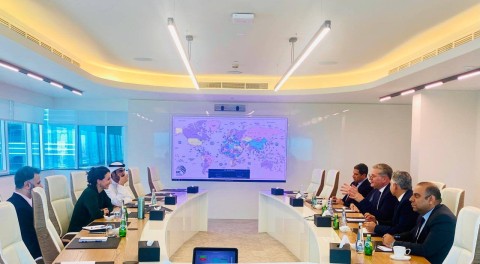
In this meeting, Badawi reviewed the efforts exerted to stimulate investment and remove obstacles facing investors in Egypt as the government’s top priorities.
He also recapped the government’s proactive plan to secure natural gas supply by increasing local production, pipeline networks, and imported liquefied natural gas (LNG).
In respect of the mining sector, Badawi highlighted the progress in improving the investment climate via transforming the Mineral Resources and Mining Industries Authority into an economic body. He also reviewed the updating of exploitation systems for gold and minerals, and developing and unifying the licensing system to streamline procedures.
For her part, Almheiri expressed her hope to further enhance cooperation between the two parties in light of the two country’s strong ties.
In another separate meeting, Minister Badawi discussed with Suhail Mohamed El Mazrouei, UAE Minister of Energy and Infrastructure, the possibility for cooperation in the energy sector. They both agreed to form a joint working group to exchange sound practices and success stories.
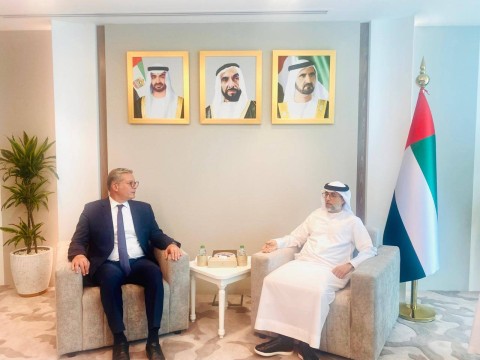
At the conclusion of the meeting, Minister Badawi extended an invitation to his Emirati counterpart to visit Egypt in the near future.
Last year, Egypt received the first oil tanker at its ports, based on the cooperation agreement signed between MoPMR and the government of the Emirate of Fujairah.
The agreement involved transferring the experience of developing the Port of Fujairah and establishing a petroleum logistics zone in the Hamra Port area on the Mediterranean Sea. It invests in Egypt’s geographical location and the infrastructure of the petroleum sector in the Hamra Port and trading petroleum products through the port’s facilities. It also includes supplying petroleum products to cover part of the local needs.