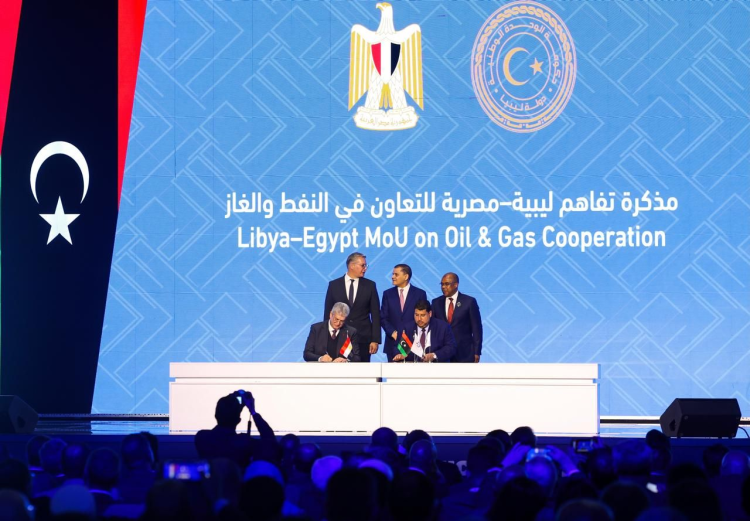
Egypt and Libya have signed a memorandum of understanding (MoU) to deepen cooperation in the oil, gas, and mining sectors on the sidelines of the Libya Energy and Economic Summit in Tripoli, according to a statement by the Ministry of Petroleum and Mineral Resources (MoPMR).
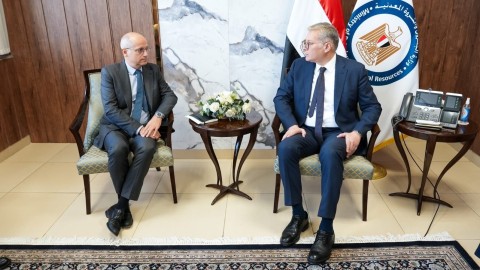
The agreement was signed by Waleed Lotfy, Chairman of the Petroleum Projects and Technical Consultations Company (PETROJET), and Masoud Suleman, Chairman of Libya’s National Oil Corporation (NOC). The signing ceremony was attended by Libyan Prime Minister Abdulhamid Al-Dbeibeh, Egypt’s Minister of Petroleum and Mineral Resources Karim Badawi, and Libya’s Minister of Oil and Gas Khalifa Abdulsadek.
The MoU establishes a framework for joint research, exploration, and the development of crude oil refining to maximize added value. The partnership also explores the feasibility of transporting crude oil and natural gas between the two nations.
The Libyan Prime Minister said the agreement stemmed from a shared commitment to building stronger energy institutions. “This agreement reflects our intent to deepen regional cooperation and exchange expertise to support production growth, energy security, and sustainable development,” Al-Dbeibeh stated.
During the Summits’ opening session, Badawi stated that supporting downstream industries such as petrochemicals, mining, manufacturing, and electricity generation, alongside other state sectors, is a key driver of economic development.
Furthermore, he noted that Egypt’s infrastructure is a strong platform for regional energy trading, citing its liquefaction plants and its position as Africa’s second-largest refining hub, with a crude processing capacity of 40 million tons per year (mmt/y).
It is worth noting that the oil and gas sector’s contribution to Egypt’s gross domestic product (GDP) stood at 8% in fiscal year (FY) 2024/25 to reach EGP1.27 trillion. This was driven by gains in downstream activities and stronger refinery operations, supported by efficiency upgrades and increased throughput.
Libya also recorded a series of discoveries in late 2025, mainly in the Sirte and Ghadames basins. It aims for an overall national output of 2 mmbbl/d by 2030, backed by a $20 billion investment program.