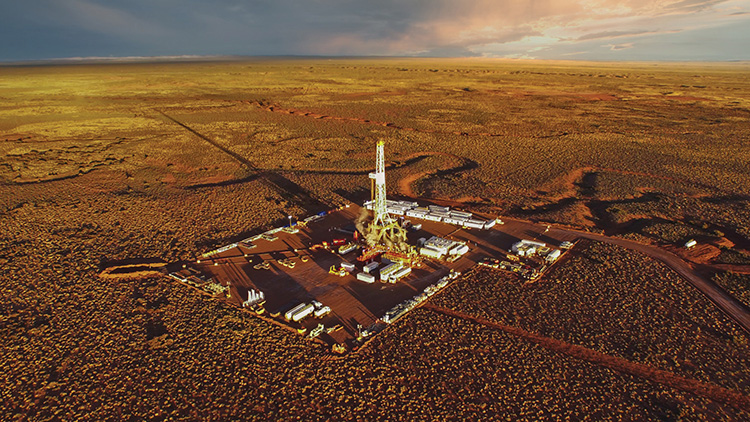
Spanning nearly two-thirds of Egypt’s landmass, the Western Desert remains one of the country’s most productive and technically challenging hydrocarbon provinces. Once defined mainly by oil production, the region has steadily evolved into a key source of natural gas and a testing ground for advanced exploration and recovery technologies. In 2025, a new wave of discoveries, reinvestment, and contract renewals is reaffirming the basin’s strategic importance to Egypt’s energy future.
New Discoveries Strengthening Output
Several recent discoveries have revitalized exploration momentum across the Western Desert. Agiba Petroleum, a joint venture between the Egyptian General Petroleum Corporation (EGPC) and Eni, announced the North Lotus Deep-1 discovery, producing both crude oil and gas from a tight reservoir previously considered low potential. The find reflects how deep exploration and improved imaging are unlocking hidden reserves beneath mature producing zones.
Furthermore, the Arcadia-28 well, also operated by Agiba, demonstrated further success by yielding significant oil volumes from the Masajid formation, a geological interval often overlooked in earlier exploration campaigns. Its commercial success highlights a growing strategy of reinterpreting older seismic data with modern geophysical tools to identify bypassed pay zones.
Meanwhile, in the Abu Sennan concession, new drilling confirmed hydrocarbon flows from the Bahariya formation, extending the life of one of the Western Desert’s oldest assets. These back-to-back discoveries underscore the effectiveness of brownfield revitalization, maximizing recovery in mature fields through directional drilling, enhanced completions, and real-time reservoir monitoring.
The Western Desert continues to attract both legacy operators and new entrants. In recent months, Egypt’s Ministry of Petroleum and Mineral Resources(MoMPR) has approved several concession amendments aimed at extending license durations, merging development leases, and improving fiscal terms to stimulate investment.
One notable development involves Lukoil and Eni, who secured extended rights for the Meleiha and Meleiha Deep concessions. The updated framework enables longer-term production planning and incentivizes deeper exploration by integrating cost recovery mechanisms and improved gas pricing terms. These policy adjustments, including a standardized gas price around USD 4.25 per Milion British Thermal Units (MMBtu), reflect the government’s commitment to maintaining investor confidence and ensuring sustainable project economics.
Simultaneously, Tag Oil has announced plans to expand its footprint in the Western Desert, applying unconventional techniques such as horizontal drilling and hydraulic fracturing to tap tight reservoirs. This marks a strategic shift toward developing unconventional resources that were previously uneconomic under older recovery methods.
The government’s ongoing bid rounds through the Egypt Upstream Gateway (EUG) platform have also attracted attention from international players such as Apache and Pharos Energy, both of which have been awarded new exploration areas. These investments demonstrate a renewed appetite for onshore exploration as global operators seek cost-effective barrels amid a balanced oil price environment.
Oil rich, Gas-Rising Potential
Historically, the Western Desert has accounted for roughly one-third of Egypt’s total hydrocarbon output, primarily from light crude oil fields such as Meleiha, West Ghazalat, and Alamein. However, recent discoveries indicate that gas is becoming an increasingly important component of the production mix.
The North Lotus Deep-1 well exemplifies this trend, producing both oil and natural gas in commercially attractive ratios. Across the region, associated gas recovery and reinjection programs are expanding, with operators integrating new gas processing facilities to reduce flaring and optimize resource use. This reflects Egypt’s broader national strategy of maximizing domestic gas supply while maintaining crude exports and feeding the country’s LNG export infrastructure on the Mediterranean coast.
As gas demand continues to rise, the Western Desert’s deeper formations are expected to play a growing role in Egypt’s medium-term gas balance. For many operators, the basin now represents a dual-resource play rather than a purely oil-dominant province.
Geological Complexity
The Western Desert’s geology remains as complex as it is promising. The basin features stacked reservoirs, tilted fault blocks, and stratigraphic traps that complicate both seismic interpretation and reservoir modeling. Yet these same structural intricacies create numerous smaller, high-productivity zones, rewarding those who invest in precision imaging and tailored drilling programs.
Hard rock lithologies and low-permeability formations often require enhanced completion methods such as acid stimulation or multistage fracturing. Operators are now employing high-resolution 3D seismic surveys, machine-learning-based interpretation, and depth-migration processing to resolve previously obscured subsurface structures. These advances have reduced drilling risk, improved well placement accuracy, and extended field life across mature concessions.
Another growing practice is the integration of digital reservoir modeling, combining production data, seismic re-analysis, and real-time downhole monitoring to forecast behavior in faulted or compartmentalized formations. Such technologies are transforming how companies approach exploration risk in one of Egypt’s most geologically diverse regions.
Policy Support
Egypt’s energy authorities have made the Western Desert a central pillar of their upstream growth plan. Recent contractual reforms emphasize flexibility, reduced bureaucracy, and accelerated tie-ins for discoveries located near existing infrastructure. This approach allows smaller finds to be monetized quickly and efficiently, especially where processing and transport facilities are already in place.
Additionally, there is growing emphasis on environmental performance. Operators are increasingly required to implement gas recovery systems, reduce flaring, and conduct biodiversity assessments for new development areas. These initiatives align with Egypt’s national strategy to balance resource development with environmental stewardship, which is a goal reinforced by the country’s continued leadership in regional energy transition dialogues.
Looking ahead, the Western Desert’s prospects remain bright. The region is transitioning from a mature oil province into a diversified hydrocarbon hub supported by modern technology and strong policy incentives. Near-field exploration, unconventional plays, and incremental recovery programs will drive the next phase of growth.
Over the next decade, success in the Western Desert will depend less on resource abundance and more on technical innovation. Operators that effectively deploy digital field management, enhanced recovery techniques, and adaptive exploration strategies will set the benchmark for sustainable upstream growth in Egypt.
In conclusion, the message emerging from 2025 is clear: the Western Desert has not reached its limits, it is redefining them. With continued investment, technological adaptation, and sound regulation, this vast landscape will remain a cornerstone of Egypt’s upstream sector and a symbol of how mature basins can continue to deliver in a changing global energy environment.