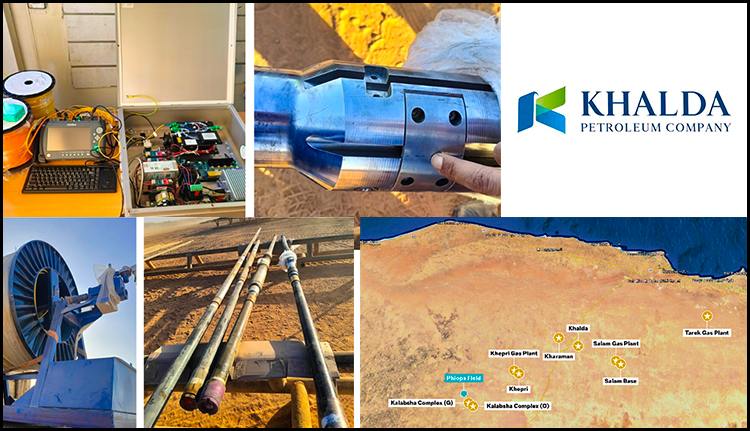
Khalda Petroleum is advancing the way reservoirs are managed by combining real-time reservoir intelligence with digital engineering workflows, demonstrating how advanced technologies can improve production performance, optimize reservoir management and support Egypt’s digital transformation across the oil and gas sector.
The company’s successful deployment of permanent downhole pressure and temperature monitoring at the Phiops-West field in Egypt’s Western Desert is providing engineering teams with continuous visibility into reservoir behavior, enabling faster decision-making, improved production optimization and measurable operational benefits.
One of Khalda Petroleum’s most productive assets, Phiops-West currently produces approximately 13,300 barrels of oil per day (bbl/d) and 34 million standard cubic feet of gas per day (mmscf) from just three producing wells, supported by a water injection system exceeding 45,500 bbl/d across four injection wells. Managing a reservoir of this complexity requires continuous optimization to maximize recovery while maintaining reservoir integrity and production efficiency.
Traditionally, reservoir engineers relied on periodic well tests and surface measurements to monitor reservoir performance. While these techniques remain fundamental to reservoir engineering, they provide only periodic snapshots of reservoir conditions. Between measurements, pressure changes, fluid movement and production behavior continue to evolve unseen beneath the surface.
To strengthen reservoir surveillance, Khalda Petroleum deployed permanent downhole pressure gauges approximately 12,000 feet below the surface, transmitting continuous reservoir data into a centralized digital platform shared by reservoir engineers, production engineers and field operations teams.
This continuous flow of information has transformed the way multidisciplinary teams monitor reservoir performance and make production decisions. Rather than relying solely on historical measurements, engineers now have access to real-time reservoir intelligence that allows pressure changes to be identified immediately, early gas or water breakthrough to be detected before production performance deteriorates, and production settings to be optimized proactively.
The benefits extend beyond improved visibility.
Continuous pressure monitoring has significantly enhanced reservoir understanding, enabling more accurate determination of bubble-point pressure and improving drawdown management to minimize unwanted gas evolution within the reservoir. Real-time surveillance has also strengthened production optimization through improved choke management, earlier operational intervention and increasingly data-driven reservoir models.
The operational impact is already measurable.
Real-time reservoir surveillance enabled a 3000 bbl/d waterflood response, demonstrating how continuous reservoir intelligence can translate directly into improved production performance. In addition, each monitored well is expected to reduce deferred production losses by approximately US$800,000 annually, based on previous operating experience using conventional monitoring systems and an oil price assumption of US$60 per barrel.
Beyond the production gains, continuous reservoir intelligence is improving production forecasting, strengthening reserve confidence, supporting automated nodal analysis currently under implementation and enabling engineering teams to make faster, more informed operational decisions.
The success achieved at Phiops-West has established the field as an important example of intelligent reservoir management within Khalda Petroleum’s operations. Building on these results, the company is expanding permanent downhole monitoring across additional oil and gas assets while supporting the Ministry of Petroleum and Mineral Resources’ digital transformation strategy.
The experience at Phiops-West demonstrates that digital transformation is not simply about adopting new technologies—it is about creating better outcomes. By combining engineering expertise with real-time reservoir intelligence, Khalda Petroleum is maximizing the value of Egypt’s energy resources, strengthening operational excellence and helping shape the future of the country’s oil and gas sector. In doing so, the company is advancing its vision of becoming a modern, industry-leading exploration and production company that delivers sustainable value through innovation, collaboration and operational excellence.