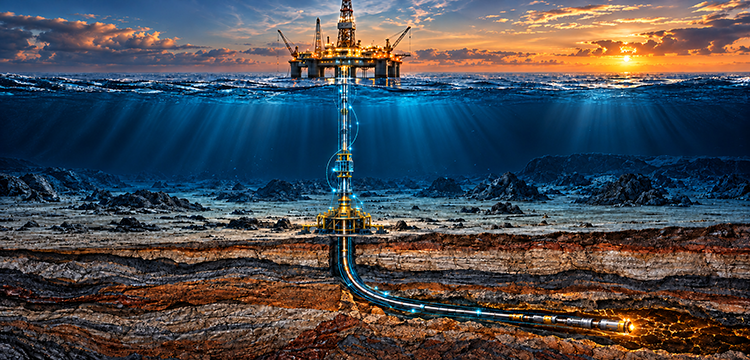
Imagine an orchestra performing thousands of feet beneath the sea. Sensors act as its ears, collecting data on drilling conditions and the surrounding environment. Software analyzes these signals, while automated equipment adjusts its operation. Each component has a distinct role, but success depends on how well they work together.
This is the principle behind autonomous drilling, which integrates artificial intelligence (AI), sensors, and rig control systems to coordinate drilling operations with less direct human intervention.
In deepwater environments, where changing rock formations, high pressures, and complex well trajectories leave little room for error, this coordination can improve drilling efficiency and operational consistency. Achieving autonomy, however, requires more than automating individual tasks. It means enabling different systems to exchange information and adjust their actions as conditions change.
From Individual Instruments to an Orchestra
Drilling a well requires continuous monitoring of parameters such as weight on bit (WOB), rotary speed, torque, pressure, and rate of penetration (ROP), which measures how quickly the drill bit advances through a formation. Traditionally, drilling teams monitor these parameters and adjust equipment as conditions change.
Automation takes over some repetitive tasks. An automated drilling system, for example, can adjust parameters to maintain a target weight on bit, while directional drilling systems help steer the well toward its intended reservoir.
Sensors provide real-time measurements for these adjustments. Machine learning and predictive analytics can also identify patterns that may indicate emerging problems, including excessive vibration, bit wear, or inadequate removal of rock cuttings from the wellbore.
The challenge becomes more complex when several automated systems operate simultaneously. One might seek to maximize drilling speed, while another prioritizes keeping the well on its planned trajectory. Without coordination, faster drilling could compromise directional control or contribute to poor hole cleaning.
Autonomous drilling addresses this challenge by linking data analysis, decision-making, and equipment control in a continuous feedback loop.
In a 2026 article published by SLB, Ziad Akkaoui, who works in marketing and technology development for digitally driven well construction workflows at the company, explained that true autonomy requires an integrated approach rather than disconnected tools.
“The entire process is a closed loop. Instead of simply supplying data or making suggestions, an autonomous system actively controls trajectory to optimize steering and well placement,” Akkaoui wrote.
In this workflow, software interprets subsurface data to identify drilling targets and passes instructions to the directional drilling system. The system transmits downlink commands, which are signals sent to downhole tools to change their settings or behavior.
Real-time engineering models monitor conditions and assess competing objectives, allowing the system to adjust or suspend commands when necessary to remain within predefined operating limits.
The drilling team remains responsible for setting objectives, supervising operations, and intervening when human judgment is required. Autonomy changes how drilling decisions are executed rather than eliminating human oversight.
Why Does This Matter in Deepwater?
As exploration and development extend into deeper and more remote offshore areas, operators face increasingly demanding well construction challenges. Deepwater projects can involve complex geology, high pressures, narrow operating margins, and long distances between offshore facilities and onshore support teams.
Deepwater generally refers to operations in water depths exceeding 1,000 feet (305 meters), although industry classifications vary. These developments commonly use floating drilling rigs or drillships connected to subsea wellheads and well-control equipment on the seabed.
Drilling in these environments requires careful management of pressure, well trajectory, and drilling fluid circulation. Unexpected formation conditions or pressure fluctuations can cause delays, equipment problems, and well-control incidents. Coordinated automation can help teams respond more consistently, although it cannot eliminate these risks.
Between 2021 and 2025, 373 high-impact wells discovered an estimated 29 billion barrels of oil equivalent (boe) in potentially commercial resources, with a commercial success rate of 30%, according to Drilling Contractor, the official magazine of the International Association of Drilling Contractors (IADC). Ultra-deepwater wells accounted for 16% of all wells drilled in 2025, the publication reported.
Major deepwater oil and gas developments are concentrated in Brazil, West Africa, the Gulf of Mexico, and the North Sea. As operators pursue resources in these regions, technologies that improve drilling control and consistency could help manage the demands of complex wells.
Technology in Action
In Brazil’s Campos Basin, SLB used an integrated rig automation system to drill a 2,695.5-meter section of a well with a 12¼-inch diameter. The project aimed to improve drilling efficiency, safety, and cost performance.
The company deployed its Neuro™ autonomous solutions and DrillOps™ software to coordinate drilling and steering decisions, maintain the planned well trajectory, and optimize the rate of penetration and energy use.
According to SLB, the approach reduced the need for personnel to enter hazardous areas.
The project delivered a reported increase of more than 60% in ROP, reaching an instantaneous rate of 80 meters per hour and a single-stand net ROP of 73.2 meters per hour.
More than 95% of the 2,695.5-meter section was controlled autonomously, with 66 of 69 downlink commands executed automatically. The team drilled 1,100 meters within 24 hours. SLB also reported a center-to-center distance of 1.58 meters between the actual wellbore and its planned trajectory.
These results demonstrate the potential of integrated automation to coordinate drilling and steering while maintaining control over well placement. The figures, however, relate to this specific project and should not be treated as universal gains across all wells.
In a deepwater exploration well offshore Indonesia, Eni and Halliburton deployed closed-loop rig automation integrated with managed-pressure drilling (MPD). Halliburton described it as the first deployment of this capability in the Asia-Pacific region.
MPD actively manages wellbore pressure to keep it within a specified operating window, particularly when the difference between formation pressure and the pressure that could fracture the formation is narrow.
The deployment combined automated rig equipment, well-placement systems, downhole hydraulics, and MPD controls. Halliburton’s LOGIX system coordinated drilling and tripping activities within a single workflow, integrating drilling execution with pressure management.
This integration helps the system respond to changing drilling conditions while maintaining control over wellbore pressure.
Jim Collins, vice president of Sperry Drilling at Halliburton, explained the value of the approach: “When we integrate rig automation with [managed-pressure drilling] controls, we close a critical gap and give operators better control, consistency, and performance in complex wells. This deployment proves the model scales in a deepwater environment,” Collins said.
Halliburton reported that the deployment improved efficiency by more than 15% while maintaining well control within a narrow operating margin.
What Could Disrupt Performance?
Autonomous drilling depends on reliable data, communication between system components, and accurate models of changing conditions.
Poor-quality sensor readings, communication failures, or unexpected geological conditions can undermine automated decisions. Systems must recognize when conditions fall outside predefined operating limits and respond appropriately, including suspending automated actions or transferring control to the drilling team.
Integration is another challenge. Equipment and software from different suppliers may use different data formats, control protocols, and operating procedures. Coordinating them requires reliable interfaces and testing under different operating conditions.
As Akkaoui noted in his SLB article, drilling autonomy also depends on “data quality, system integration, and process design.” These foundations determine whether automated workflows can deliver reliable, repeatable performance across different wells.
The orchestra analogy captures the central challenge: sensors collect the signals, AI helps interpret them, and control systems coordinate the response. The drilling team sets objectives and remains responsible for supervision and intervention when necessary.
The next step is to make this coordination reliable across different rigs, geological formations, and deepwater environments. Progress will depend not simply on how many tasks can be automated, but on how effectively integrated systems maintain well control, meet drilling targets, and respond safely when conditions change.