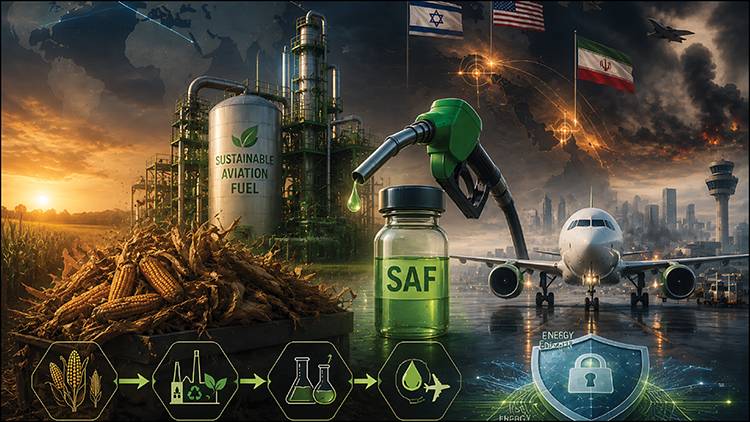
In times of geopolitical uncertainty, energy security suddenly becomes more than an economic concern, it becomes a strategic imperative. The recent US-Israeli war on Iran served as another reminder of just how vulnerable the aviation sector remains to disruptions in global energy markets.
The Middle East, the world’s largest supplier of aviation fuel, saw its exports severely disrupted during the conflict. The closure of the Strait of Hormuz halted around 400,000 barrels per day (bbl/d) of jet fuel exports, driving European spot prices to record highs of more than $200 per barrel in April, according to Reuters. Following the reopening of the strait, global prices eased and stabilized at an average of $119.17 per barrel, however, they are still higher than pre-war levels, which averaged globally between $85 and $90 per barrel.
The International Air Transport Association (IATA), which represents more than 370 airlines accounting for roughly 85% of global air traffic, projects the industry’s fuel bill will rise 39% to $350 billion in 2026, up from $252 billion in 2025, with fuel nearing one third of operating costs.
As a learned lesson, scaling up the production of sustainable aviation fuels (SAF) becomes necessary to expand resources. SAF is considered sustainable because it is produced from renewable or waste-based sources which in return reduce dependence on fossil fuels while reducing greenhouse gas emissions. It acts as a “drop in” fuel, meaning it can be blended with regular jet fuel and used in existing aircraft, engines, and airport fuel systems.
The aviation industry is at the very beginning of this mountain. In 2026, IATA expects global SAF production to reach around 2.4 million tons (mt), accounting for just 0.8% of aviation fuel use.
Researchers from the World Resources Institute (WRI) have explored an innovative method of utilizing agriculture waste to produce SAF. Rather than relying on corn grain, the study focuses on corn stover, the stalks, leaves, husks, and cobs left behind after corn is harvested. They argue that these agricultural residues could provide more sustainable feedstock for SAF while avoiding many of the environmental challenges associated with crop-based biofuels.
SAF from Corn Waste
While some SAF pathways in the US already rely on corn-based ethanol, researchers found that using the crop itself is relatively inefficient, requiring about 1.7 gallons of ethanol to produce a single gallon of jet fuel. In addition, diverting corn to fuel production creates competition with food and animal feed markets. To compensate for this gap, farmers might rely on adding agricultural lands elsewhere. This could result in clearing forests and converting grasslands, all of which increases deforestation as well as greenhouse gas emissions (GHG).
Meanwhile vast quantities of this corn stover remain in fields every year after the harvest in the Corn Belt in the American Midwest region. Researchers found that US contains around 90 million tons per year (mt/y) of sustainably recoverable corn stover. According to the study, this volume could produce around three billion gallons of SAF annually, enough to meet the US’ 2030 SAF Grand Challenge target, designed since 2021 for the purpose of increasing adoption of SAF in the US and overcome its challenges to ultimately replace the jet fuel.
However, turning fibrous plant waste into a fuel capable of powering commercial aircraft is far more complex than refining vegetable oils, used cooking oil, or animal fats, into today’s SAF. Corn stover is made up largely of cellulose, hemicellulose, and lignin; tough plant materials that must first be broken down before they can be transformed into hydrocarbons suitable for aviation.
Four technologies, One Goal
The study analyzed the potential for implementing four solutions for SAF production.
The most commercially advanced is Alcohol-to-Jet (AtJ) technology. In this process, corn stover is first converted into cellulosic ethanol through biochemical processing. Microorganisms ferment the plant sugars into alcohol, which is then chemically upgraded into jet fuel molecules. The major advantage of AtJ is that it can leverage much of the Midwest’s existing ethanol infrastructure, allowing producers to build upon decades of investment in biofuel production. However, the process is relatively inefficient, producing only about 34 gallons of jet fuel per ton of corn stover.
A more technologically intensive route is the Fischer-Tropsch (FT) process, a technology originally developed in Germany nearly a century ago but now being adapted for sustainable fuels. Instead of fermenting biomass into alcohol, FT gasifies corn stover at extremely high temperatures, converting it into a synthetic gas known as “syngas”, a mixture primarily composed of hydrogen and carbon monoxide. The syngas is then catalytically transformed into liquid hydrocarbons that closely resemble conventional jet fuel. This pathway is more efficient than AtJ, yielding roughly 52 gallons of fuel per ton of stover, but requires expensive gasification facilities and substantial upfront investment.
Researchers are also exploring a newer generation of electro-fuel technologies, which combine biomass with renewable electricity and hydrogen.
One example is Power-to-Liquid (PtL) technology. Rather than relying directly on corn waste, PtL uses renewable electricity to split water into hydrogen through electrolysis. The hydrogen is then combined with captured carbon dioxide—often sourced from ethanol plants, to synthesize liquid aviation fuel. Because PtL relies heavily on clean electricity and carbon capture, its environmental performance and costs depend on the availability of cheap renewable power and low-cost hydrogen production.
Perhaps the most promising technology examined in the study is Power-and-Biomass-to-Liquid (PBtL), which effectively combines the strengths of biomass conversion and electro-fuels. In this process, corn stover is gasified into syngas, while renewable hydrogen is added to maximize fuel production. By supplementing biomass with green hydrogen, technology extracts significantly more energy from every ton of agricultural residue.
The result is a dramatic improvement in efficiency. According to the study, PBtL can produce about 163 gallons of SAF per ton of corn stover, nearly five times more than Alcohol-to-Jet technology and more than three times the output of Fischer-Tropsch systems. Among all pathways evaluated, PBtL delivers the highest fuel yield while making the most effective use of limited biomass resources.
SAF Initiatives Beyond the US
While the World Resources Institute study highlights the potential of agricultural residues such as corn stover, most of today’s SAF production relies on a very different feedstock.
In Egypt, for example, two major SAF projects are being developed based on used cooking oil (UCO) conversion technologies.
The first is the Alexandria SAF Plant, a $530 million project licensed in December 2025 in partnership with Honeywell UOP. The facility is expected to produce up to 120,000 tons per year (t/y) of SAF
The second is the Ain Sokhna SAF Hub, being developed within the Suez Canal Economic Zone (SCZONE) by Qatar’s Al Mana Holding through SAF Fly Ltd. The multi-phase project represents more than $500 million in direct investment and targets a production capacity of approximately 600,000 t/y.
Backed by a long-term offtake agreement under which Shell will purchase 100% of its output, the project aims to begin commercial supply by the end of 2027 and is expected to generate up to $15 billion in export revenues over the following decade.
Agricultural waste such as corn stover offers a vast, underutilized resource for sustainable aviation fuel. The challenge now lies not in feedstock availability but in advancing technologies that can unlock its full potential. Whether through biochemical, thermochemical, or hybrid electro fuel pathways, scaling these innovations from pilot projects to commercial deployment will determine if crop residues can truly fuel the future of aviation and help shield the industry from the volatility of global energy markets.