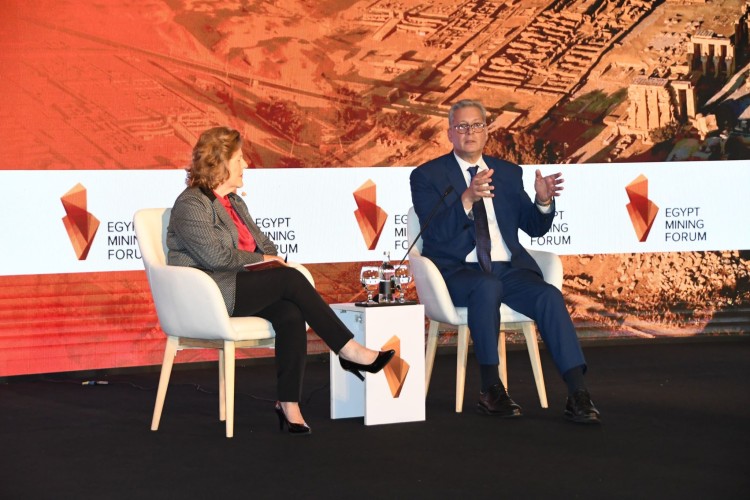
The Mineral Resources and Mining Industries Authority (MRMIA) will commence aerial survey for mineral exploration for the first time in decades as part of the sector development strategy, said Minister of Petroleum and Mineral Resources Karim Badawi during the closing session of the Egypt Mining Forum in Cairo.
This is one of the first decisions taken by the authority following the parliament’s approval to amend law no.198 of 2014 to transform the authority from a service to an independent economic entity to empower investors and unlock Egypt’s full mining potential.
“The revamped authority now possesses the capability to carry out comprehensive aerial surveys and process the necessary geological data to attract new investments,” said Badawi.
Badawi explained that the authority in its new form represents an advanced operational model aligned with the best global best practices to yield real results. “The current efforts focus on rapidly addressing reform priorities, continuously improving the investment climate, and simplifying procedures for stakeholders.”
The House of Representatives conducted a legislative assessment to study the impact of the 2014 law and found that it failed to achieve the desired impact on the mining’s contribution to Egypt’s Gross Domestic Product (GDP), according to Mohamed Ismail, Member of the Constitutional and Legislation Affairs Committee at the Egyptian House of Representatives.
Ismail, further explained during a morning session at the Egypt Mining Forum that the most prominent challenge facing the authority is the lack of financial independence.
To address this, the authority’s Board of Directors now includes representatives from various relevant government agencies, such as the Ministries of Environment, Finance, and Defense, thereby allowing the rapid start of projects.
Furthermore, Mohamed El Sallab, Chairman of the Industrial Committee at the Egyptian Parliament, explained the importance of modernizing geological and economic databases related to mineral resources. He noted that access to accurate figures and technical indicators will accelerate investment decisions, particularly for industrial projects that convert raw minerals into high-value economic goods.
“Within three years, the sector could raise its contribution to Egypt’s GDP to 5%, potentially reaching 10%,” El Sallab said during the same morning session.
He emphasized the critical role of the amended law in enabling the mineral resources authority to forge investment partnerships and implement local mineral processing projects that maximize economic returns and added value, instead of exporting raw materials and re-importing them as finished products.