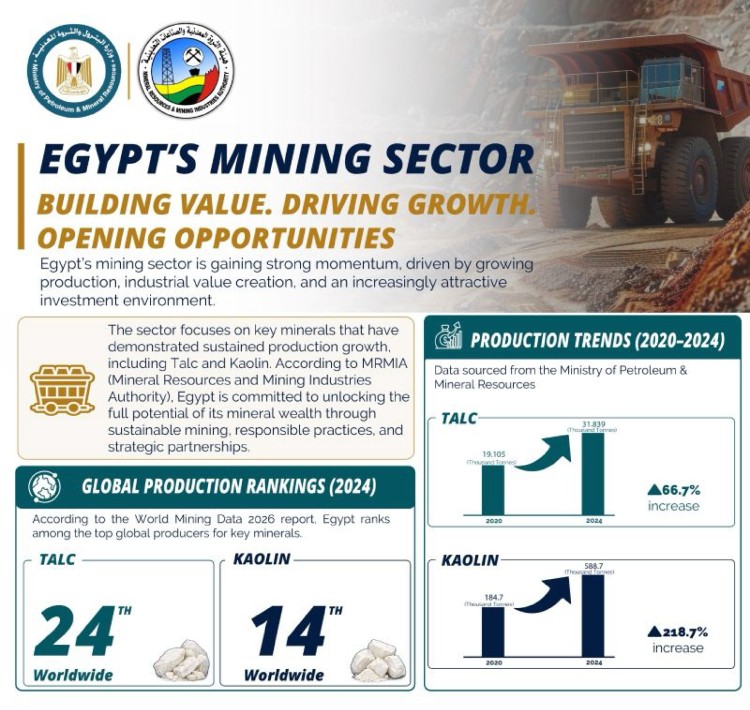
Egypt ranked 14th globally in kaolin production and 24th in talc production, according to the World Mining Data 2026 report, underscoring the country’s growing mining sector and expanding industrial mineral output.
An infographic by the Ministry of Petroleum and Mineral Resources (MoPMR) showed that Egypt’s kaolin production increased by more than 218% between 2020 and 2024, while talc production rose by nearly 67% over the same period, reflecting the country’s expanding mining capabilities.
Kaolin and talc are key industrial minerals used in the production of ceramics, glass, paper, paints, plastics, and cosmetics. Increased production of these minerals is expected to support industrial growth, boost exports, expand value-added manufacturing, and create new employment opportunities.
To build on this momentum, the Mineral Resources and Mining Industries Authority (MRMIA) launched the Open Blocks System (OBLP) in June 2026, a year-round licensing framework designed to attract investment in mineral exploration.
The new system provides exploration opportunities for gold, phosphate, talc, and kaolin, while streamlining access to prospective mining areas through a transparent and competitive licensing process. It also gives priority to projects that include local value-added processing, in line with the government’s strategy to maximize the economic returns from Egypt’s mineral resources.
According to the report, the surge in production aligns with a broader expansion of Northern Africa’s total mineral output, which reached 313.82 million metric tons in 2024. This activity highlights the region’s foundational role in global energy and commodity supply chains, a position further reinforced by Egypt’s strategic integration into the expanding BRICS economic bloc. The integration formally welcomed Egypt, Ethiopia, Iran, and the United Arab Emirates, marking a structural shift in South-South economic cooperation and resource governance.
Within this global distribution, Asia maintained its dominant position with 62.7% of total production, while the African continent accounted for 4.8%. The Northern Africa region recorded 313.82 million metric tons in 2024, down from 361.36 million metric tons in 2023, underscoring an institutional shift toward optimizing high-value processing rather than raw extraction.
The Federal Ministry of Finance of the Republic of Austria compiles the World Mining Data report annually in cooperation with the International Organizing Committee for the World Mining Congresses. Published in Vienna, the statistical framework monitors global output across iron, non-ferrous metals, precious metals, industrial minerals, and mineral fuels, serving as a primary benchmark for international resource policy and commodity forecasting.