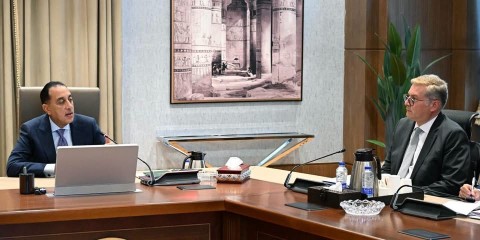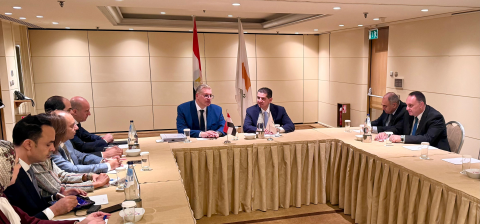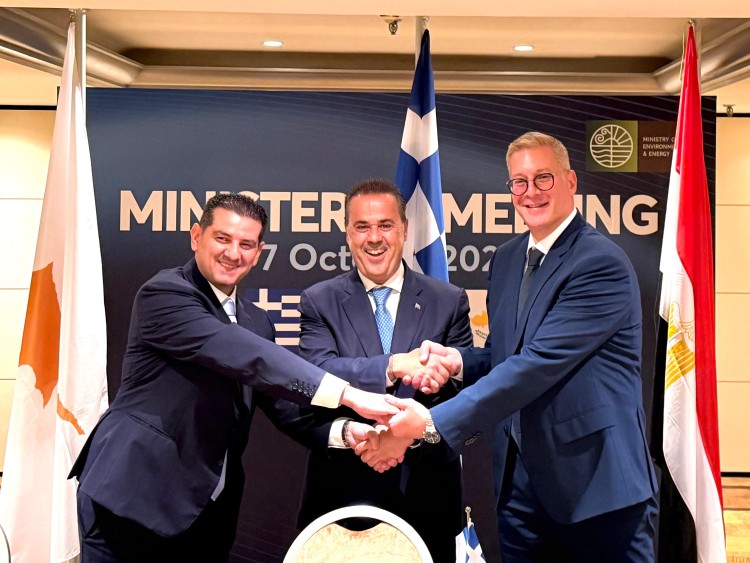
Karim Badawi, Egypt’s Minister of Petroleum and Mineral Resources, held talks with Greek Environment and Energy Minister Stavros Papastavrou and Cypriot Energy Minister Michael Damianos on accelerating East Mediterranean gas development and connecting regional resources to European markets.
The meeting, held on the sidelines of the Eastern Mediterranean Gas Forum’s (EMGF) high-level roundtable in Athens, focused on advancing energy cooperation under the Egypt-Cyprus-Greece trilateral framework and developing regional gas projects.
The ministers underscored the countries’ complementary strengths: Cyprus with its promising gas reserves, Egypt with its established infrastructure for transport, processing, liquefaction and re‑export, and Greece with its strategic location and interconnected networks providing access to Southern and Central European markets
They discussed the development of Cyprus’ Cronos and Aphrodite fields, including opportunities to process and liquefy Cypriot gas in Egypt before exporting it to European markets. Talks also covered integrating regional gas infrastructure, maximizing existing facilities, and assessing future capacity needs.
The ministers highlighted the role of the Vertical Gas Corridor in opening routes for East Mediterranean gas to Southern and Central Europe, supporting supply diversification and regional energy connectivity. The corridor is a network of existing and planned gas infrastructure linking Greece with Bulgaria, Romania, Moldova, Ukraine, Hungary, and Slovakia along a south-to-north route. Egypt is one of the potential gas sources for the corridor.
Badawi said integrating Egypt’s infrastructure with East Mediterranean resources and European interconnections would strengthen Egypt’s position as a regional gas trading hub and support additional cross-border projects. The network includes pipelines with Greece serving as a key entry point through infrastructure. Egypt is one of the potential gas sources for the corridor.
The meeting also stressed moving priority projects from planning to implementation by addressing technical, commercial, and regulatory challenges and advancing eligible projects toward final investment decisions (FIDs).
The three energy ministers emphasized the need for a stable investment environment with clear regulations, streamlined approvals, and transparent infrastructure-access arrangements. They also reaffirmed the EMGF’s role in coordinating governments, regulators, and energy companies, monitoring priority projects, and connecting regional resources with infrastructure and markets.
Energy cooperation between Egypt and Greece also extends to electricity through the GREGY interconnection project, which aims to transmit renewable electricity generated in Egypt to Greece and onward to the European market. Egypt plans to export 3,000 megawatts (MW) of electricity to Europe via the Greek network.