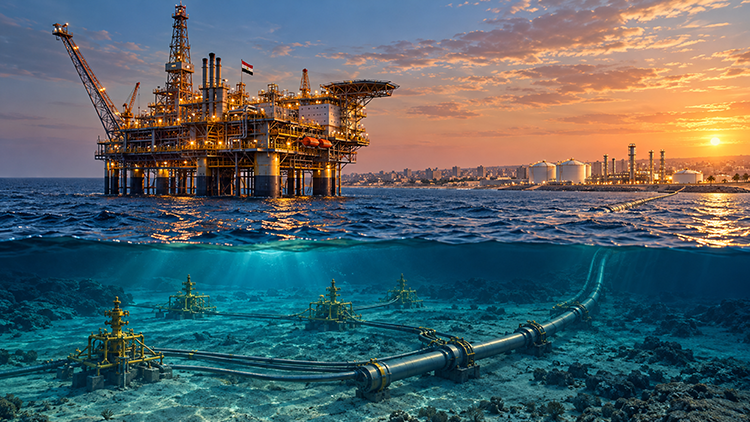
Deep-water exploration has become a key part of Egypt’s upstream strategy as the country aims to reverse declining natural gas production, cut its dependence on costly liquefied natural gas (LNG) imports and reaffirm its status as a regional energy hub. Deepwater gas finds can be game changers, but they also rank among the most capital- and technology-intensive investments in the global energy business. The economics of these projects are therefore at the heart of Egypt’s energy future.
Relieving Pressure on the State Budget
Egypt’s renewed focus on deepwater exploration is driven by a mix of economic and energy-security factors. Growing domestic gas demand, declining output from mature fields and increasing LNG import needs have driven the critical need for new supply sources.
The financial implications are considerable as imported LNG comes at a significantly higher cost than domestically produced gas, according to Omar Youssef Sallam, Energy Consultant. “Imported LNG costs about $12–13.5 million British thermal units (MMBtu), while deepwater gas costs $6 to $7 per MMBtu. That leaves a saving of about $5–7.5/MMBtu.” He said adding that 1 billion cubic feet per day (bcf/d) of imported LNG replaced by domestic production could save Egypt roughly $1.9-2.8 billion annually.
The Economics of Going Deep
There is significant money to be made in deepwater gas, but reaching that potential requires years of investment and a high tolerance for risk. Unlike onshore or shallow-water developments, deepwater projects demand massive upfront spending long before the first molecule of gas reaches the market.
The spending begins during exploration, when operators invest heavily in advanced seismic imaging, geological modeling, and exploratory drilling. Identifying reservoirs buried beneath deep waters and complex geological formations often requires sophisticated 3D and 4D seismic surveys, adding substantially to early-stage costs.
Drilling is another major financial hurdle. Ultra-deepwater wells can cost hundreds of millions of dollars, with companies facing the constant risk of drilling dry wells that yield no commercial discovery.
Recent activity underscores the scale of investment required. In January 2026, the Egyptian Natural Gas Holding Company (EGAS) announced plans to continue expanding the giant Zohr field and drill two new wells at a combined cost of about $360 million.
Yet drilling is only part of the equation.
“The biggest cost burden is typically offshore development and subsea infrastructure, not exploration drilling alone,” said Mohamed Basyouni, Global Geological Strategist with a PhD in Geology. “Deepwater wells are expensive, but the real economic challenge lies in the combined cost of subsea wells, flowlines, pipelines, SURF systems, offshore facilities, and the logistics needed to install and operate them. The deeper the water and the farther the project is from existing infrastructure, the higher the capital requirements.”
Once a discovery is made, operators must finance extensive subsea networks, pipelines, production systems, and processing facilities. These developments often take years to complete before generating any revenue. During that period, companies remain exposed to financing costs and commodity-price swings, adding another layer of risk.
As Basyouni puts it: “Deepwater gas requires far greater upfront capital than conventional developments. To make the economics work, operators need larger reserves, stronger production potential, and greater confidence in the project’s development plan.”
Economies of Scale in Deepwater Exploration
Because costs are so high, access to infrastructure is important for deepwater exploration. “Unlike many onshore or shallow-water projects, infrastructure access can be a decisive economic factor,” according to Basyouni.
This consideration has encouraged the adoption of development-cluster strategies, where multiple discoveries can share infrastructure and benefit from lower marginal development costs. Such approaches reduce capital requirements, accelerate project timelines, and improve commercial viability.
A recent example is the Denise W discovery in the Eastern Mediterranean. Announced by bp in April 2026, the Denise W-1 exploration well encountered an estimated 2 trillion cubic feet (tcf) of gas initially in place, along with around 130 million barrels of condensate. The discovery is particularly significant given its location in just 95 metres of water and less than 10 kilometres from existing infrastructure. The asset lies within the Temsah Concession, where Eni and bp each hold a 50% stake.
For discoveries such as Denise W, proximity to existing infrastructure can significantly improve project economics by reducing development costs, shortening timelines to first production, and accelerating commercialisation.
“Proximity to existing infrastructure and processing facilities can significantly enhance the economics of a deepwater gas discovery,” Basyouni says. “Infrastructure-led exploration and tie-back opportunities are particularly attractive because they can lower development costs, shorten lead times and bring first gas online more quickly.”
Rather than choosing between frontier and near-field exploration, Basyouni advocates a balanced portfolio approach. “The most effective strategy for Egypt is to leverage near-field and infrastructure-led opportunities to generate near-term value while maintaining a disciplined pipeline of high-impact deepwater prospects,” he says.
Balancing Risk with Incentives
Recognising the strategic importance and high risks of deepwater exploration, Egypt has introduced a series of reforms to improve investor confidence and project economics.
According to Sallam, the most significant step was clearing outstanding payments to international oil companies. “Arrears of around $6.1 billion were fully settled by June 2026, triggering $19 billion in new investment commitments,” he says.
Pricing reforms have also strengthened project economics. “Offshore gas offtake prices now exceed $6/MMBtu, compared with a previous ceiling of $2.65. More flexible contractual frameworks have also been introduced, including traditional PSAs, R-factor PSAs and tax-and-royalty models.”
Beyond pricing and payments, Egypt has updated petroleum agreements to include incentives tailored to the higher costs and risks of deepwater developments in frontier areas of the Mediterranean and Red Sea. According to the Ministry of Petroleum and Mineral Resources, the measures are designed to improve investment returns and accelerate the transition from discovery to production.
The government has also rolled out incentives linked to production growth and faster field development. Part of the revenues from incremental output will be used to settle obligations to international partners, while higher production will help meet domestic demand and reduce reliance on energy imports.
Despite strong competition from neighbouring markets, Egypt retains key advantages.
“Egypt’s fiscal terms remain less attractive than those offered by Israel, Cyprus and Greece, but this is offset by superior infrastructure and robust domestic demand,” says Sallam. “Egypt competes on infrastructure and market scale rather than generous fiscal terms.”
The economic value of deepwater gas extends well beyond project revenues. By boosting domestic production, Egypt can significantly reduce the foreign currency needed to import LNG, easing pressure on both the balance of payments and the state budget. According to Sallam, the country’s oil trade deficit widened by 31.5% to $18.3 billion in FY2025/26, largely because of higher natural gas imports. He estimates that domestic gas requires roughly 70% less foreign currency per unit than imported LNG, as the state pays in dollars only for the foreign partner’s share of production, while LNG cargoes must be paid for entirely in foreign currency.
Why Deepwater Still Matters
Despite high costs, technical complexity and long development cycles, deepwater exploration remains central to Egypt’s energy ambitions. Infrastructure-led developments, supportive fiscal policies and the drive to curb LNG imports continue to underpin the sector’s economics, positioning deepwater resources as a key contributor to long-term energy security and economic resilience.
Deep-water exploration has become a key part of Egypt’s upstream strategy as the country aims to reverse declining natural gas production, cut its dependence on costly liquefied natural gas (LNG) imports and reaffirm its status as a regional energy hub. Deepwater gas finds can be game changers, but they also rank among the most capital- and technology-intensive investments in the global energy business. The economics of these projects are therefore at the heart of Egypt’s energy future.
Relieving Pressure on the State Budget
Egypt’s renewed focus on deepwater exploration is driven by a mix of economic and energy-security factors. Growing domestic gas demand, declining output from mature fields and increasing LNG import needs have driven the critical need for new supply sources.
The financial implications are considerable as imported LNG comes at a significantly higher cost than domestically produced gas, according to Omar Youssef Sallam, Energy Consultant. “Imported LNG costs about $12–13.5 million British thermal units (MMBtu), while deepwater gas costs $6 to $7 per MMBtu. That leaves a saving of about $5–7.5/MMBtu.” He said adding that 1 billion cubic feet per day (bcf/d) of imported LNG replaced by domestic production could save Egypt roughly $1.9-2.8 billion annually.
The Economics of Going Deep
There is significant money to be made in deepwater gas, but reaching that potential requires years of investment and a high tolerance for risk. Unlike onshore or shallow-water developments, deepwater projects demand massive upfront spending long before the first molecule of gas reaches the market.
The spending begins during exploration, when operators invest heavily in advanced seismic imaging, geological modeling, and exploratory drilling. Identifying reservoirs buried beneath deep waters and complex geological formations often requires sophisticated 3D and 4D seismic surveys, adding substantially to early-stage costs.
Drilling is another major financial hurdle. Ultra-deepwater wells can cost hundreds of millions of dollars, with companies facing the constant risk of drilling dry wells that yield no commercial discovery.
Recent activity underscores the scale of investment required. In January 2026, the Egyptian Natural Gas Holding Company (EGAS) announced plans to continue expanding the giant Zohr field and drill two new wells at a combined cost of about $360 million.
Yet drilling is only part of the equation.
“The biggest cost burden is typically offshore development and subsea infrastructure, not exploration drilling alone,” said Mohamed Basyouni, Global Geological Strategist with a PhD in Geology. “Deepwater wells are expensive, but the real economic challenge lies in the combined cost of subsea wells, flowlines, pipelines, SURF systems, offshore facilities, and the logistics needed to install and operate them. The deeper the water and the farther the project is from existing infrastructure, the higher the capital requirements.”
Once a discovery is made, operators must finance extensive subsea networks, pipelines, production systems, and processing facilities. These developments often take years to complete before generating any revenue. During that period, companies remain exposed to financing costs and commodity-price swings, adding another layer of risk.
As Basyouni puts it: “Deepwater gas requires far greater upfront capital than conventional developments. To make the economics work, operators need larger reserves, stronger production potential, and greater confidence in the project’s development plan.”
Economies of Scale in Deepwater Exploration
Because costs are so high, access to infrastructure is important for deepwater exploration. “Unlike many onshore or shallow-water projects, infrastructure access can be a decisive economic factor,” according to Basyouni.
This consideration has encouraged the adoption of development-cluster strategies, where multiple discoveries can share infrastructure and benefit from lower marginal development costs. Such approaches reduce capital requirements, accelerate project timelines, and improve commercial viability.
A recent example is the Denise W discovery in the Eastern Mediterranean. Announced by bp in April 2026, the Denise W-1 exploration well encountered an estimated 2 trillion cubic feet (tcf) of gas initially in place, along with around 130 million barrels of condensate. The discovery is particularly significant given its location in just 95 metres of water and less than 10 kilometres from existing infrastructure. The asset lies within the Temsah Concession, where Eni and bp each hold a 50% stake.
For discoveries such as Denise W, proximity to existing infrastructure can significantly improve project economics by reducing development costs, shortening timelines to first production, and accelerating commercialisation.
“Proximity to existing infrastructure and processing facilities can significantly enhance the economics of a deepwater gas discovery,” Basyouni says. “Infrastructure-led exploration and tie-back opportunities are particularly attractive because they can lower development costs, shorten lead times and bring first gas online more quickly.”
Rather than choosing between frontier and near-field exploration, Basyouni advocates a balanced portfolio approach. “The most effective strategy for Egypt is to leverage near-field and infrastructure-led opportunities to generate near-term value while maintaining a disciplined pipeline of high-impact deepwater prospects,” he says.
Balancing Risk with Incentives
Recognising the strategic importance and high risks of deepwater exploration, Egypt has introduced a series of reforms to improve investor confidence and project economics.
According to Sallam, the most significant step was clearing outstanding payments to international oil companies. “Arrears of around $6.1 billion were fully settled by June 2026, triggering $19 billion in new investment commitments,” he says.
Pricing reforms have also strengthened project economics. “Offshore gas offtake prices now exceed $6/MMBtu, compared with a previous ceiling of $2.65. More flexible contractual frameworks have also been introduced, including traditional PSAs, R-factor PSAs and tax-and-royalty models.”
Beyond pricing and payments, Egypt has updated petroleum agreements to include incentives tailored to the higher costs and risks of deepwater developments in frontier areas of the Mediterranean and Red Sea. According to the Ministry of Petroleum and Mineral Resources, the measures are designed to improve investment returns and accelerate the transition from discovery to production.
The government has also rolled out incentives linked to production growth and faster field development. Part of the revenues from incremental output will be used to settle obligations to international partners, while higher production will help meet domestic demand and reduce reliance on energy imports.
Despite strong competition from neighbouring markets, Egypt retains key advantages.
“Egypt’s fiscal terms remain less attractive than those offered by Israel, Cyprus and Greece, but this is offset by superior infrastructure and robust domestic demand,” says Sallam. “Egypt competes on infrastructure and market scale rather than generous fiscal terms.”
The economic value of deepwater gas extends well beyond project revenues. By boosting domestic production, Egypt can significantly reduce the foreign currency needed to import LNG, easing pressure on both the balance of payments and the state budget. According to Sallam, the country’s oil trade deficit widened by 31.5% to $18.3 billion in FY2025/26, largely because of higher natural gas imports. He estimates that domestic gas requires roughly 70% less foreign currency per unit than imported LNG, as the state pays in dollars only for the foreign partner’s share of production, while LNG cargoes must be paid for entirely in foreign currency.
Why Deepwater Still Matters
Despite high costs, technical complexity and long development cycles, deepwater exploration remains central to Egypt’s energy ambitions. Infrastructure-led developments, supportive fiscal policies and the drive to curb LNG imports continue to underpin the sector’s economics, positioning deepwater resources as a key contributor to long-term energy security and economic resilience.