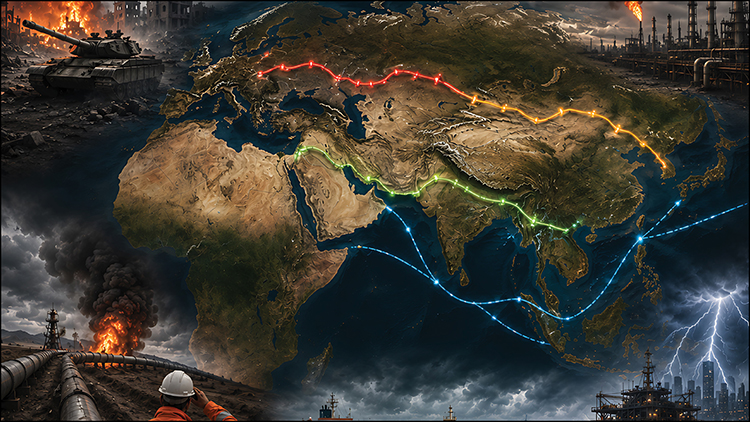
Since the outbreak of the US-Israeli war on Iran and the subsequent closure of the Strait of Hormuz, global energy markets have experienced severe disruptions in oil and gas supplies, particularly flows from the Gulf region to Europe. The crisis has reignited concerns over the vulnerability of traditional maritime energy routes and accelerated the search for safer and more reliable alternatives.
Confidence in Energy Corridors Shaken
According to a Reuters survey, OPEC oil production in April 2026 fell to its lowest level in more than two decades. Output declined by 830,000 barrels per day (bbl/d) month-on-month to 20.04 million barrels per day (mmbbl/d), marking the lowest production level since at least 2000 and dropping below even the levels recorded during the COVID-19 demand collapse in 2020.
The International Energy Agency (IEA) warned that the consequences could extend far beyond temporary supply losses. Speaking in Vienna, IEA Executive Director Fatih Birol stated that confidence in the Strait of Hormuz as a secure energy corridor may already be permanently damaged.
“If it was closed once, it can be closed again,” Birol said, describing the current period as “historic” in terms of energy, geopolitics, and foreign policy.
The IEA’s latest Oil Market Report also warned that the disruption is beginning to affect global demand itself. The agency expects oil demand to decline by as much as 2.45 mmbbl/d year on year (YoY) this quarter as higher prices and supply shortages weigh on industrial activity, aviation, and petrochemicals.
At the same time, major producers have cautioned that restoring market stability could take significantly longer than initially expected. During the company’s first-quarter earnings call, Amin Nasser, CEO of Saudi Aramco, warned that prolonged supply disruptions would delay the market’s recovery even if the Strait of Hormuz were to reopen immediately.
Against this backdrop, large Gulf producers Saudi Arabia and the UAE have been turning to alternative export routes to maintain crude supplies to global markets.
Bypassing Hormuz: Gulf Alternatives
The UAE is working to reduce its dependence on the Strait of Hormuz by expanding the Habshan–Fujairah pipeline, which already carries up to 1.8 million barrels per day (mmbbl/d) directly to the Gulf of Oman. A new West–East pipeline, due by 2027, will double this bypass capacity to around 3.6 million barrels per day. In parallel, new logistics corridors through Oman—linking Sharjah’s ports with Sohar, Duqm, and Salalah—are being developed to secure trade flows. Together, these routes aim to safeguard exports, strengthen Fujairah’s role as a hub, and shield the UAE from Hormuz disruptions.
Saudi East-West Pipeline, which currently works at its maximum capacity of 7 mmbbl/d of oil, has proven itself to be a critical supply artery, helping to mitigate the impact of a global energy shock and providing relief to customers affected by shipping constraints in the Strait of Hormuz.
In March, Saudi Aramco instructed several buyers of its Arab Light crude to load shipments from Yanbu port on the Red Sea coast instead of Gulf terminals, effectively bypassing the Strait of Hormuz. The company operates the 745-mile East-West pipeline, which has a capacity of up to 7 mmbbl/d and transports crude from the kingdom’s eastern oil fields to Yanbu port.
Shipping data showed that crude exports from Yanbu surged to nearly 4 mmbbl/d in March, compared to significantly lower levels before the outbreak of the Iran war. The increase demonstrates Saudi Arabia’s growing reliance on Red Sea export infrastructure to sustain global oil supplies amid regional instability.
Oil transported to Yanbu reaches global markets through two principal routes: Northbound to Europe and the Americas where crude travels through the Red Sea to Egypt’s Ain Sokhna terminal, enters the Suez-Mediterranean (SUMED) pipeline, and is transported to Sidi Kerir on the Mediterranean coast for re-export. The Other route is southbound to Asia where supertankers sail south through the Bab el-Mandeb Strait.
However, continued Houthi attacks and disruptions in the Bab el-Mandeb corridor have significantly reduced the reliability of the southern route, increasing the importance of Egypt’s SUMED pipeline.
SUMED Regains Strategic Importance
Established in 1974, the SUMED pipeline connects Ain Sokhna on the Red Sea to Sidi Kerir on the Mediterranean coast through twin 42-inch pipelines extending approximately 320 kilometers (Km) across Egypt. Originally designed to transport Gulf crude to Europe while bypassing the Suez Canal’s limitations, the pipeline is once again emerging as a cornerstone of global oil logistics. SUMED’s combined storage capacity across both the Ain Sokhna and Sidi Kerir terminals is 6 million cubic meters (mmcm) of crude oil and petroleum products.
According to Asharq Business, oil flows through SUMED surged by nearly 150% following the escalation of the Iranian conflict, reaching the pipeline’s maximum operating capacity of 2.5 mmbbl/d, compared to roughly 1 mmbbl/d before the crisis.
The pipeline is operated by the Arab Petroleum Pipelines Company, a joint venture between Egypt (50%) and gulf countries including, Saudi Arabia, Kuwait, the UAE, and Qatar.
Beyond oil, the closure of the Strait of Hormuz has also disrupted liquefied natural gas (LNG) exports from Qatar and the UAE, which together account for nearly 20% of global LNG exports. Europe still relies on liquefied natural gas (LNG) from the Gulf, especially Qatar, to diversify away from Russian supplies. As Gulf gas supplies face mounting uncertainty, attention is increasingly shifting toward to other routes including the Eastern Mediterranean.
East Med: Secure LNG Corridor
The Eastern Mediterranean is rapidly consolidating its role as a major alternative supplier for European energy security, supported by significant offshore discoveries near Cyprus, particularly the Aphrodite and Cronos gas fields, with reserves estimated at 3.1 trillion cubic feet (tcf) and 4.5 tcf, respectively.
Both projects are designed to transport natural gas directly to Egypt’s LNG infrastructure, bypassing high-risk maritime chokepoints (Strait of Hormuz and Bab el Mandeb) strengthening Egypt’s role as a regional gas hub.
Cooperation between Egypt and Cyprus has accelerated considerably in 2026. In April, the Egyptian Natural Gas Holding Company (EGAS) signed a 15-year agreement to purchase the entire production of the Aphrodite field, with an option to extend the agreement for an additional five years. Gas from the field will be transported via pipeline to Port Said, initially supplying up to 700 million cubic feet per day (mmcf/d) for six years before transitioning to more flexible volumes.
Under the agreement, Egypt and the Aphrodite consortium partners, US Chevron, UK Shell, and Israeli NewMed Energy, will establish a dedicated joint venture, Aphrodite Midstream Company, to construct and manage an integrated offshore gas transmission network linking Cyprus directly to Egypt’s energy infrastructure.
Meanwhile, Cypriot Energy Minister Michael Damianos announced on May 13, following a meeting of EU energy ministers in Nicosia, that stakeholders in the Cronos field are targeting first gas production by late 2027 or the first half of 2028, pending the finalization of commercial agreements.
The gas is expected to be transported through a 110-kilometer subsea pipeline connected to the Zohr field infrastructure before reaching the 5 million tons per year (mt/y) Damietta LNG facility for liquefaction and re-export to European markets.
The ongoing geopolitical turmoil in the Gulf has fundamentally reshaped global energy logistics and highlighted the vulnerabilities of traditional export routes. In this environment, Egypt is uniquely positioned to emerge as the premier alternative route for global energy trade.