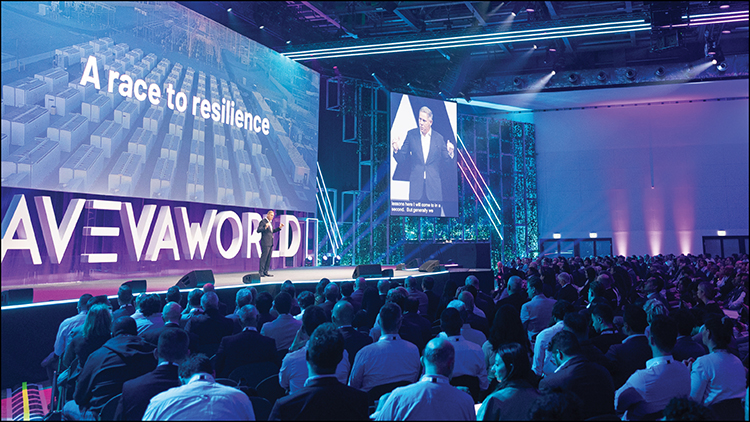
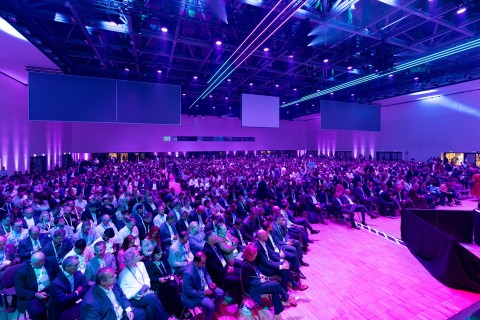
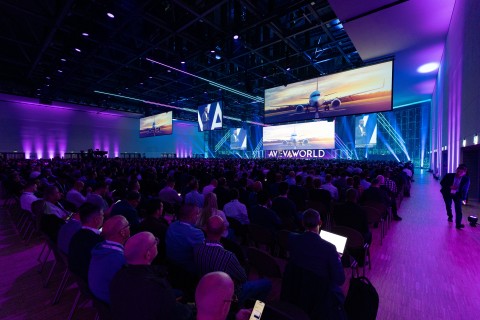
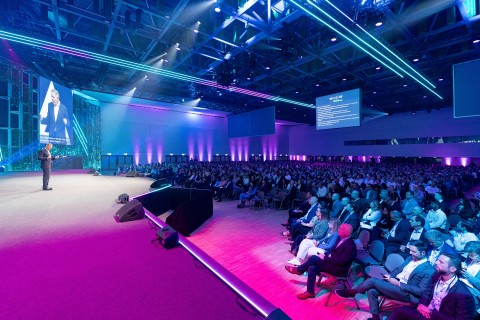
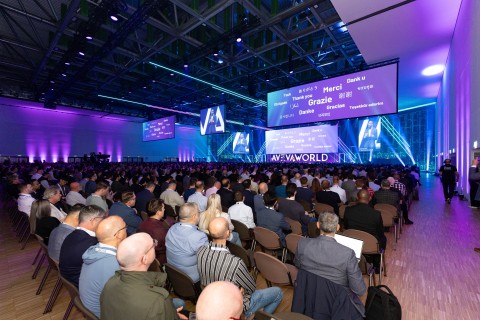
AVEVA World 2026 reaffirmed the company’s standing as a global leader in industrial intelligence and digital transformation. Over three days in Milan, more than 900 companies, 260 speakers, and 250 breakout sessions showcased how AVEVA’s integrated platforms, AI solutions, and cloud architecture are reshaping resilience and sustainability in the energy sector. Branded as “the industrial intelligence event,” the conference was not only a forum for technology but a demonstration of how AVEVA’s software and partnerships enable industries to withstand geopolitical shocks, accelerate innovation, and unlock new value across upstream, midstream, and downstream operations.
AVEVA’s Vision Highlighted
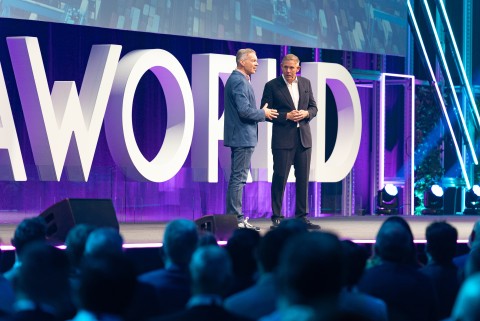
During the event, Caspar Herzberg, AVEVA CEO, set the tone by linking digital innovation directly to today’s turbulent geopolitical climate. He emphasized industries operating in the Gulf are “directly affected by the events of the last couple of months,” referencing the US–Iran war. Herzberg explained that supply chains are being “reshored, diversified, changed,” and energy systems are being rewired not only for sustainability but also for resilience and redundancy. “Resilience is now a key factor in decision making,” he stressed, adding that data sovereignty and the diversification of industrial assets are becoming critical drivers.
Moreover, Herzberg underscored AVEVA’s mission to keep humanity at the center of progress, highlighting that despite multiplying challenges, there are many possibilities and opportunities. “To seize that possibility means creating scale, and creating scale requires integrated software, software that seamlessly talks to each other.”
He then highlighted AVEVA’s innovation journey since 2024, culminating in the first quarter (Q1) of 2026 2026 with the launch of its generative design assistant and predictive design models. These tools, Herzberg explained, are transforming engineering by surfacing issues earlier and reducing manual effort through automated point cloud intelligence.
In addition, Herzberg pointed to new partnerships announced during the event. AVEVA has recently signed two landmark agreements: the first with IFS, the Swedish enterprise software company, together with Snowflake, the US cloud based data platform, and Amazon Web Services (AWS), the US cloud computing giant; the second with Schneider Electric and Egypt’s Elsewedy University of Technology (SUTech) to establish green industrial training centers in Egypt.
Industrial AI in Action and Applied Innovation
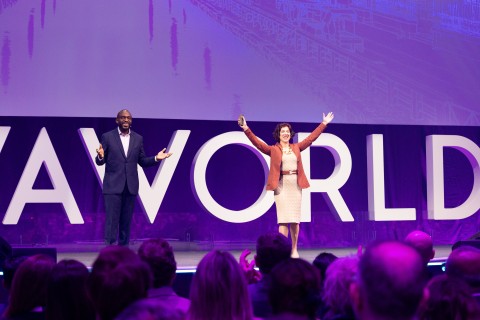
Herzberg captured the essence of AVEVA’s mission: ““AI is no longer optional—it is the competitive edge we cannot afford to lose. The real challenge is making it tangible: inspiring people, forging strong partnerships, and sustaining relentless innovation.” Building on this, Raylene Charron, CIO and Vice President of Information Services at Canada’s TC Energy, underscored AVEVA’s role as the backbone of modern energy resilience. She reframed energy security as national security, stressing that “People, economies, and governments expect energy to be available every hour of every day. When it isn’t, the consequences cascade fast.”
Charron revealed that TC Energy has migrated all four of its North American gas control rooms—covering 94,000 kilometers of pipeline—to AVEVA platforms. With AVEVA Connect, the company’s cloud based industrial intelligence hub that unifies engineering, operations, and business data for real time collaboration and analytics, TC Energy now scales capabilities seamlessly, reducing operational risk, improving decision making, and enabling growth without added complexity.
She elaborated: “Our industrial AI vision—this is where industrial AI and AVEVA intersect—is enabling us to be safe, make real time decisions, anticipate issues before they even happen, optimize our performance, and reduce our risk. Industrial AI helps us accelerate growth by making our systems smarter as we scale, not more complex.” Her remarks positioned AVEVA not only as a technology provider but as a strategic partner in safeguarding national infrastructure.
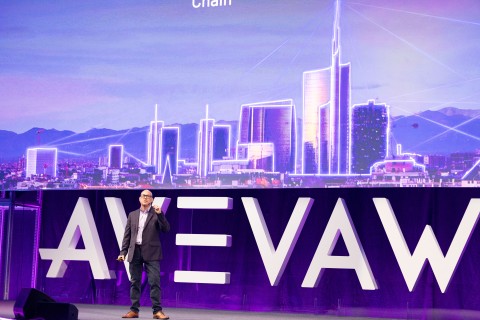
Meanwhile, Paolo Albini, Chief Supply Chain and Digital & IT Officer at Saipem, the Milan based engineering and construction giant, illustrated how AVEVA enables operational excellence: “Partnering with AVEVA has enabled us to build a unique digital platform that carries data seamlessly from start to finish—from the cutting stage to project completion. It makes us faster, more effective, and able to deliver higher quality to our clients.”
Albini emphasized that Saipem is embedding AI across its processes, from isometric verification to digital twins, with AVEVA as a key enabler. He cautioned that adoption is critical: “If people do not embrace the technology, there is little gain, a lot of spending, and a lot of failures,” he said, underscoring that successful innovation depends as much on cultural acceptance as on technical capability. His remarks reinforced AVEVA’s role as both a technological and cultural partner in digital transformation.
Collaboration and Ecosystems
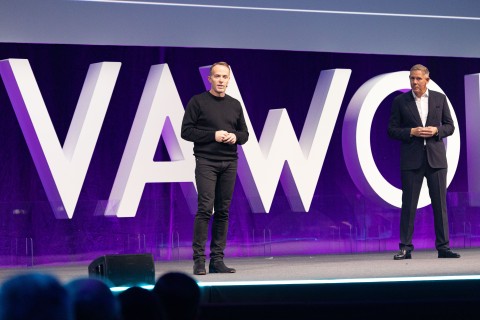
Herzberg joined Michael Wade, Director of the Global Center for Digital and AI Transformation at IMD Business School, to present findings from a joint AVEVA-IMD research report. The study revealed that while most companies have vast data, inefficiencies persist because information remains fragmented and isolated across departments.
“We define a digital ecosystem as a network of independent yet interdependent organizations that come together to share technology, data, and decision making,” Wade noted, highlighting that the purpose is “to create value to the whole of the ecosystem that’s greater than the sum of the particles.”
Herzberg tied this directly to AVEVA’s strategy: “We want to integrate data-driven insights and then mix them with human expertise and AI and share them across multiple parties that are not usually talking to each other while they should be talking to each other.”
Thus, the message was clear: AVEVA is not just building software, it is building ecosystems that unlock collective value.
Ultimately, AVEVA World 2026 proved that resilience, diversification, and sustainability are inseparable from digital innovation, and AVEVA is leading that transformation. From TC Energy’s unified control rooms to Saipem’s AI-driven engineering, AVEVA’s platforms are redefining what it means to operate safely, efficiently, and intelligently in an era of volatility. AVEVA World 2026 was not just an industry event; it was a declaration that AVEVA is the indispensable partner for building resilient, intelligent, and sustainable energy systems worldwide.

Making The Connection: A Site Visit to Snam’s Dispatching Center
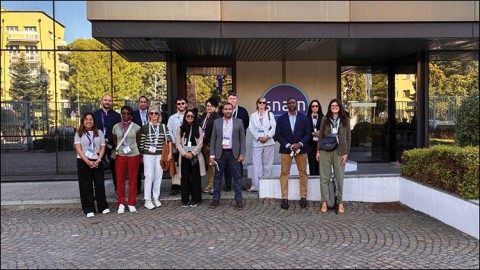
The event’s activities further included a high‑profile international press delegation visit to Italy’s Snam dispatching center, the nerve hub of the country’s leading operator for natural gas transport, storage, and regasification. Journalists and industry observers were given rare access to the facility, where they witnessed firsthand how AVEVA’s Supervisory Control and Data Acquisition (SCADA) software enables real‑time visualization of critical operational data, ensuring transparency and efficiency across Italy’s gas infrastructure.
The dispatching center’s operations are underpinned by a sophisticated technological architecture that integrates telemetry networks, remote data transmission systems, and centralized acquisition, supervision, and control platforms. At the heart of this architecture lies SCADA, an advanced software environment capable of managing real‑time variations across more than 130,000 parameters for approximately 3,000 remotely monitored and controlled plants. This capability allows operators to respond instantly to fluctuations in demand, equipment performance, and pipeline conditions, safeguarding both reliability and safety.
Beyond its technical sophistication, the dispatching center plays a strategic role in Italy’s energy security. It serves as the central hub for managing gas flows across the domestic transmission network, coordinating the movement of natural gas through the country’s main pipelines and compressor stations. From its operations room, teams of engineers and controllers monitor and remotely adjust flows around the clock, 24 hours a day, 365 days a year. This continuous oversight ensures that Italy’s energy system remains resilient even under conditions of stress, whether from seasonal demand spikes or unexpected disruptions.
The balancing of flows against real‑time demand is a particularly critical function. Consumption patterns in Italy can fluctuate sharply by hour, day, and season. On a typical summer day, off‑take may fall to around 80 million cubic meters (mmcm), reflecting lower household heating needs. In contrast, during winter weekday peaks, demand can surge beyond 460 mmcm, driven by heating requirements and industrial consumption. The dispatching center’s ability to anticipate and manage these swings is vital to maintaining uninterrupted supply and preventing bottlenecks.