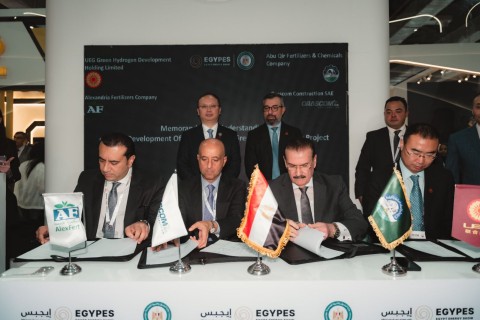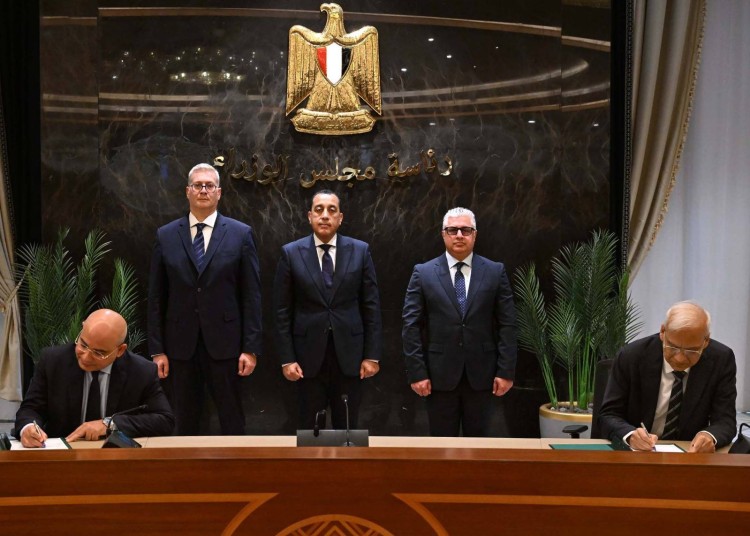
Two agreements, with total investments of $740 million for establishing a Phosphate Fertilizer plant and a Chemical project in the Suez Canal Economic Zone(SCZONE), were signed on April 8 in the presence of Prime Minister Mostafa Madbouly.
The Indorama Egypt Fertilizer project will be established in the Sokhna Industrial Zone, on an area of 522,000 square meters, with investments of $525 million for the first phase. The project is expected to provide up to 2,500 direct job opportunities during the operational phase, in addition to 500 jobs during the construction stage.
The project aims to establish an integrated industrial complex for fertilizers and basic chemicals, with an annual production capacity of up to 600,000 tons in the first phase. This will include the production of phosphate fertilizers and a range of related products, such as rock phosphate, ammonia, sulfur, potash (potassium chloride), and urea, along with specialized chemicals like zinc sulfate, boric acid/sodium borate, and sodium molybdate.
The complex is designed to support agricultural and industrial supply chains, with around 80% of production directed toward exports.
The contract was signed by Moustafa Sheikhon, Vice President of the General Authority of SCZONE for Investment and Promotion, and Mukul Agarwal, CEO of Indorama.
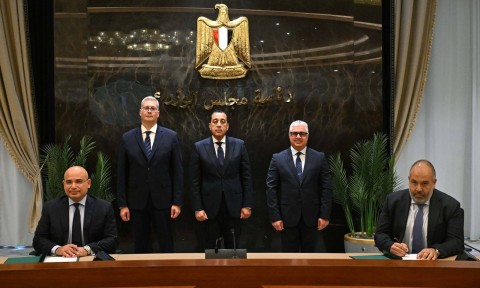
The second contract was also signed between Sheikhon and Mostafa El Gabaly, CEO of Polyserve for Fertilizers and Chemicals, for establishing a Polyserve Egyptian chemicals project, worth $215 million, in the Sokhna Integrated Industrial Zone. The project, spanning an area of 650,000 square meter, is designed for a nameplate capacity of 3.5 million tons per year (mmt/y) and is expected to generate 500 direct jobs.
The signing ceremonies of both agreements were attended by Karim Badawi, Minister of Petroleum and Mineral Resources, and Waleid Gamal Eldien, Chairman of the General Authority for SCZONE.
Polyserve is a diversified Egyptian firm with operations spanning mining, fertilizers, and various chemical streams, including basic chemicals, nitrogenous compounds, and the extraction of industrial minerals. Its portfolio includes the downstream production of sulfuric and phosphoric acids as well as speciality and compound fertilizers.
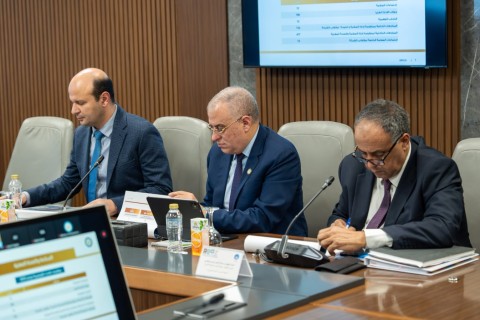
Following the signing, Madbouly emphasized that localizing industries significantly bolsters the national economy by reducing the import bill and driving export-led growth. He noted that the SCZONE offers a robust enabling environment for investors, stressing the government’s push for high-value-added private sector projects to deepen local content and enhance the competitiveness of Egyptian products in regional markets.
Gamal El-Din added that the chemical complex serves as a direct backbone for petroleum services and agriculture. He highlighted that SCZONE’s strategy focuses on industrial localization, technology transfer, and enhancing midstream and downstream logistics across 21 sectors. He stated that the integration between the Mediterranean and Red Sea ports and their industrial hubs offers a definitive solution to global supply chain challenges, while also citing Egypt’s qualified technical workforce as a primary competitive advantage for global investors.