Badr Petroleum Company recorded an average daily production of 6500 barrel of oil equivalent (boe/d), achieving its targets for the first half (H1) of the fiscal year (FY) 2025/2026, said Ibrahim Massoud, the company’s chairman.
Massoud added that two development wells were drilled, contributing to higher natural gas production rates, with the second well scheduled to be brought online next week.
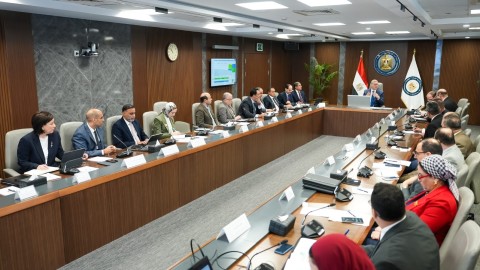
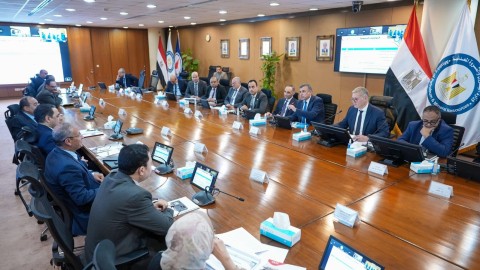
This came during the general assembly meeting of the Badr Petroleum Company to review the amended investment plan for the FY 2025/2026, including the addition of new development wells at the Badr-1 field, boosting production outputs.
the Western Desert Operating Company (WEPCO), Badr Petroleum’s parent company, had succeded in boosting crude oil production at the Badr-1 field to more than 7,500 barrels per day (bbl/d), up from 800 bbl/d when it first assumed operations, according to Mohamed Elghamry, Senior Exploration Geophysicist at Badr Petroleum Company, speaking on the petroleum ministry’s Petrocast podcast in January. He noted that recoverable reserves expanded from 3 million barrels (mmbbls) to 36 mmbbls, with 20 mmbbls already produced.
The surge followed a technical reassessment of wells drilled in the 1980s, which were successfully re-entered using advanced seismic and drilling technologies. The field also resumed natural gas production for the first time in four decades after drilling three exploratory wells, one of which initially produced 20 million cubic feet per day (mmcf/d).
During the meeting, the company outlined its five-year plan to boost production and reserves. This includes adding two new concession areas in the Western Desert in the coming period, expanding drilling in unconventional reservoirs in cooperation with Canadian-based oil and gas company, Tag Oil, and implementing modern technologies to enhance production rates.
Karim Badawi, Minister of Petroleum and Mineral Resources, directed the preparation of studies to assess the potential for applying horizontal drilling and hydraulic fracturing techniques in the company’s concession areas in the Western Desert.
He stressed the importance of these techniques in unlocking untapped resources and achieving a qualitative leap in production, citing successful regional and international experiences in this field.