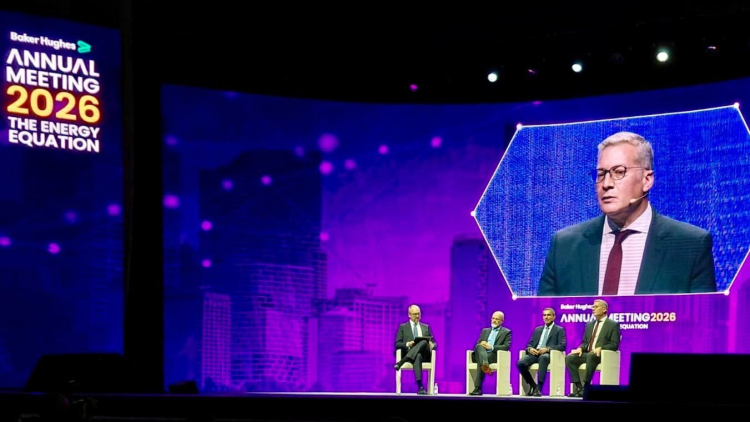
Karim Badawi, Minister of Petroleum and Mineral Resources, outlined Egypt’s strategy to maximize the use of its assets, infrastructure, and geographical location to meet the demands of the domestic, regional and global liquefied natural gas (LNG) markets. This came during a panel discussion titled “The energy equation implementation: government pathways to a balanced energy held on the sidelines of Baker Hughes Annual Meeting 2026 in Italy. The panel discussed the global challenges facing governments in realizing energy policy objectives such as securing supplies, reducing costs, environmental sustainability, and economic growth.
Badawi emphasized the importance of developing refining, petrochemical, and value-added industries, noting that Egypt is working to achieve balance in the energy sector; ensuring supply security, attracting long-term investments, and supporting industrialization, while remaining open to future energy solutions.
Egypt continues to reinforce its role as a regional energy hub over the upcoming decade, leveraging its significantly developed infrastructure and intensified upstream activities, all of which are efforts that will solidify its position as a reliable energy partner in a volatile global environment, Badawi said.
Badawi highlighted that Egypt’s petroleum sector is optimizing the utilization of crude oil, condensates, and natural gas through refining, processing, and conversion into higher-value products for both domestic consumption and export. Petroleum, petrochemical, and mining exports exceed $7 billion, representing about 14% of Egypt’s total exports.
He also stressed that Egypt focuses on developing the refining and petrochemical sectors and value-added industries, pointing out that Egypt is working to achieve the balance within the energy sector to ensure security of supply, attract long-term investments, and support industrialization while adopting future energy solutions.
The minister also noted that investor confidence has strengthened due to clear and competitive regulatory and fiscal frameworks, pointing to the latest Red Sea exploration bid round, open until May 2026, which applies a profit-based production sharing model and offers competitive terms for international oil companies (IOCs).
In November, the ministry revealed a new international bid round for exploration and production operations in blocks RS-Block (1), RS-Block (2), RS-Block (3), and RS-Block (4) located in the Red Sea, and will introduce a production-sharing system based on the R-Factor.
During the panel, Badawi highlighted Egypt’s five-year upstream strategy, backed by strong foreign partner commitments. The $5.7 billion investment plan targets drilling 480 new wells by 2030, including 101 wells scheduled for 2026 across the Mediterranean, Western Desert, Gulf of Suez, and Nile Delta basins.