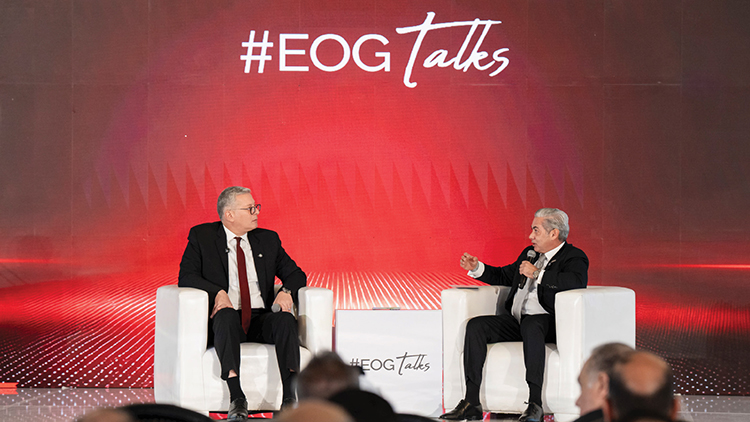
Amidst the high-energy atmosphere of the 11th edition of the Egypt Oil & Gas (EOG) Convention—EOGC 2025—a clear outline for the nation’s most vital sector in 2026 and beyond was unveiled. In a candid conversation, Eng. Mohamed Fouad, CEO of Egypt Oil & Gas and co-chairman of the Egypt Oil and Gas Committee, hosted H.E. Eng. Karim Badawi, Minister of Petroleum and Mineral Resources, to dissect the ministry’s six-pillar modernization strategy that is currently reshaping the oil and gas sector landscape.
The dialogue moves beyond traditional production targets, focusing instead on the “molecules in, molecules out” philosophy that underpins Egypt’s regional hub ambitions. With a record $1.2 billion exploration investment targeted for 2026 and a transformative focus on empowering the sector’s human capital, Minister Badawi outlines how the industry is moving from incremental growth to a massive “step change” in performance.
From the introduction of the R-factor incentive model to an ambitious $4 billion refinery investment plan, the discussion highlighted a “Strategic Triangle” of upstream success, regional collaboration, and human empowerment. This interview captures the minister’s vision for a 2026 “inflection point,” where advanced technology and pragmatic partnerships converge to secure Egypt’s status as the premier energy hub of the Mediterranean.
How does the Ministry envision the six pillars collectively shaping Egypt’s position as a regional energy hub over the next decade?
When I look at the sector, I can see a lot of talent, a lot of opportunities, and a lot of will. This is why I am a firm believer in the spirit of collaboration and fostering an environment where everyone can thrive, contribute, and unlock the true potential that lies ahead of us.
When we look at the six pillars, they essentially provide direction in terms of our key priority areas. However, they are actually interlinked rather than discrete. For me, it always starts with the upstream, because ultimately, those molecules need to be made available.
I believe that if we do one thing well, it is fostering an environment where we can help our partners unlock the potential of the upstream sector in both production and exploration, which then impacts the rest of the flow across the value chain.
As long as those molecules are unlocked, we can use those molecules as feedstock for the petrochemical and refinery sectors, providing revenue for the economy and driving growth across all regional sectors.
Again, you cannot achieve this without collaboration. To maximize the efficiency of unlocking those molecules, you cannot work in isolation. The pillar of collaboration represents the union of different human capabilities, the leveraging of various technologies, and collaboration beyond borders.
The collaboration part helps us realize that our success is not defined only internally; it is also defined by working with others, such as the Ministry of Electricity and Renewable Energy. When we succeed together in increasing our renewables contribution aiming for the 45% renewables in the energy mix by 2030, it feeds those molecules back into the system to create value for investors, our partners, and the country.
These elements fuel the different pillars. They tie together to provide a transparent avenue for engagement with existing partners, and they serve as anchors for discussions with future investors. We can also work with other governments to enable cross-border success, create win-win collaborations, and unlock more value for people between different countries. Ultimately, this allows companies to lower the cost per barrel and make tangible progress together.
Given the complexity of the six-pillar strategy, how does the government’s aggressive plan to drill 101 wells next year—and over 400 within five years—act as a catalyst for the ministry’s broader vision of unlocking regional potential through upstream commitment and investor collaboration?
The upstream sector is at the heart of the industry. This is why we started by always highlighting to our partners that their success is our success; as we always say, “Help us to help you to help us.” This is not an individual statement; the entire leadership of the sector genuinely mean that and are genuinely collaborating and interacting with our partners to be able to unlock potential.
Hence, the key focus has been on being pragmatic and honest in realizing the challenges that existed for our partners to invest and to make Egypt the investable destination for hard-earned budgets across the different companies.
When we look at the challenges that existed, they were very straightforward and we were very clear. It all started with making sure that we put our partners as our number one priority. The government, the Egyptian General Petroleum Corporation (EGPC), and the ministry are honoring the views of our partners. This is why we were always clear on one important investment lesson: it is vital to consistently honor our commitments to our partners so they are able to invest, reinvest, and generate profits for their shareholders.
If those profits are there, it becomes an automatic mechanism to create more value for the country and, hence, invest more in production and exploration.
The second aspect was to make sure that we are very pragmatic in how we look at economics as a key driver of decision-making. We look at how we can make the economics right so that we can deliver value to shareholders—whether local, regional, or international—while also bringing value to the country.
When you put the numbers together, it makes life very easy. This is where we looked at what we need to do to make economics right in the various basins, because economics offshore are different than economics onshore. Economics offshore where you are close to infrastructure are very different than economics offshore in emerging areas away from infrastructure. It is also very different when you are looking at economics where you have an abundance of data, which changes the risk level. This is what drove a lot of the incentives and the new methodology of looking at how we make opportunities investable.
To bring a tangible aspect to this, look at the Western Desert. It has been a big source of oil production for decades. By working with our partners, such as Apache, we looked at unlocking gas potential; however, gas pricing in the region was not economic.
To actively unlock that gas, we had an open conversation and engagement, asking: “If we change that gas pricing, what would that drive in terms of investments?” Looking at how this gas would enable us to minimize our import bill, it was a “win-win” choice to change that price to enable the Western Desert to activate and deliver more gas.
We have done the same thing with our partners on offshore projects. We looked at the Western Mediterranean and realized there are frontier areas with higher risk and higher reward but located away from infrastructure. We worked with partners like ExxonMobil and TotalEnergies to investigate introducing the R-factor as an economic model.
We explored how this would help de-risk investment and ensure a fair distribution of returns for the investors and the country. This led us to implement the R-factor in the Western Mediterranean, the Red Sea, and the GANOPE area in southern Egypt. Introducing the R-factor in areas where there is less exploration, makes it more attractive for partners.
Implementing the R-factor requires various levels of action; certain things are numerical decisions, while others require Cabinet support to introduce new models. This is why I go back to the collaboration between all the different entities of the government to pass these terms through the Cabinet.
We are also looking at practicalities where many of our partners find that when they come close to the final five years of their agreements, investing becomes financially unattractive. However, that incremental production is very important for the country. Hence, we are working on mechanisms for extensions or different government methods to promote investments through those last few years of a concession.
Essentially, we are linking the process of how we make Egypt investable with what makes sense for the government, where our partners—Egyptian, regional, and international—are our number one priority. This is not just words mentioned in a presentation; this is a commitment from the highest leadership of the country, from His Excellency President Abdel Fattah el-Sisi.
All our partners who have met with His Excellency hear directly from him that honoring our commitment is our number one priority. We have incentives to help our partners increase their investments and unlock more value. I am very optimistic because I have seen it and we have all experienced it: that commitment is there, and it is a true example of partnership, collaboration, and alignment as a country.
Egypt is currently sitting on more than 14 Trillion cubic feet (tcf) of stranded gas. This resource is vital for the country’s energy needs, but it remains ‘stranded’ because the previous economic terms didn’t make extraction viable. The core of the issue now is: how dynamic is this approach?
It is very dynamic. This is why we focus on helping our partners achieve the lowest possible costs. We are very keen to leverage the Egypt Upstream Gateway (EUG) platform, utilizing existing data, the reprocessing of that data, and now incorporating AI capabilities. By making this available through open blocks, our partners can expand their portfolios with a long-term view toward reducing the cost per barrel.
Another major focus is promoting exploration and seismic activity. Seismic data is vital; we are very appreciative of our partners conducting 3D and 4D seismic surveys. We are working closely with them to utilize the latest seismic technology to de-risk investment opportunities and improve selection. This is not a hypothetical or academic discussion,it has been proven that advanced seismic technology de-risks projects and maximizes success.
We have seen this clearly in the Gulf of Suez with the Ocean Bottom Node (OBN) surveys conducted by GUPCO and Dragon Oil. While the Gulf of Suez has significantly untapped potential, the success rate for hitting hydrocarbon zones had declined in later stages. By using these advanced technologies, we are turning that around. The OBN survey conducted in the Gulf of Suez—along with the recalibration of that data—has been a key driver for the success of GUPCO and their partner, Dragon Oil. They are truly unlocking potential, and you can see the results in their recent success stories.
This is why we are also very optimistic about the agreement signed with SLB-Viridien partnership for 95,000 square kilometers in the Mediterranean. This will help our partners with existing blocks to de-risk and identify new potential, such as stranded gas or prospects that are not currently visible and will help us promote additional investment opportunities in open acreage.
Furthermore, with the GANOPE team, we have been driven to invest alongside TGS to conduct seismic surveys over 100,000 square kilometers in the Western Desert and the Southern Desert near the Libyan border. The goal is to provide more data and promote further investment opportunities for our partners.
This is why we focus on how we can help our partners achieve the lowest cost. We are very keen to leverage the EUG platform, reprocessing existing data, and utilizing new AI capabilities to make blocks available to our partners. This allows them to expand their portfolios with a long-term view toward reducing the cost per barrel.
Regarding undeveloped discoveries, we realized we have a portfolio that can be packaged. Driven by economics, we can package different areas with multiple small discoveries. When combined, developing them and tying them back to existing infrastructure becomes more economically viable. Our message to partners is to help us identify what terms would make existing wells within their concessions economic.
I must also give credit to our various partners who are helping one another leverage existing knowledge and facilities to unlock resources in each other’s concessions. This helps partners monetize subsurface resources and allows the government to accelerate its own monetization models. Ultimately, the goal is to minimize our import bill and return to self-sufficiency.
On the oil front, we are initiating new incentives. Egypt has historically produced around 600,000 barrels per day, though we are currently at about 520,000. Our ambition is much higher. To achieve self-sufficiency, we need to target 900,000 barrels of oil equivalent per day(boe/d), with an ultimate goal of one million(boe/d). We know we won’t achieve that by doing things the same way. We must introduce new technologies, different incentives, and work with our partners to implement these projects differently.
We will have to actually introduce new technology and different incentives. We must ensure that we work with our partners to identify how to achieve self-sufficiency, whether through traditional oil drilling, fracking, or unconventional resources.
All of these different approaches require different economics and different kinds of incentives to be delivered. They require different commercial models with service companies and various partners. Again, we are very much focused on looking at how we can unlock a steep change in oil production, and we will be launching new incentives very soon specifically around oil production. These will be tied to incremental production, technology deployment, and making a genuine step change in that production.
Is the self-sufficiency plan for the next four years, give or take, based on achieving both oil and gas goals at the same time, or will the oil targets take longer to realize?
We are establishing a plan that targets the year 2030 to reach our goal of one million barrels of oil equivalent per day. To support this, we have identified specific projects to increase our refinery capacity. Egypt already possesses a very robust refinery infrastructure, and by executing an identified $4 billion investment plan over the next four to five years, we will enable ourselves to achieve self-sufficiency in fuel production. This strategy is designed to stop the importation of petroleum products while simultaneously generating additional value-added derivatives from our systems.
We are working on a very detailed plan to get there. We will not be able to achieve this on our own, which is why we will be working closely with each of our partners. In our future assembly meetings, the focus will be on reviewing our five-year plans, determining exactly what is required to reach our targets, and identifying how we will unlock the necessary incentives to ensure we succeed. I am fully committed to continuing with that plan.
To achieve this plan between 2026 and 2030, you have an all-important, integrated strategy in place. However, within that six-pillar framework, which specific pillars would you consider the strategic priorities necessary to realize these 2030 goals?
From a priority perspective, Upstream will always be a cornerstone. However, I view the Collaboration pillar as equally essential, and I tie it directly to our Infrastructure. This ‘triangle’ is what will enable Egypt to succeed as a regional energy hub but for a hub to function, we need a seamless flow: ‘molecules in and molecules out.’
Establishing regional interconnections remains a key priority. A prime example is our collaboration with Cyprus. We are working to help our Cypriot friends unlock their subsurface potential by utilizing Egypt’s existing processing facilities to bring their gas to the Egyptian market and beyond. While we will always work to increase our local production, we are equally committed to regional interconnections.
Ensuring a constant inflow of gas is vital, which is why our Floating Storage and Regasification Units (FSRU) infrastructure is an integral part of this strategy. These units provide the flexibility we need today and may eventually transition into permanent infrastructure to ensure gas continues to flow through Egypt to be monetized on the global market.
We also have an industrial infrastructure in petrochemicals and refining that has scaled up significantly. This capability isn’t just for local needs; it’s for exporting high-value products to the rest of the world.
There is often confusion because we are currently net importers, but it’s important to remember our legacy as exporters through terminals like Idku and Damietta liquefication plants with partners such as Shell, Petronas, and Eni. By working with both existing and new investors, we will once again make energy available for various global markets.
This is not hypothetical. The leadership of our major partners meets directly with President Abdel Fattah el-Sisi, who has seen the recent investment announcements from companies like Eni and BP. As we speak, we are seeing record-breaking activity. In 2026, we expect to see exploration investment reach $1.2 billion, including 14 offshore wells in the Mediterranean alone. I believe 2026 and 2027 will be the major inflection points for both the sector and the country.
Given that attracting investments is one of your core interlinked pillars, and considering the exciting outlook for 2026 and 2027, how is the Ministry measuring success? Specifically, what are the Key Performance Indicators (KPIs) the Ministry is using to track progress and unlock the production model, providing the transparency that the international global market demands?
Before discussing indicators, we must recognize that we cannot achieve anything without our people. Attracting and investing in talent is vital, but so is communicating the successes of our people to both internal and external communities. To me, the human element is paramount; this is why I advocate empowerment at every level.
I want to ensure that our chairmen, exploration managers, operations managers, and individuals in the field are fully empowered—whether to introduce new ideas or to stop unsafe acts. While we can create frameworks for this, communication is the key. We must communicate the successes of our teams, in their own voices, through active knowledge sharing. I encourage everyone to leverage the ministry’s platform and individual company platforms because we are not doing enough to highlight our “stars”—the young and experienced talent, both men and women, working in our facilities and offices.
This is also why I am a firm believer in site visits, whether announced or unannounced. I was very pleased with the recent field workshops conducted without management present, allowing people to express themselves freely. This is essential for talent identification and for maintaining the true wealth of our sector: its people.
When we look at how to measure our success, we must rely strictly on numbers; it is not a matter of feelings or emotions. Ultimately, in the short term, the primary metric for our progress is the reduction of the import burden. This is the most significant challenge we face today, and it is the driving force behind our focus on incentives and increasing local production. We are closely monitoring the number of incremental barrels of oil and volumes of gas we are bringing into the national network to see how effectively we are reducing the existing import bill.
Our goal is to see how steadily we are progressing toward our targets, specifically getting back to the production level of 6 billion cubic feet per day(bcf/d) of gas. We are focused on what incremental gains we are achieving year-on-year. We understand that we are not going to reach these targets in a single day. As professionals in this sector, we know the technical reality: we have to address the natural decline of our fields while simultaneously ensuring we invest further to drive future increases.
Beyond production volumes, we are monitoring the returns being generated for our partners. It is not just about the total dollars invested, but about how many barrels are actually coming from existing fields and how successful our exploration activities are in bringing future reserves into production. We are working very collaboratively to ensure these investments yield tangible results for both the state and the international companies involved.
At the same time, our KPIs on the safety front remain critically important. We must not lose focus on safety during this aggressive drive to increase exploration and production activity. I have always maintained that we should not pursue growth at the expense of safety. This is something we need to continue working on, investing in, and managing effectively to ensure that our operations remain as safe as they are productive.
To achieve these goals, we must work together as one team. I believe in fostering an environment that is deeply transparent and highly collaborative. By aligning our efforts and sharing our successes, we can overcome the technical and economic challenges of the sector. This unified approach is what will allow us to maximize the potential of Egypt’s resources and ensure a sustainable, profitable future for all stakeholders involved.