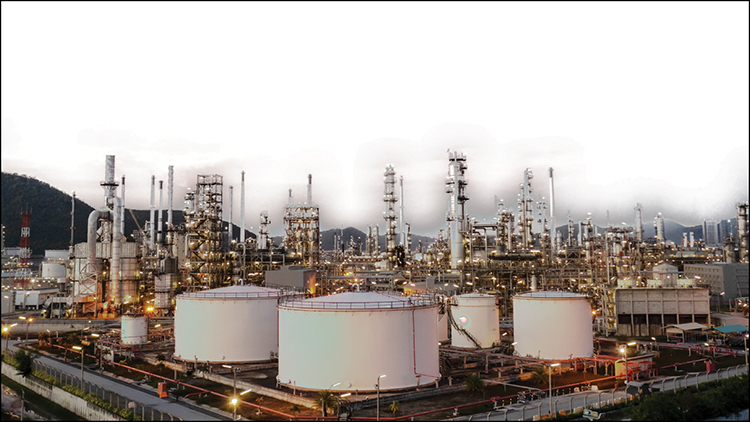
Oil-importing nations like Egypt face a persistent challenge: balancing rising domestic demand with the volatility of global energy markets. By building and upgrading refining capacity, countries can reduce their dependence on imported finished products such as gasoline and diesel, which are often subject to price swings and supply disruptions. Egypt ranks among the African countries with the highest refining capacity, currently estimated at 650,000 barrels per day (bbl/d)-a 10% increase since February. Plans are underway to further expand capacity to accommodate both local and imported crude, aiming to close the supply gap.
Driving Output Recovery
In January, the petroleum sector recorded a total output of 520,197 bbl/d of crude oil and condensate. In November, Karim Badawi, Minister of Petroleum and Mineral Resources, explained that lower investment in exploration and production had led to a decline in gas and oil output. Since 2021, oil output averaged 600,000 bbl/d, stabilizing in February 2025 at 540,000 bbl/d. “We will start the phase of increasing production in oil,” Badawi said.
To support this, the government reduced overdue payments to International Oil Companies (IOCs), settling $5 billion in debts in late 2025. It also introduced incentive packages and applied the R-factor mechanism to make production-sharing agreements more flexible and profitable. These measures attracted new investment, led to fresh discoveries, and boosted production from field developments in 2025. The ministry has also set a plan to drill over 100 wells in 2026, including 67 wells in the Western Desert. Recently, four wells discovered in the Western Desert added about 4,500 bbl/d of crude oil and 2.6 million cubic feet of natural gas per day (mmcf/d) to local output.
More Refineries, Lower Import Bil
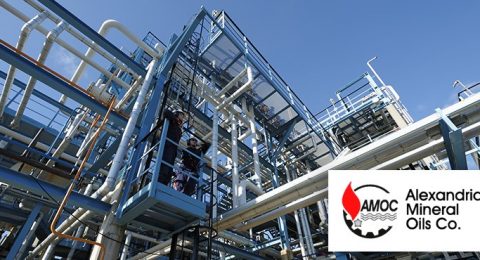
Alongside exploration, the ministry has prioritized expanding refining capacities and implementing upgrades to process more imported crude. Although Egypt’s refining capacity exceeds its domestic crude output, refinery expansion reduces reliance on finished product imports such as gasoline and diesel.
By refining more crude domestically, Egypt gains greater control over supply and pricing of petroleum products, insulating itself from global market volatility. Currently, Egypt imports about 28% of its gasoline and 45% of its diesel, Badawi noted during a cabinet meeting on March 10.
Data from the Central Bank of Egypt showed that in the first quarter of fiscal year (FY) 2025/2026 (July–September 2025), oil imports rose by $1 billion, reaching $6.4 billion, compared with $5.4 billion in the same period a year earlier.
Major Refinery Expansion Projects
Badawi previously announced six refinery upgrade projects with total investments exceeding $4 billion. These upgrades aim to maximize the use of both domestic and imported crude, reduce reliance on imported refined products, and strengthen energy security.
One of the most notable upgrades took place at the Middle East Oil Refinery (MIDOR) in Alexandria. After modernization works, MIDOR reached its maximum production capacity of 170,000 bbl/d in 2025. The upgrades included restarting production units at full capacity and activating kerosene treatment operations for the first time. The refinery produced 49 million barrels (mmbbl) of crude in 2025, compared with 47 mmbbl in 2024, generating 6.6 million tons (mmt) of petroleum products.
Similarly, Cairo Oil Refining Company (CORC), which operates the Mostorod and Tanta refineries, allocated EGP 4.47 billion for replacement, renewal, and environmental projects during FY 2025/26. Plans also include investments in local manufacturing workshops, efficiency improvements, solar energy installations, and energy-saving systems.
In Upper Egypt, Assiut Oil Refining Company (ASORC) is expanding refining capacity to process 4.2 million tons of crude annually. Projects include a new atmospheric distillation unit, a gas recovery unit for LPG production, and sustainability initiatives such as renewable energy and water recycling.
Innovation in Oilfield Chemicals
The ministry is also promoting local innovation in oilfield chemicals. A recent breakthrough was the development of a locally manufactured demulsifier, a chemical used to separate water from crude oil before refining.
Developed by Developed by a team lead by the Egyptian General Petroleum Corporation (EGPC) in cooperation with CORC the product reduces reliance on costly imports. “Petroleum companies use a wide range of chemicals, most of which are imported and priced in dollars,” explained Ehab Shokry, Production Chemist at Khalda Petroleum Company. “During the pandemic and the inflation that followed, costs increased significantly. That’s when the idea emerged to develop a locally manufactured product using mainly Egyptian raw materials.”
The demulsifier was tested on crude samples from multiple oil fields, including GPC’s Sinai fields, securing a supply contract of around 1,000 barrels per year (bbl/y). It delivered performance comparable to imported chemicals while achieving cost savings exceeding $300 per barrel.
Shokry added that testing is ongoing at PetroBaker and PetroShahd fields, with new trials scheduled at Mogawish and Esh El-Mallaha. The project’s business plan targets 4,500 barrels of production in 2026, rising to 7,000 barrels by 2027, with a five-year strategy that includes potential exports to Iraq, Libya, and Oman.
Expanding Oil Logistics Infrastructure
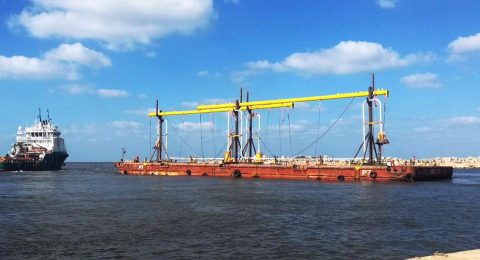
To complement refinery expansion and exploration activities, the ministry has optimized port and pipeline infrastructure to boost crude and refined product trading.
El Hamra Oil Port expanded its storage capacity from 2.8 to 5.3 million barrels (mmbbl) through new tank construction, according to BMI’s Oil and Gas report (2025). The Western Desert Operating Petroleum Company, WEPCO Chairman Ibrahim Massoud announced plans to trade approximately 88 mmbbl/y in FY 2026/27.
Key storage facilities at Ain Sokhna and Sidi Kerir serve the SUMED Pipeline, which now handles up to 2.5 mmbbl/d. The pipeline provides a vital route for transporting crude from the Arabian Gulf to the Mediterranean, enabling efficient supply to European and global markets.
Toward Greater Self-Sufficiency
While refinery expansion cannot fully offset Egypt’s crude production shortfall, it maximizes the utility of both domestic and imported crude. This strategy shifts Egypt closer to self-sufficiency in refined products and opens opportunities for regional exports.
Such efforts are particularly significant amid disruptions affecting major fuel storage facilities and ports across neighboring Arab countries following the US and Israel strikes on Iran since February 28. By strengthening refining and logistics infrastructure, Egypt positions itself as a resilient energy hub in the region.