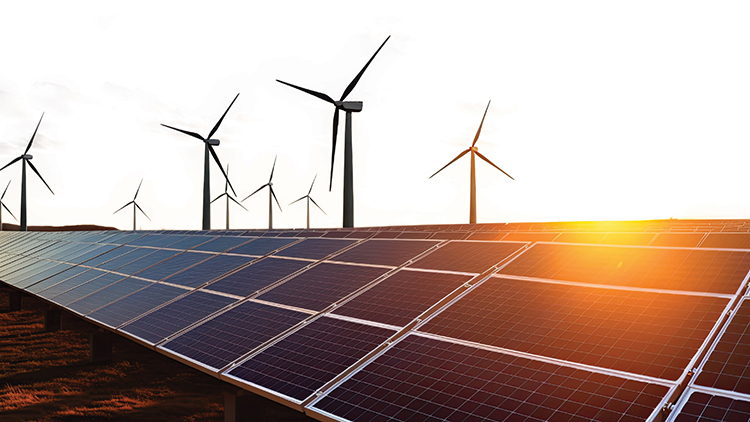
Egypt’s renewable energy journey reached a defining phase in 2025. This past year has witnessed the country’s efforts to consolidate capacity, scale production, and re-calibrate strategy. While green hydrogen initially was represented as a solution for energy decline, real progress during the year came from solar and wind deployment, institutional reform, and a national expansion strategy that increasingly prioritizes domestic integration.
The Minister of Electricity and Renewable Energy, Mahmoud Essmat, said that Egypt aims to raise the contribution of renewable energy in the national energy mix to more than 42% by 2030, as an initial milestone toward achieving 60% by 2040, in line with the most recent revisions to the national energy strategy.
From Plan to Results
According to the New and Renewable Energy Authority (NREA), Egypt’s total renewable installed capacity reached approximately 8.6 gigawatt (GW) during the fiscal year (FY) 2024/25, reflecting a notable year-on-year increase driven primarily by wind and solar additions. “Egypt has successfully integrated more than 2,000 MW of wind power and over 2,500 MW of solar power into the national grid—a significant shift compared to the situation a decade ago,” Azza Ghanem, Energy and Environmental Economist told Egypt Oil and Gas (EOG), underscoring how renewables are now a central part of the energy system.
Renewable electricity generation reached around 32 terawatt-hour (TWh), translating into substantial fuel savings and emissions reductions. “Renewable energy has contributed to reducing reliance on fossil fuels and lowering emissions, thereby supporting Egypt’s climate goals,” Ghanem said, indicating that renewables have moved from supplementary to system-relevant contributors in 2025.
Led by the Ministry of Electricity and Renewable Energy, in coordination with the Ministry of Petroleum and Mineral Resources (MoPMR), the year’s progress included accelerated capacity deployment, diversified contracting mechanisms, and infrastructure-aware planning. Rather than relying solely on state-backed procurement, the 2025 strategy expanded the use of long-term power purchase agreements (PPAs), build-own-operate (BOO) models, and peer-to-peer (P2P) mechanisms that allow private generators to sell electricity directly to industrial consumers. “Public Prive partnerships (PPP), long-term PPAs, and BOO frameworks have provided clear institutional and financial structures that encourage strong private-sector participation, facilitating faster project execution, especially for energy-intensive industries,”Azza stated.
Harnessing Sun and Wind
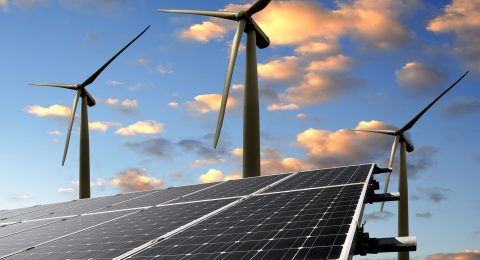
Solar and wind energy formed the backbone of Egypt’s renewable expansion in 2025, advancing in parallel as complementary resources. Building on earlier flagship developments, new projects reached financial close, construction milestones, and operational phases during the year. Production data underscores the combined impact of solar and wind deployment.
According to NREA’s 2025 operational bulletins, wind facilities generated around 3,329 GWh, while grid-connected solar PV systems produced approximately 1,855 GWh in the early months of FY 2025/26. Together, these sources significantly strengthened the resilience of the electricity system and reduced reliance on fossil-fuel-based generation during peak demand periods.
On the solar side, one of the most significant milestones of the year was the financial close for the large 1.1 GW Obelisk hybrid and battery storage project, backed by Norwegian renewable energy company Scatec. The 25-year PPA agreement is financially supported by major development finance institutions, including the European Bank for Reconstruction and Development (EBRD), the African Development Bank (AfDB), and the UK’s British International Investment (BII). “Recent investments have brought not only financial value but also advanced technical expertise in project design, construction, and operation,” Ghanem said.
Additionally, Egypt approved four solar and wind projects under the P2P mechanism with a total capacity of 400 MW and investments of about $388 million. Under this setup, companies sell renewable electricity directly to industrial consumers, with the transmission handled by the Egyptian Electricity Transmission Company (EECT)—without state financial guarantees.
The Energy economist said, “securing long-term capital at competitive interest rates remains a key challenge, especially for energy storage and green hydrogen projects requiring large upfront investments,” the Economist explained, demonstrating that financial innovation must continue alongside technical deployment.
The expansion of solar and wind capacity in 2025 translated into measurable national benefits. According to NREA, renewable generation during the year resulted in fuel savings of approximately 1.76 million tons of oil equivalent and avoided nearly 4.1 million tons of CO₂ emissions. These figures highlight a critical shift: renewables in Egypt are no longer evaluated solely by installed megawatts, but by their contribution to energy security, emissions reduction, and reduced dependence on fossil fuels.
Financing, Institutional Support, and Grid Modernization
In 2025, institutional and financing collaboration under the government-led Nexus of Water, Food, and Energy (NWFE) program, which mobilized more than $10 billion in commitments from international partners, helped propel multiple large renewable projects into development and execution. A landmark initiative was the 1-GW Abydos II solar plant with an integrated 600 MWh battery system, backed by a $572 million debt package led by the International Finance Corporation (IFC) and partner Development Finance Institutions, expected to generate more than 3 million MWh per year and reduce carbon emissions by around 1.6 million tons annually.
The first NWFE phase also aims to connect nearly 3,700 MW of solar capacity and 2,840 MWh of battery storage to the grid, including 1,000 MW plants at Benban and Nagaa Hammadi and 900 MW at El Wahat. On the wind side, the 1.1 GW Suez wind farm in the Gulf of Suez—co-financed by the OPEC Fund, EBRD, AfDB, and others—will supply clean power to over a million households while cutting an estimated 2.5 million tons of CO₂.
Additional wind capacity includes a 200 MW Ras Ghareb project supported with a $74.1 million financing package led by EBRD, reducing 390,000 tons of emissions annually. The expansion of the French multinational electric utility company ENGIE of the Red Sea Wind Energy park to a capacity of 650 MW also underscores the rapid scale-up of utility-scale renewables.
“Modernizing the grid and efficiently integrating renewable energy is also essential. Egypt recently signed agreements to build two storage plants with a combined capacity of 1,500 MW to ensure grid stability during peak periods,” Ghanem added highlighting concrete steps toward smart grid integration.
Green Hydrogen : From Export Ambitions to Domestic Use
Egypt’s green hydrogen strategy shifted from export-led ambition to a more pragmatic, domestically focused approach. Slower European demand—driven by regulatory delays, high costs, and weak incentives—pushed policymakers to prioritize local industrial use over exports. High costs and infrastructure constraints limited rapid scaling, positioning hydrogen as a complementary pillar reliant on solar and wind growth.
Milestones included Egypt’s first industrial use of hydrogen as boiler fuel at the Alexandria National Refining and Petrochemical Company, French-backed projects near Ras Shukeir, a $210 million Suez Canal Economic Zone investment, and new incentives targeting 10 million t/y production and an 8% global market share.
In conclusion, 2025 stands out as a year of strategic maturity for Egypt’s renewable energy sector. Solar and wind moved decisively from ambition to output, supported by a national expansion strategy grounded in realism and implementation.