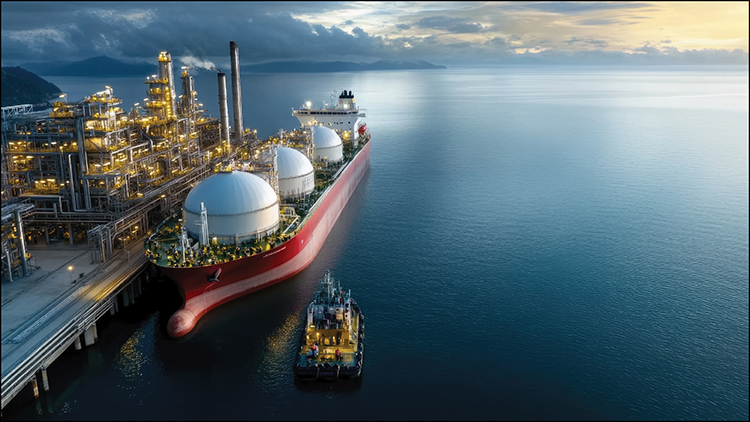
For more than two decades, Egypt has positioned itself as the premier energy hub of the East Mediterranean. This status is underpinned by growth in domestic oil and natural gas production, alongside the steady expansion of renewable energy capacity, and liquefied natural gas (LNG) export infrastructure. While Egypt currently faces a domestic supply gap, the government is increasingly aligning with global energy trade practices, replicating the ‘refinery hub’ model used by India and China. Leveraging advanced liquefaction facilities to process both imported and domestic gas, Egypt is reshaping its infrastructure into a strategic hub for regional trade after satisfying local demand.
In 2018, Egypt achieved self-sufficiency in natural gas, driven by the discovery and rapid development of Zohr field. Discovered in 2015, Zohr began production in December 2017 and swiftly transformed Egypt’s gas balance. By 2019, the country shifted from being an LNG importer to a net exporter. This transition was enabled by operating the Idku LNG plant at full capacity and resuming operations at the Damietta LNG plant in January 2021 after an eight-year halt.
As a result, Egypt’s natural gas exports surged by 92% between 2018 and 2021, according to data from the Organization of the Petroleum Exporting Countries (OPEC). Export revenues rose even more sharply, increasing by 768% year-on-year (YoY) to reach $3.9 billion in 2021 compared to 2020, according to the Ministry of Petroleum and Mineral Resources (MoPMR). LNG exports from the Damietta and Idku plants jumped by 333% in 2021 compared to the previous year, as reported by the Organization of Arab Petroleum Exporting Countries (OAPEC).
Addressing the Production Gap
However, production has since recorded a decline, driven mainly by falling output from Zohr and lower investment in exploration due to accumulating arrears to international oil companies (IOC)s. A multi-pillar plan to secure gas supply during the last year succeeded in making things better but Egypt still has an energy supply gap.
“Egypt’s current natural gas production stands at about 4.1 billion cubic feet (bcf), compared with around 7 bcf previously, creating a clear supply gap,” said Tharwat Hassane, Petrophysical Advisor and Operational General Manager at Sahara Oil and Gas Company. “With daily consumption at roughly 6.5 bcf, the shortfall of about 2.5–3 bcf must be covered through imports.”
Despite this, Hassane told Egypt Oil and Gas (EOG) that the Ministry’s strategy to increase production and investments would eventually restore self-sufficiency. In 2025, Minister of Petroleum and Mineral Resources Karim Badawi revealed a five-year plan to drill 480 new wells with investments exceeding $5.7 billion. The Ministry aims to reverse declines and lift output toward 6.4–6.6 bcf/d over the medium term, as Badawi noted in November during the Ministry’s podcast, PetroCast.
Cutting the LNG import bill
After importing a record 8.92 million tons of LNG in 2025, Egypt’s gas dynamics are entering a new phase. Early signals point to a moderation in import volumes for 2026. Contractual flexibility enabled Egypt to cut January shipments by around 50% to six or seven cargoes, down from 14–16 cargoes a year earlier, supported by improving inventories and incremental production recovery.
“Egypt is working on reducing imported LNG as it is costly for the national economy, especially with the need for leasing floating storage and regasification units (FSRUs),” Mustafa Shafie, Head of Research at Acumen Asset Management told EOG.
He added that the government must cut short the LNG imports to lessen burdens on the balance of payment. “For realising this goal, the government followed a dual approach of steadily paying dues to the foreign companies working in the natural gas to enhance production and, at the same time, encouraging new explorations,” he said.
Tackling Debt, Regaining Confidence
A cornerstone of this reset is clearing overdue payments to international oil companies (IOCs). Outstanding receivables owed to IOCs stood at $6.5 billion at the start of 2025.
The Egyptian government repaid $400 million of overdue arrears to foreign oil companies in early January, bringing the total repaid over the past four months to about $1.4 billion, an anonymous senior government official told Asharq Bloomberg at early January.
The official explained that the total outstanding arrears owed to foreign oil companies operating in Egypt fell to around $1.1 billion after the latest payment, with plans to fully settle them during the first quarter of this year.
Egypt repaid about $4.2 billion in arrears to foreign oil companies during 2025, the official added, noting that the repayment process came under “direct presidential instructions, as part of a strategy aimed at stimulating foreign companies’ activity and re-establishing Egypt as a gas-producing and exporting country by 2027.
New Discoveries and Field Upgrades
Since July 2025, more than 18 new oil and natural gas discoveries have been announced, mostly in the Western Desert. Thirteen were rapidly integrated into the national system, adding around 14,000 barrels per day (bbl/d) of crude and condensates, and 44 million cubic feet per day (mmcf/d) of natural gas.
Production also increased in major existing fields. Italian energy giant Eni increased development at Zohr, where the Zohr-6, Zohr-13, and Zohr-9 wells reached outputs of 60 mmcf/d, 55 mmcf/d, and 70 mmcf/d, respectively. Additionally, Shell boosted production from Phase 11 of the West Delta Deep Marine (WDDM) project.
“To achieve production volumes sufficient to cover national demands, additional investments in development activities are essential,” said Hossam Arafat, Head of the General Division for Petroleum Products at the Federation of Chambers of Commerce.
Egypt has recently received international investment commitments From Eni, bp and Arcius with a total value of $16.7 billion through 2030.
Re-supplying the Region
Egypt has extended its gas import agreement with Israel until 2040 and is advancing the interconnection project with Cypriot fields. Imports from both countries will help meet part of domestic demand while also being directed to liquefaction facilities for re-export to international and regional markets.
Now that it would have enough supply of imported gas, Egypt is pursuing deals to export gas to its neighbors: it signed in recent weeks memoranda of understandings (MoUs) with Lebanon and Syria to help alleviate chronic electricity shortages in both countries by providing them with gas through the Arab Gas pipeline. This step comes as Egypt take advantage of a gas surplus due to reduced consumption during the winter season and the entry of new concession areas in the Red Sea and Western Desert into the production phase.
Since April 2025, Egypt supplied LNG to Asian and European markets, including Spain, Italy, Taiwan, Greece, Türkiye, and Canada, with volumes totaling around 891,000 cubic meters.
Hassane noted that cooperation with Cyprus is expected to unlock incremental offshore volumes of Cypriot gas through a planned subsea tie-back into Egypt’s established gas facilities and liquefaction infrastructure. In October, Egypt signed two commercial agreements with operating companies, Italian Eni and French TotalEnergies for the development of Cypriot Cronos field It is expected to speed up the Final Investment Decision process in order to commence operations as hoped for in 2027.
“I think once the Cronos field begins supplying gas to Egypt through Zohr’s facilities, production is expected to rise gradually, supported by ongoing discoveries, particularly in the Mediterranean, as they are brought on stream. This will strengthen supply and eventually restore gas self-sufficiency,” Hassane said.
Qatar is playing a key role in this hub strategy. Under a recent MoU between the Egyptian Natural Gas Holding Company (EGAS) and QatarEnergy, Doha agreed to deliver 24 LNG cargoes to Egypt during the summer months, providing the flexibility needed for Egypt to maintain its role as a regional energy gateway.