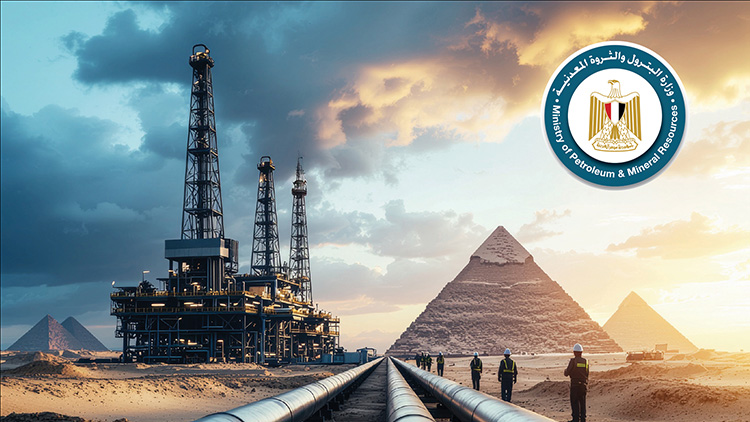
At the crossroads of continents, where trade routes meet and civilizations have risen for thousands of years, Egypt stands at the heart of a global transformation, a powerhouse shaping the future of energy. This is the story of a sector rising with purpose, a nation transforming its resources into momentum, and a region finding in Egypt not just a partner but a gateway.
The Egyptian oil and gas sector works not only on securing the nation’s energy needs, it also is unlocking new frontiers, attracting global investment, and leading a regional alliance that is redefining the energy landscape of the Eastern Mediterranean and beyond.
This vision is anchored by the Ministry of Petroleum and Mineral Resources’ (MoPMR) six strategic pillars that guide Egypt’s path toward energy security, value creation, and regional leadership.
To meet rising domestic demand and fuel its development trajectory, Egypt is unlocking its full exploration potential. The upstream sector currently includes 57 operating companies, among them eight of the world’s leading international energy players, underscoring growing investor confidence in Egypt’s stable and well-structured petroleum framework. While Egypt drilled 100 exploratory wells in FY 2024/25 , it added 55 new discoveries.
Bold sector reforms have positioned Egypt as one of the region’s most stable and investor-friendly environments. These reforms feature predictable cash flows, incentive-driven programs, and a flexible agreement structure encompassing Production Sharing Agreements (PSA), PSA with R-Factor, and Tax and Royalty systems. Together, they ensure competitive returns, promote reinvestment, and sustain upstream momentum.
In addition, awarding exploration blocks adjacent to existing producing fields, often to the same partners, has fostered operational synergy and encouraged further investment. In fiscal year (FY) 2024/25.
Strategic Investments and Technological Advancements
Over the next five years, Eni and bp alone plan to invest $13 billion in new exploration and development programs across Egypt. An upcoming bid round in the Red Sea region is also expected to attract additional investors.
Egypt’s upstream momentum is further reinforced by the deployment of cutting-edge technologies, including the Ocean Bottom Node (OBN) seismic survey project, led by SLB and Viridien, to unlock deepwater potential in the Mediterranean Sea. This initiative offers advanced subsurface imaging and data-driven mapping, accelerating bid rounds and field development. Egypt is expanding 2D, 3D, and OBN Surveys across the Mediterranean, Western Desert and Upper Egypt, providing critical data to sustain exploration momentum and investment interest.
Together, these investments and modern exploration techniques are poised to expand Egypt’s resource base and sustain growth across the upstream value chain.
Digital Transformation and Transparency
Egypt Upstream Gateway (EUG) has become a cornerstone of the sector’s modernization program and a key driver of exploration growth. As a fully integrated digital platform, the EUG enhances data accessibility, transparency, and efficiency for investors. Since its launch in 2021, the platform has achieved remarkable achievements, as shown in the following figure.
Tangible Outcomes and Energy Security Gains
These results have played a pivotal role in reducing Egypt’s import bill by approximately $3.6 billion, underscoring the success of domestic production in strengthening national energy security and supporting the country’s economic stability.
Maximizing Returns through Refining and Petrochemicals
Egypt is transforming its raw hydrocarbon resources into engines of economic growth by expanding its refining and petrochemical capabilities. Through a series of strategic upgrades and new investments, the Ministry of Petroleum and Mineral Resources is driving value creation, industrial integration, and export growth.
Three major refinery upgrades, MIDOR, Assiut, and the Suez Diesel Complex, are at the heart of Egypt’s strategy to enhance production efficiency, improve fuel quality, and reduce the import gap in diesel and gasoline.
Expanding Petrochemical Investments
In parallel, Egypt is launching a new wave of petrochemical projects, including the Red Sea Petrochemicals, Soda Ash Production, and Metallurgical Silicon complexes. Together with other ventures, they form part of an ambitious plan to establish 10 major petrochemical complexes under construction, expected to deliver over $4.4 billion in value-added petrochemical output by 2030.
The integration of refining and petrochemical operations is creating powerful industrial clusters that stimulate local industries and generate thousands of job opportunities. This synergy moves Egypt further up the energy value chain, shifting from exporting raw commodities to exporting high-value refined and petrochemical products.
Mining Sector Relaunch
Beyond hydrocarbons, Egypt is revitalizing its mining sector as a strategic pillar of economic diversification. Backed by reforms aligned with global best practices and a modernized licensing framework, the country aims to increase the sector’s contribution to GDP from 1% today to 5% by 2030.
This transformation is anchored in four interconnected pillars: geology, infrastructure, energy supply, and regulatory framework, each strategically developed to enhance Egypt’s competitiveness in the global mining arena. Key resources, including gold, phosphate, copper, and rare minerals, are being developed under transparent, investor-friendly conditions.
While gold and silver output rose by around 14% in FY 2024/25, the production of mineral and ore surged by 39% during the same year.
These advancements were showcased at the Egypt Mining Forum 2025, where thousands of international stakeholders convened to participate in Egypt’s next phase of resource-driven transformation.
Investment Environment, Efficiency, and Sustainability
As the world transitions toward low-carbon development, Egypt is reshaping its energy mix to align with a sustainable future. With an ambitious target to generate 42% of its electricity from renewables by 2030, the country is optimizing the use of natural gas for value-added industries and export, while accelerating investments in green hydrogen and other clean molecule initiatives, projects that have already attracted over $900 million in investment.
Social Responsibility Toward Local Communities
At the core of these achievements is a culture of safety, environmental stewardship, and shared responsibility. While Over 250 CSR were executed between 2022 and 2024, 47 projects were executed in the second half of fiscal year 2024/2025 demonstrating the sector’s commitment to citizens, providing social development, education, healthcare, and opportunities for youth and future generations.
Egypt: The Beating Heart of the Regional Energy Hub
While strengthening its foundations at home, Egypt is extending its influence across the region through partnerships that transform pipelines and ports into bridges of energy integration. Strategic agreements with Cyprus, Greece, Jordan, and other East Mediterranean partners are turning Egypt’s infrastructure into a shared platform for trade, security, and growth.
The landmark Aphrodite and Cronos tie-back projects, signed during Egypt Energy Show (EGYPES 2025) in the presence of the Presidents of Egypt and Cyprus, will deliver 1.2 billion cubic feet of natural gas per day by 2030 through offshore pipelines directly into Egypt’s liquefaction hubs. From these coastal facilities, energy will flow onward to Europe, ensuring stability of supply, strengthening regional ties, and advancing Egypt’s role as a trusted energy partner.
This transformation is supported by a world-class infrastructure network where expanding pipelines, storage systems, and port infrastructure have created a seamless network capable of handling growing import–export dynamics. Egypt’s two liquefaction plants in Idku and Damietta, with a combined capacity of 2 billion cubic feet per day, anchor this network, enabling both domestic supply flexibility and large-scale LNG exports to Europe.
Leveraging its strategic ports and logistics corridors on the Red Sea and the Mediterranean, Egypt connects Africa, the Middle East, and Europe in a unified energy network. Through this integration, the country is not only securing its own energy future but also enabling that of its neighbors, building a new model of regional partnership grounded in trust, connectivity, and shared prosperity.