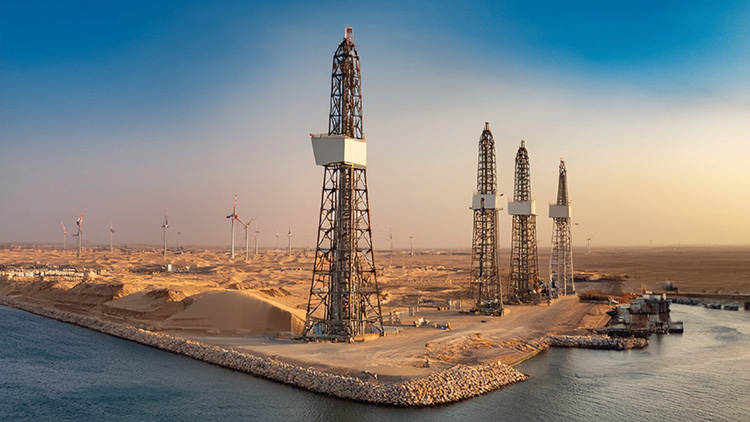
Egypt is embarking on a defining new chapter in its energy sector, placing the vast, gas-rich potential of the Mediterranean Sea and Nile Delta at the forefront of a national upstream revitalization. The government’s recently unveiled five-year exploration master plan will channel $5.7 billion in investments to drill 480 new wells by 2030, a strategic pivot designed to reverse production declines and cement Egypt’s status as a premier regional energy hub. While the plan spans Egypt’s key hydrocarbon provinces, its center of gravity lies in the deep waters and complex geologies of the Mediterranean and Delta, regions that hold the key to the country’s next wave of energy security and export growth.
This ambitious program builds on a recent surge in exploration momentum, which saw 21 new agreements worth $1.1 billion signed and 300 wells added to the production map in the past year. These efforts successfully reversed a persistent decline in gas output, marking the first signs of a production upswing in August 2025. The 2025–2030 master plan now aims to institutionalize this recovery, providing a clear roadmap for sustained growth driven by strategic investment and targeted exploration in the nation’s most promising offshore basins.
Prof. Abdelaziz Khlaifat, Chair, Department of Petroleum and Energy Engineering, AUC, explained that “Egypt’s plan to drill 480 new wells by 2030 is ambitious but well within reach. The Mediterranean and Nile Delta basins hold strong geological promise, and with many concessions still underexplored, there’s considerable room for new discoveries. The real key to success will be how efficiently projects are executed. By embracing modern drilling approaches, including underbalanced techniques, and harnessing digital reservoir technologies, Egypt can boost well performance, cut costs, and shorten development timelines.”
Scale and Strategic Focus
The five-year plan’s first phase, slated for 2026, will see the drilling of 101 wells across the Western Desert (67), Gulf of Suez (9), Mediterranean Sea (14), and the Nile Delta (6). Although the Western Desert receives the highest number of wells in the initial phase, the strategic emphasis and long-term value are heavily weighted toward the Mediterranean and Delta. These regions, accounting for 20 of the first year’s wells, represent Egypt’s frontier for large-scale gas discoveries. Unlike the mature, primarily oil-producing basins elsewhere, the Mediterranean offers the prospect of world-class deepwater gas plays capable of significantly shifting Egypt’s production profile and underpinning its energy hub ambitions for decades to come.
Geostrategic Importance and Geological Distinction
The Mediterranean and Nile Delta regions are now central to a historic energy shift, as abundant natural gas drives both economic growth and geopolitical influence. Together, these provinces account for roughly 83% of Egypt’s total natural gas production and approximately 72% of condensate output. Their proximity to major global maritime chokepoints, including the Suez Canal and the SUMED pipeline, coupled with extensive cross-border interconnections such as the Arab Gas Pipeline and the Arish-Ashkelon link, infuse the region with added strategic weight.
The geological character of the Mediterranean and Nile Delta sets them apart from Egypt’s other hydrocarbon provinces. The regions are defined by complex pre-Messinian and Miocene structures, deep water turbidite systems, and vast, underexplored sub-salt plays that have yielded colossal discoveries like the Zohr field. Operating in these environments—at water depths that can exceed 1,500 meters—requires advanced drilling technologies, sophisticated seismic imaging, and substantial capital investment, distinguishing it from the more conventional onshore activities in the Western Desert. The government’s recent incentive measures, introduced in 2024, have further de-risked exploration, drawing fresh commitments from industry leaders. Major players like Eni and bp have pledged substantial new investments—around $8 billion and $5 billion, respectively—signaling strong confidence in the region’s prospectivity, according to the Ministry of Petroleum and Mineral Resources (MoPMR).
Upstream Growth: Egyptian Discoveries and Digital Enablement
Egypt’s upstream sector is experiencing a historic surge, driven by a new wave of significant discoveries across the Mediterranean and Nile Delta regions that reinforce the areas’ geological and operational appeal.
The foundation of this strategy remains the Major Offshore Mediterranean fields. The Zohr field, discovered in 2015 within the Shorouk Block, is the region’s cornerstone, boasting initial estimated reserves of 30 trillion cubic feet (tcf) of gas. Zohr currently contributes more than 23% of Egypt’s total gas production, having successfully recovered from a recent production decline, as reported by Minister Karim Badwi in an interview with DMC TV. Further reinforcing the deepwater promise, the Chevron-led Nargis discovery in the Nargis Offshore block, announced in January 2023, is estimated to hold 3.5 tcf of gas, according to an Egypt Oil and Gas report, significantly expanding the prospective play fairway across the Eastern Mediterranean.
A combination of sustained output from legacy fields and new discoveries highlights the continued productivity of the Nile Delta. Established fields like Nooros (online since August 2015) and Baltim Southwest (online since September 2019) continue to deliver robust production through ongoing new well tie-ins. This is complemented by new onshore finds in 2025—North Sidi Ghazi 9-1 (Harbour Energy/Desouq Petroleum) and West Qantara’s Salma Delta-6 (Dana Gas)—which have added a combined 19 million standard cubic feet per day (mmscf/d) to the national grid, as reported by (MoPMR).
This exploration success is attracting a surge of fresh investment, streamlined by the country’s digital transformation. Recent licensing rounds in 2024 and 2025, managed through the Egypt Upstream Gateway (EUG), have secured significant commitments. The 2024 international bid round concluded with the award of six new exploration blocks for an initial investment of $245 million to drill at least 13 wells. A separate series of agreements signed in August 2025 secured a further $343 million for exploration across four additional blocks. These deals have brought in major international oil companies (IOCs) such as Chevron, Shell, and Eni, along with other key players like Arkeus Energy, Cheiron, and Zarubezhneft, committing hundreds of millions to initial exploration in Mediterranean and Nile Delta blocks, as reported by (MoPMR).
Synergy with National Energy Ambitions
The focus on the Mediterranean and Delta aligns perfectly with Egypt’s strategic imperative to enhance its domestic energy supply and expand its role as a regional hub for Liquefied Natural Gas (LNG) exports. Natural gas from these offshore fields directly feeds into the country’s world-class liquefaction facilities at Idku and Damietta, allowing Egypt to capitalize on global demand for LNG while ensuring its own long-term energy security. Recent agreements underscore this synergy: in September 2025, bp signed a Memorandum of Understanding (MoU) to evaluate a five-well drilling program in the Mediterranean, explicitly designed to fast-track the development of gas reserves by leveraging existing production infrastructure in the West Nile Delta to minimize costs and accelerate time-to-market.
Upstream Uncertainties and Risks
Egypt’s upstream oil and gas sector is gaining momentum, particularly in the Mediterranean and Nile Delta, yet key uncertainties remain that could impact the scale and commercial viability of future projects.
The main challenges are technical and financial. Monetizing deepwater and ultra-deepwater reserves faces delays due to complex engineering and economic hurdles. Meanwhile, although past issues with delayed government payments to IOCs have seen partial resolution, they continue to weigh on investor confidence and risk appetite.
Market and logistical pressures also persist. Rising domestic demand for gas and electricity, coupled with non-market gas pricing, may constrain export volumes. Regional instability including Middle East tensions and maritime security incidents, adds further risk to upstream operations and export logistics.
Compliance is another growing concern. As global ESG standards tighten, Egypt’s upstream operators must uphold rigorous benchmarks on emissions, biodiversity, and stakeholder rights to avoid regulatory and reputational fallout.
Prof. Khlaifat noted that despite of the challenges, the region’s geology remains world-class and under-explored. He added that “there is definite potential for a “second act” in the Mediterranean focused on unconventional resources like tight and shale gas. The region’s deep clastic basins, organic-rich shales, and over pressured zones suggest promising opportunities alongside Egypt’s proven conventional reserves. To realize this potential, Egypt should begin expanding subsurface data acquisition through advanced seismic imaging and basin modeling, supported by core analysis to assess reservoir quality and geomechanical behavior. Small-scale pilot projects and test wells will also be essential to evaluate real-world performance under Mediterranean conditions. “
Success will depend on navigating market volatility, maintaining ESG discipline, and reinforcing investor trust in fiscal and operational governance.