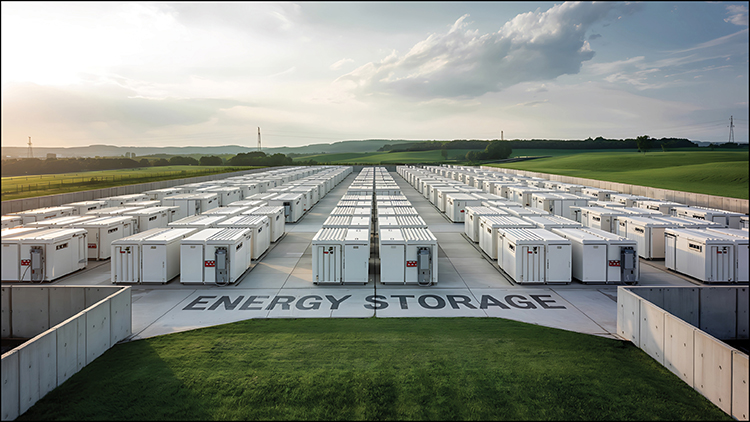
Egypt stands at the forefront of renewable energy expansion in the MENA region, with ambitious targets to increase the share of renewables in Egypt’s energy mix to 42% by 2030 and 60% by 2040. As the country accelerates the integration of renewable energy into its power mix, battery energy storage systems (BESS) emerge as a critical enabling technology. Once viewed as a supporting technology, battery storage is increasingly being treated as essential infrastructure—one that underpins grid stability, enables higher renewable penetration, and strengthens long-term energy security. BESS play a pivotal role in this transition, bridging the gap between intermittent solar and wind resources and the demands of a growing economy.
BESS Revolutionizing Egypt’s Renewable Sector
Solar and wind power do not produce electricity on demand. Solar output drops sharply after sunset, while wind generation can fluctuate within minutes. For grid operators, managing these variations becomes increasingly complex as renewable capacity grows.
Mohamed Sherwali, Sustainability Expert at the Regional Center for Renewable Energy and Energy Efficiency (RCREEE), said “without storage, fluctuations in solar power directly translate into frequency deviations, voltage instability, and dispatch challenges.” Battery systems address this problem at its core. “BESS absorbs excess generation during the day and releases energy during shortages to smooth power delivery and ensure grid reliability and stability,” he explained.
In Egypt, where peak electricity demand often coincides with evening hours, battery storage enables solar power generated during the day to be shifted into the evening peak. This reduces reliance on fossil-fuel peaking plants and improves overall system efficiency.
Different Storage Technologies
Globally, energy storage takes several forms. Pumped hydro storage remains the most widely used large-scale option, relying on elevation differences to store energy in the form of water. However, this technology is heavily dependent on geography and requires long development timelines.
Thermal energy storage, particularly in concentrated solar power (CSP) plants, allows heat to be stored and later converted into electricity. CSP has seen limited deployment in Egypt compared to photovoltaic solar, largely due to cost considerations.
Additionally, flywheel energy storage is a mechanical technology that stores energy in a rapidly spinning rotor, delivering high power for short periods—typically up to 15 minutes—to manage sudden fluctuations in electricity supply and demand. It provides fast, short-term grid support while backup generation or longer-duration storage comes online.
Alongside established options, several emerging storage technologies—including compressed air, superconducting magnetic systems, underground pumped storage, and hydrogen—are under development, though most remain at early or pilot stages of commercial deployment.
Electrochemical storage, chiefly battery-based systems, has become the most adaptable solution. Batteries can be deployed at utility scale, connected directly to renewable plants, or installed as standalone grid assets. Their modular design allows projects to be scaled quickly, a key advantage in fast-growing power systems such as Egypt’s. Within this category, lithium-ion batteries have emerged as the dominant technology.
Lithium-Ion Batteries Take the Lead
The vast majority of grid-scale storage projects in Egypt rely on lithium-ion batteries, with lithium iron phosphate (LFP) chemistry gaining increasing preference. Sherwali noted that “the latest studies showed that the lowest total lifecycle cost for utility-scale storage today is Lithium Iron Phosphate (LFP).”
Project-level decisions, however, go beyond headline costs. Alaa Yahia Faid, Technology Project Lead, explained that “project teams balance cost, safety, performance, and climate when selecting battery chemistries.” Within lithium-ion technologies, trade-offs are critical. High energy-density chemistries save space, while chemistries with strong thermal stability, like LFP, cut cooling and fire risk—important in hot climates,” he said, adding that “cycle life, expected duty, and total cost of ownership drive the final choice.”
LFP batteries are particularly well-suited to Egypt’s operating conditions. Sherwali highlighted that “LFP technology has high thermal stability, which matches Egypt’s high summer temperatures that can reach 45°C in desert areas where most PV projects are installed.”
From a financing and risk perspective, LFP’s advantages are equally compelling. According to Faid, “LFP is bankable for utility storage because it offers long cycle life, good thermal safety, no cobalt exposure, and predictable O&M, lowering project and insurance risk.” He added that “LFP delivers the biggest value in solar-plus-BESS for peak shifting and firming, fast frequency and ancillary services, and localized congestion relief or backup in weaker parts of the grid.”
Modern lithium-ion BESS installations are complex systems. Thousands of battery cells are assembled into modules and containers, supported by inverters, control systems, and advanced software platforms. Together, these components allow operators to monitor performance in real time and dispatch stored energy in response to grid needs.
In practical terms, lithium-ion batteries in Egypt are already being deployed at scale. In hybrid solar-plus-storage projects, batteries store excess daytime generation and discharge it after sunset, such as the 300-megawatt (MW) BESS paired with a 500 MW solar PV plant in Abydos, Aswan, implemented by AMEA Power.
They are also central to Scatec’s solar-plus-storage developments, including the 1.1-gigawatt (GW) Obelisk solar project with a 100 MW / 200 megawatt-hour (MWh) BESS in Nagaa Hammadi, and the 1.7 GW Energy Valley project in Minya. Together, these projects signal a fundamental shift in Egypt’s power system—where battery storage is no longer an add-on, but a core grid asset enabling the country’s renewable future.
Challenges and the Road Ahead
Despite the increasing strategic importance of battery energy storage within Egypt’s power system, a number of regulatory, financial, and technical challenges remain, experts said. “BESS still lacks a clear legal classification—whether as a generation asset, a transmission and distribution asset, or an independent grid service—making clear classification essential to unlock investment,” the Sustainability Expert explained. This challenge is reinforced by a “grid code gap,” since “current grid codes were developed for synchronous generation, and therefore storage-specific grid codes are required,” he added.
Sherwali noted that, from a financing perspective, “BESS remains capital‑intensive and revenue-light under current rules,” with investors constrained by the absence of standardized, bankable storage service agreements. Unlike power purchase agreements (PPAs)—long‑term contracts between electricity producers and off‑takers—or net‑metering mechanisms that allow renewable generators to offset their consumption with self‑produced power, storage lacks a comparable framework. As a result, financing remains largely project‑by‑project and concessional, underscoring the structural hurdles that continue to limit the sector’s scalability.
On the operational side, effective integration will require “advanced SCADA system, to manage, automate, and optimize processes remotely, as well as real-time dispatch capability” to fully enable storage’s role in grid flexibility and system support, he stated. SCADA are systems that monitor and control industrial or utility operations in real time.
Supporting this vision, Faid said that “Egypt needs storage-friendly market rules, including clear asset classification, dispatch, and compensation mechanisms, alongside tailored financing and guarantees for BESS projects, and stronger grid and local supply-chain planning covering cells, assembly, and recycling. Addressing these gaps would unlock higher renewable penetration at lower cost.”
Looking Ahead
Battery storage is set to become a central pillar of Egypt’s energy transition. As renewable capacity grows, these systems will ensure a reliable and flexible power supply, support solar and wind integration and reducing dependence on fossil-fuel peaking plants. Beyond electricity generation, BESS could enable emerging technologies such as green hydrogen production and regional power exports. With continued investment, regulatory support, and technical innovation, battery storage will play a pivotal role in building a modern, resilient, and sustainable Egyptian power grid.