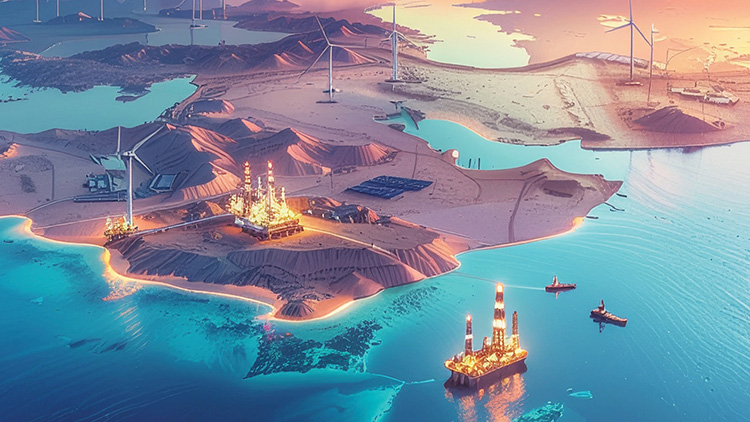
Together the Mediterranean and Nile Delta anchor Egypt’s hydrocarbon mix, supplying a disproportionate share of the country’s gas and condensate and balancing export scale deepwater projects with faster, mid scale developments in shallow waters and onshore. The corridor delivers both scale for long term export contracts and agile projects that stabilise domestic supply and generate quicker cash flow.
Zohr, the region’s best known field and one of the largest gas discoveries in the Eastern Mediterranean, is recovering and now provides about 23% of Egypt’s gas production. The Mediterranean and Nile Delta together account for roughly 82 % of national gas output and 72% of condensates. Recent exploration, production deals and infrastructure investments are concentrated on the Mediterranean–Delta corridor, with major international oil and gas companies increasing their commitments.
Targeted upgrades, expanded LNG and condensate handling at Idku and Damietta, SUMED’s bidirectional enhancements, modernised ports and digitised logistics, are shortening time to market and lowering transport costs. These midstream improvements are turning geological potential into commercial throughput and positioning the corridor as a resilient gateway linking Africa, Asia and Europe.
Mediterranean for Big Investments, Nile Delta for Rapid Returns
Egypt’s Mediterranean Basin is defined by deepwater and ultra-deepwater geology, marked by complex subsalt formations and high-pressure reservoir exemplified by the Zohr gas field. These conditions require high-cost, technically advanced exploration, but offer vast reserves and strong export potential.
In contrast, the Nile Delta features more accessible shallow offshore and onshore formations, rich in gas and condensate, with lower drilling costs and faster development timelines. It complements the Mediterranean’s deepwater plays by ensuring domestic supply stability and attracting mid-sized investments geared toward quick returns.
Both regions benefit from proximity to major refineries in Alexandria, Tanta, and Suez, facilitating efficient routing of condensate and light oil for domestic use or export. The Mediterranean’s offshore infrastructure, including subsea pipelines, platforms, and LNG terminals at Idku and Damietta, positions it as a gateway for large-scale gas exports to Europe and Asia. Meanwhile, the Nile Delta’s integration with Egypt’s gas grid and processing facilities enables rapid deployment of new projects.
Access to strategic ports such as Alexandria, Port Said, Rosetta, and Idku further enhances logistics, drawing robust foreign investment: global majors like Eni, Shell, BP, and Chevron dominate Mediterranean operations, while Delta appeals to mid-tier players seeking lower-risk, high-reward ventures.
Delta Med Infrastructure Advantage
The Mediterranean and Nile Delta energy corridor is anchored by strategic petroleum ports along the Mediterranean , Damietta, Idku, Port Said and Alexandria , which act as gateways for LNG exports, refined-product handling and crude transit. Damietta and Idku are key gateways for deliveries to European markets. Managed by the Ministry of Petroleum and national oil companies, the ports are being modernized to expand storage, upgrade berths and introduce digital logistics systems, positioning Egypt as a tri-continental energy hub linking Africa, Asia and Europe.
A complementary pipeline network connects Nile Delta gas and condensate fields to Mediterranean terminals.
The Western Desert Gas Complex and the Abu Madi system facilitate flows from major assets such as Zohr and Atoll to export hubs at Idku and Damietta. Recent SUMED pipeline upgrades have improved crude transit between Ain Sokhna and Sidi Kerir, enabling more flexible, bidirectional flows for domestic supply and exports. Together, these port and pipeline enhancements strengthen Egypt’s Delta Med connectivity and advance its strategic push for regional energy leadership.
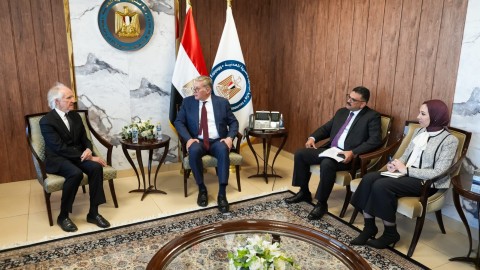
Egypt and the Emirate of Fujairah have agreed to develop a logistics and crude-trading hub in New Alamein, including a joint stock company to transform Hamra Petroleum Port into a regional crude center linking the Middle East and Europe. The deal also includes a commercial supply arrangement with the Egyptian General Petroleum Corporation to bolster domestic fuel security; Hamra’s location and integration with existing pipelines make it a logical node in the northern corridor.
Bright Prospects
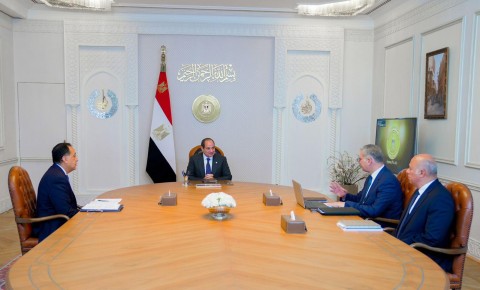
The region is attracting more attention, and the outlook seems positive. Egypt aims to lift natural gas production to 6.4–6.6 billion cubic feet per day over the next five years, driven largely by intensified Mediterranean exploration and major inbound investment from international energy companies such as Eni and BP. Petroleum Minister Karim Badawi set out this target during the ministry’s “Petrocast” podcast in the first week of November.
Recent upstream moves underline that ambition. ExxonMobil signed an MoU with EGAS for the West Zohr concession, a 4,319 km² deepwater block west of Zohr and adjacent to Cypriot waters, while Chevron is expanding its deepwater presence with the pending Lotus award alongside its North Simian and North Atoll blocks. These holdings show the American companies strategic alignment with Egypt’s offshore program.
Regional integration accelerates using the infrastructure of Zohr and the country’s liquefication plants. Cyprus appears increasingly likely to export gas discoveries from, Cronos and Aphrodite fields via Egyptian infrastructure rather than build a domestic LNG hub, reinforcing Cairo’s role as a Mediterranean gas export gateway.
The 2024 international bid round added momentum as six blocks were awarded to international firms (four offshore in the Mediterranean and two onshore in the Nile Delta and North Sinai), with committed investments of $245 million and plans to drill 13 exploratory wells, highlighting both export-scale and near-term domestic development potential.
Renewed Oil Momentum and Growing Condensate Output
Oil activity in Egypt’s Mediterranean and Nile Delta regions is gathering pace, driven by fresh discoveries, strategic exploration agreements, and targeted infrastructure upgrades. While both provinces remain gas-dominant, they host notable oil and condensate production, chiefly from Abu Qir and Abu Madi and from condensate-rich zones within larger gas fields such as Zohr and Atoll. Condensates, light hydrocarbon liquids produced alongside gas, are treated as liquid hydrocarbons and are routed to refineries in Alexandria, Tanta and Suez for domestic processing or export.
In October 2025 new finds in the Nile Delta and Western Desert added around 5,000 barrels per day of crude to national output, while Nile Delta’s onshore blocks registered their first oil-linked activity in two years.
Improvements in seismic acquisition and advanced imaging have sharpened subsurface resolution in the East Nile Delta, allowing operators to identify and target deeper, oil-bearing horizons beneath complex gas reservoirs. A technical paper presented at the 2024 Mediterranean Offshore Conference noted that multiple reservoir levels lie beneath producing gas fields, and that enhanced seismic techniques are revealing these targets with greater precision.
In Egypt’s five year drilling plan, a total of 480 oil and gas exploration wells are planned, with 101 wells scheduled for the first phase in 2026 including 14 wells in the Mediterranean Sea and six wells in the Nile Delta.
The Delta Med corridor’s combined strengths , large deepwater resources, fast turnaround delta projects and improving midstream infrastructure, create a compelling investment case. By marrying export capacity with domestic supply security and streamlined logistics, the corridor boosts Egypt’s bargaining power in regional markets. For policymakers and investors alike, the strategic priority now is to sustain infrastructure upgrades and regulatory clarity so the corridor can convert growing interest into deliverable production and lasting export revenues.