Each autumn, as rice harvests season wrap up in Egypt, a thick blanket of smoke descends over Cairo and the Nile Delta. Farmers, with few disposal options, would set fire to leftover rice straw. The result: a suffocating haze known as the “black cloud.” First reported in 1997, it grew into a national crisis, and by 2017 was responsible for nearly half of the country’s air pollution.
But what if that smoke could be transformed into something valuable? What if the waste fueling Egypt’s pollution could instead fuel its industry?
Rethinking Rice Straw
In 2019, the Wood Technology Company (WOTECH) was established as a partnership between the Egyptian General Petroleum Corporation (EGPC), Egyptian Petrochemicals Holding Company (ECHEM), Sidi Keriri Petrochemicals Company (SIDPEC), and Petrojet to build and operate a plant in Idku, Beheira Governorate, dedicated to producing medium-density fiberboard (MDF) from rice straw.
WOTECH partnered with Petrojet, the state-owned oil company, to manage construction, and with Germany’s Siempelkamp to supply advanced technology and engineering design. Siempelkamp’s expertise covers every stage of the process—from raw material handling and refining to pressing, cooling, sanding, and packaging.
The project attracted total investments of around €210 million, with an initial planned production capacity of 205,000 cubic meters of MDF annually.
Importantly, the MDF is manufactured using a formaldehyde-free resin system, a safer alternative to traditional adhesives that often release harmful emissions into indoor air.
Former Minister of Petroleum and Mineral Resources, Tarek El Molla, described the project as part of Egypt’s broader strategy to expand petrochemical industries and support local manufacturing sectors such as furniture, construction, and interior design.
Jürgen Philipps, Managing Director of Siempelkamp Maschinen- und Anlagenbau GmbH, at the time commented on the project, stating: “We have been pursuing research into the raw material and the development of a market-ready plant for processing rice straw for many years. In this respect, we are very pleased about the order from our Egyptian partner who is breaking new ground in sustainable wood-based products production with us.”
From Vision to Reality
Despite disruptions caused by the COVID-19 pandemic, construction continued in 2022 through close collaboration between German engineers and Egyptian specialists, both onsite and remotely.
By 2024, the plant had entered its experimental operation phase—making Egypt the second country worldwide, after the United States, to adopt this advanced rice-straw MDF technology.
During a field visit in 2025, WOTECH Chairman Ahmed Baraka announced that the plant’s capacity is projected at 460,000 tons of MDF annually. Most of the output will serve the local market, with surplus volumes targeted for export, particularly to European Union countries.
Green Technology and Safer Products
So how exactly does rice straw become sleek wooden panels?
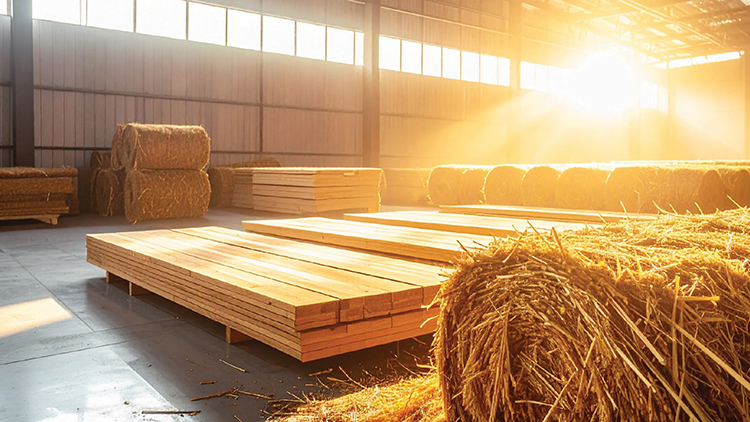
The process begins in the fields with the collection of rice straw, which is baled, cut, and cleaned to remove dust. The material is then ground into fine fibers, refined, and treated with eco-friendly glue. To guarantee quality, fibers are carefully weighed, tested for moisture, and screened to eliminate clumps.The treated fibers are formed into mats of various thicknesses and densities, then pressed into MDF or HDF boards ranging from 3 to 40 millimeters thick. After pressing, the boards are cut to standard sizes, cooled to stabilize bonding, and stored for 8 to 24 hours to ensure strength, durability, and uniformity. Environmental protection is embedded throughout the process. All industrial emissions are purified before release, ensuring compliance with global sustainability standards.
Supporting facilities play a critical role in the process. The plant includes a 25-megawatt gas-fired power station for electricity, a water desalination and treatment unit, gas regulation and metering systems, and advanced firefighting systems for safety.
For decades, rice straw was seen as nothing more than troublesome waste. Now, it’s the backbone of a project that tackles pollution, creates jobs, and supplies Egypt with a sustainable material for its growing furniture and construction industries.
The process begins in the fields with the collection of rice straw, which is baled, cut, and cleaned to remove dust. The material is then ground into fine fibers, refined, and treated with eco-friendly glue. The treated fibers are formed into mats of various thicknesses and densities, then pressed into MDF or HDF boards ranging from 3 to 40 millimeters thick.